Selling on Amazon starts with a sequence of separate decisions: what you are allowed and equipped to sell, how you will source it, which selling plan you need, how orders will be fulfilled, and whether the unit economics still work under realistic costs. This guide turns those choices into a practical launch framework for 2026.
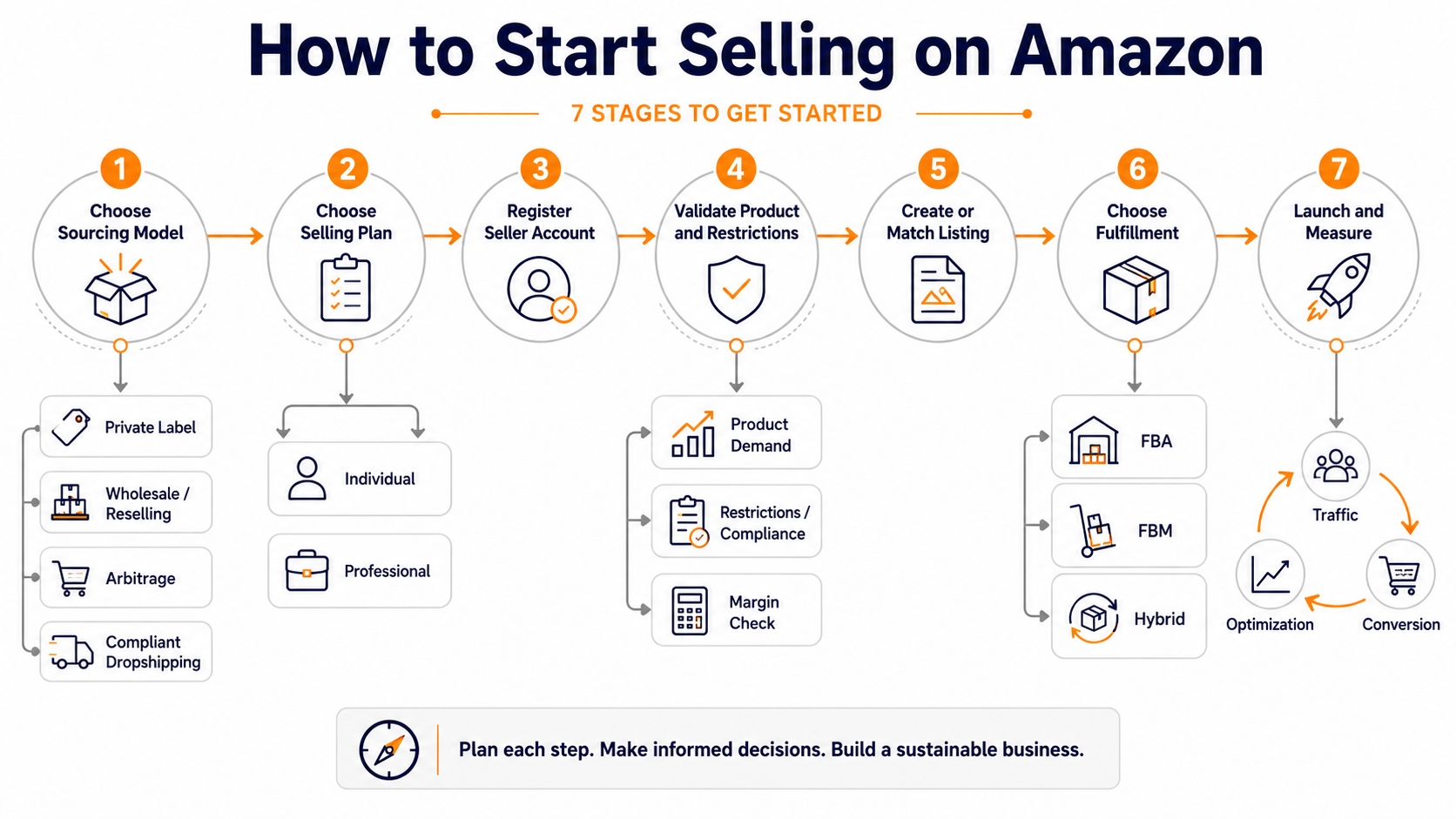
To sell on Amazon in 2026, choose a defensible sourcing model, register an Individual or Professional Amazon selling account, match or create accurate product listings, set a price based on complete unit economics, select FBA, FBM, or a hybrid fulfillment plan, and launch with a written scale or stop rule. Validate restrictions, documentation, demand, competition, and margin before you commit meaningful inventory.
Key takeaways
- Separate the decisions. Your business model, selling plan, listing strategy, and fulfillment method solve different problems.
- Validate permission before demand. A product is not a real opportunity until you can document supply rights, category eligibility, safety, and compliance.
- Model contribution margin, not only gross margin. Include selling fees, fulfillment, inbound freight, storage, ads, returns, and working-capital pressure.
- Choose FBA or FBM by total operating fit. The lowest visible fee is not always the lowest total cost or risk.
- Start with a controlled test. Define the date and evidence that will trigger a scale, hold, fix, or stop decision before launch.
Amazon provides one marketplace, but sellers can reach it through very different operating systems. A private-label brand, a wholesale reseller, an arbitrage seller, and a compliant dropshipper may all use Seller Central, yet they face different sourcing evidence, inventory exposure, listing control, pricing pressure, and fulfillment risk. Treating these models as interchangeable is one of the fastest ways to build a plan that looks simple but fails under real operating conditions.
The framework below separates four layers that new sellers often combine: how the product is sourced, which Amazon plan unlocks the required tools, who performs fulfillment, and how profit and cash are validated. Make each choice explicitly, then connect them into one coherent launch plan.
| Decision layer | Main options | Question to answer first | Evidence to keep |
|---|---|---|---|
| Sourcing model | Private label, wholesale and reselling, arbitrage, generic products, compliant dropshipping | Can you prove supply, product rights, quality, compliance, and realistic margin? | Supplier agreement, invoices, specifications, test records, authorization, and cost sheet |
| Selling plan | Individual or Professional | Which volume, listing, advertising, reporting, and brand capabilities do you need? | Expected monthly units, required features, and current plan fee disclosure |
| Fulfillment | FBA, FBM, or hybrid by product | Who should store, pick, pack, ship, manage returns, and absorb capacity risk? | Fee estimate, warehouse and labor costs, service levels, return process, and backup plan |
| Growth | Listing optimization, ads, promotions, brand tools, catalog expansion | Does the base contribution margin survive before extra growth spend? | Baseline conversion, ad budget, break-even point, review date, and scale or stop rule |
How does selling on Amazon work in 2026?
At the platform level, the process is straightforward: register an account, list or match a product, set an offer price, let customers discover the offer, fulfill orders through FBM or FBA, and receive settlement through the seller account. Amazon's current 2026 selling guide also recognizes that sellers may offer their own branded products, generic products, or products legitimately sourced for resale.
The commercial reality is more demanding. Amazon is not the supplier, compliance reviewer, cash-flow manager, or margin owner for your business. You remain responsible for product legality and safety, sourcing evidence, intellectual-property rights, listing accuracy, inventory decisions, pricing, customer experience, and the costs that sit outside Amazon's visible fee lines.
Marketplace access
Your Amazon selling account and Seller Central permissions determine which tools, programs, and categories are available.
Offer economics
The product, price, fee category, fulfillment method, ads, returns, and landed cost determine contribution margin.
Operating system
Inventory planning, listing quality, order handling, account health, supplier control, and cash conversion determine whether the model can scale.
Do not ask only, "Can this product sell?" Ask, "Can this specific business source, document, fulfill, finance, and improve this product at an acceptable downside?"
Which Amazon business model should you choose?
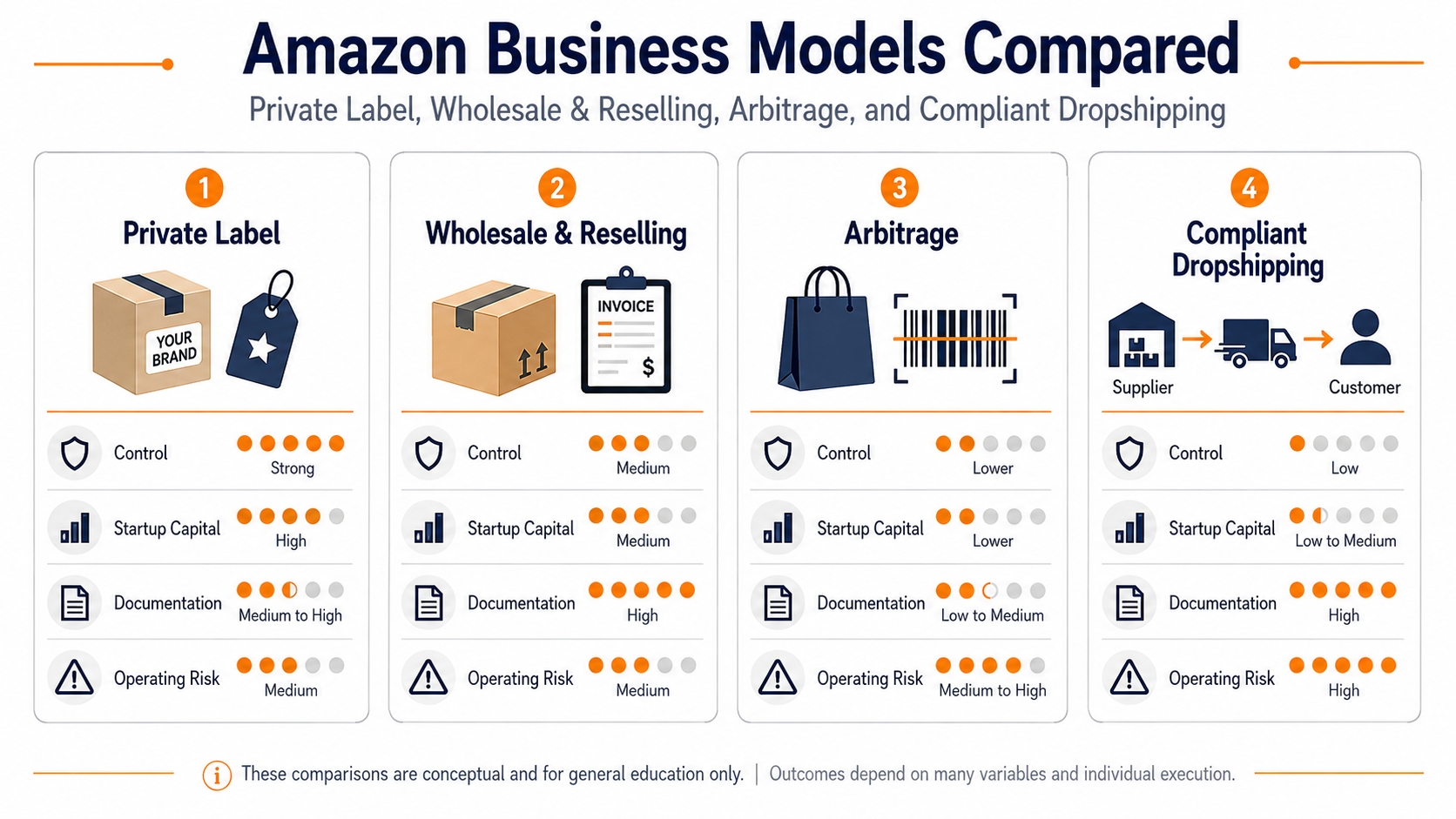
The best model is not the one with the most attractive revenue story. It is the one your team can document, operate, finance, and test without exposing the business to an unacceptable loss. Evaluate control, startup capital, supply consistency, listing ownership, documentation, and operational complexity together.
A seller may use more than one model, but each SKU should have a clear sourcing record and operating logic. For example, private-label products may use owned listings and FBA, while wholesale products may compete on shared detail pages and use a mix of FBA and FBM. The account can support both, but the economics and risks should not be blended into one average.
| Business model | What the seller controls | Typical capital profile | Documentation priority | Main operating risk |
|---|---|---|---|---|
| Private label | Product specification, brand, packaging, supplier, listing, and positioning | Usually higher upfront development, testing, trademark, and inventory commitment | Specifications, test reports, supplier agreements, product claims, trademark and IP records | Demand overestimation, quality defects, compliance gaps, and slow inventory |
| Wholesale and reselling | Supplier selection, buying terms, offer price, inventory depth, and fulfillment | Inventory capital varies by minimum order quantity, payment terms, and assortment breadth | Invoices, supplier legitimacy, brand authorization where needed, and chain of custody | Shared-listing competition, price compression, authenticity complaints, and unstable access |
| Arbitrage | Product selection, purchase timing, offer price, and test size | Can begin with smaller buys, but replenishment and sourcing consistency are limited | Receipts, condition records, product eligibility, and any documentation Amazon may request | Inconsistent inventory, sudden price changes, restrictions, and weak long-term defensibility |
| Compliant dropshipping | Supplier agreement, offer, customer promise, seller-of-record presentation, and returns process | Lower inventory ownership can be possible, but operations and supplier controls require investment | Seller-of-record agreement, packaging controls, service levels, tracking, and returns responsibility | Supplier errors, third-party identifiers, late delivery, stock mismatch, and policy noncompliance |
Should you choose the Individual or Professional selling plan?
Amazon's current US pricing page lists the Individual plan at $0.99 per item sold and the Professional plan at $39.99 per month, plus referral fees and any other applicable costs. The simple fee break-even occurs at a little more than 40 items per month, but the correct choice is not purely a division exercise.
A Professional plan can be appropriate earlier when you need bulk listing, advertising, advanced reporting, brand programs, or other scaling tools. An Individual plan can fit a limited test or low-volume catalog when those capabilities are not required. Review the live Amazon standard selling fees before registration because fees, included services, and category rules can change.
| Plan | US plan fee | Often fits | Choose based on |
|---|---|---|---|
| Individual | $0.99 per item sold | Small tests, limited catalogs, occasional sellers, or lower monthly unit volume | Expected unit count, listing workflow, pricing needs, and whether advanced programs are necessary |
| Professional | $39.99 per month | Higher-volume sellers, brands, larger catalogs, advertisers, and teams using advanced tools | Required tools and programs, bulk operations, growth plan, and fee break-even |
Do not confuse the selling plan with fulfillment. Both Individual and Professional sellers can access Seller Central, but plan features differ. FBA and FBM are separate decisions about how orders are fulfilled.
How do you register an Amazon Seller Central account?
An Amazon Seller Central account is the operating hub for listings, prices, inventory, orders, payments, fulfillment settings, reports, account health, and user permissions. Amazon's current registration guide organizes signup into five stages: business information, seller information, billing information, store and product information, and identity verification.
Amazon says registration timelines vary. In many cases, the form can be completed in a few hours, while identity verification usually takes three business days or less. Treat this as current guidance rather than a guarantee, and allow additional time when documents, names, addresses, or ownership information do not match exactly.
Provide business information
Enter the business location, business type, legal name, registration number where applicable, registered address, and phone number. Amazon's guide states that you do not need an LLC or incorporated business to sell; individuals can select the relevant individual business type.
Provide seller information
Identify the primary contact using a government-issued ID and provide legal name, citizenship, birth details, residential address, phone number, and the appropriate beneficial-owner or legal-representative status.
Provide billing and deposit information
Add the bank account used to receive disbursements and the credit card used for charges. Ensure the account-holder and business information are consistent with the registration record.
Provide store and product information
Choose the public store name and answer questions about product codes, certifications, manufacturer status, and brand status. A store name must be unique, but it does not need to match the legal business name.
Verify identity
Upload a government-issued ID and recent proof of residential or business address, then complete the required face-photo or video verification route. Use clear color files that show all corners and readable text.
- Government-issued identification for the primary contact
- Recent proof of residential or business address
- Bank account and accepted credit card details
- Exact legal business information and ownership details
- Proposed store name and initial product categories
- Product IDs, manufacturer status, brand status, and relevant certifications
Use the current Amazon seller registration guide as the source of truth because required fields and verification routes may change.
How should you decide what to sell on Amazon?
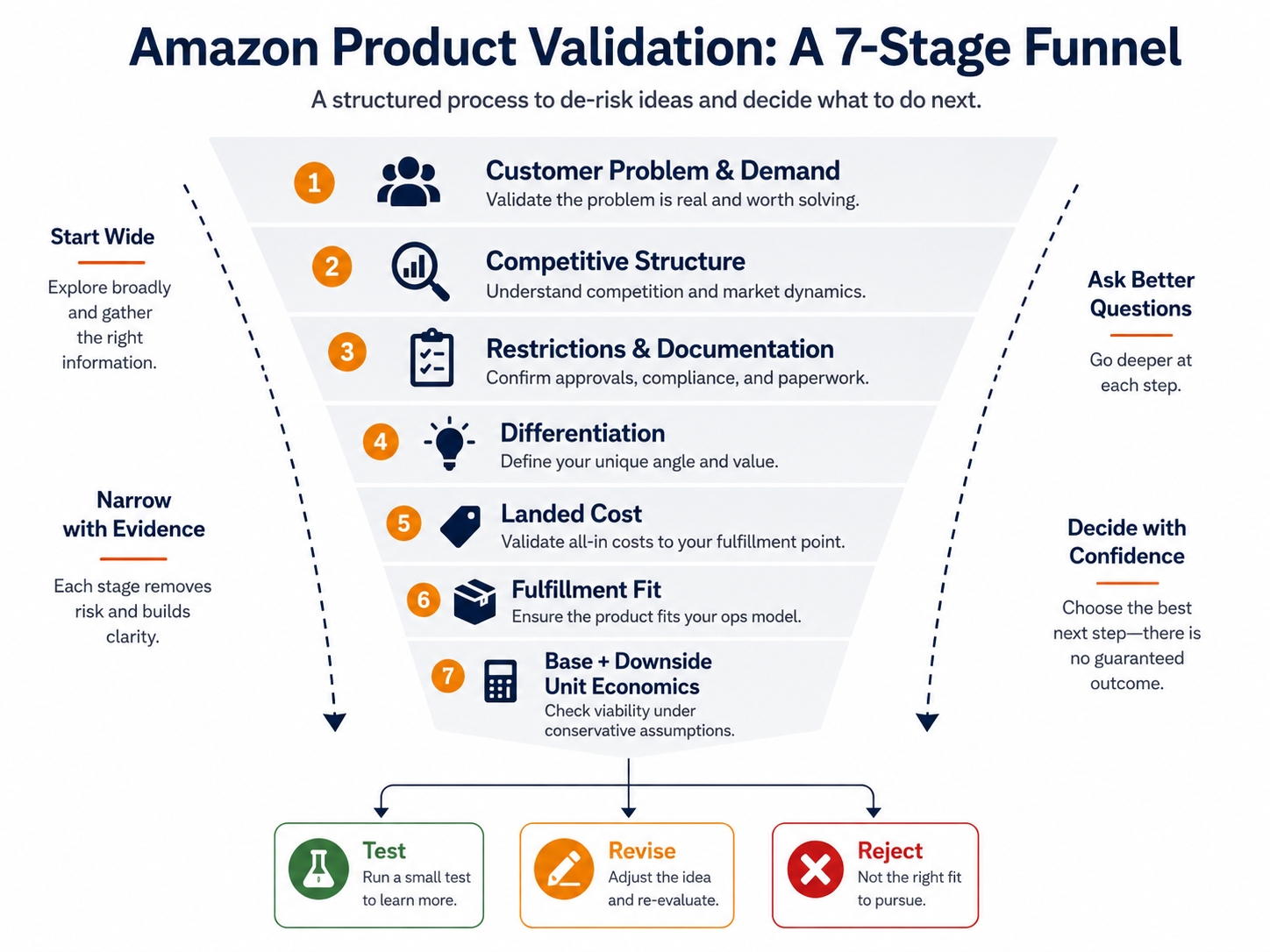
Product research is not a search for one impressive number. It is a sequence of filters that removes ideas your business cannot legally, operationally, or financially support. Begin with a customer problem and target market, then test demand, competition, differentiation, restrictions, landed cost, fulfillment fit, and cash cycle before contacting suppliers or buying inventory.
A reproducible SellerSprite validation workflow
- Size the category first. Use SellerSprite Category Insights to review category-level demand, competition, concentration, new-product activity, and trends before focusing on individual ASINs.
- Build a product shortlist. Use SellerSprite Product Research to filter products by marketplace, price, estimated sales, ratings, launch timing, fulfillment, and other decision criteria.
- Validate buyer language. Use SellerSprite Keyword Research to map seed terms, search demand, category context, and competition rather than assuming the product title represents customer intent.
- Model the economics separately. Use the SellerSprite Profitability Calculator for scenario planning, then replace estimates with supplier quotes, current Amazon fee disclosures, and your own operating costs.
Evidence boundary: Marketplace demand and sales estimates help prioritize research. They are not purchase orders, revenue forecasts, or guarantees that your product, price, listing, and fulfillment offer will convert.
Should you match an existing product or create a new listing?
Amazon organizes offers around product detail pages. If the exact product already exists in the catalog, a reseller generally matches an offer to that product. If the product is genuinely new to the catalog, the seller creates a new listing and supplies the required product identity, images, title, bullet points, description, attributes, and compliance information.
Product identity matters more than keyword convenience. Do not attach an offer to a similar but different product, reuse an unrelated variation, or modify a shared detail page in a way that misrepresents other sellers' inventory. Confirm model, size, color, quantity, generation, included accessories, and product ID before listing.
| Listing task | What to verify | Common failure to avoid |
|---|---|---|
| Product identity | GTIN or approved exemption, brand, model, package quantity, material, and exact variation | Matching to a similar product because it has stronger traffic or reviews |
| Title and attributes | Accurate product type, differentiating attributes, size, compatibility, quantity, and required fields | Keyword stuffing that reduces clarity or creates claims the product cannot support |
| Images and media | Actual product, scale, included items, key use cases, compatibility, and limitations | Showing accessories, results, or features that are not included or not supported |
| Bullets and description | Customer problem, supported benefits, setup, care, compatibility, and purchase decision details | Writing only for search coverage while leaving customer objections unanswered |
| Variations | Valid parent-child relationship, distinct child attributes, correct SKU mapping, and variation-specific media | Combining unrelated products to aggregate traffic or reviews |
For branded products, evaluate Brand Registry before listing. Amazon's registration guide describes it as a free program for eligible rights owners and notes that a pending or registered trademark is required. Verify current eligibility in the target marketplace rather than assuming the same process applies globally.
How should you price a product before launch?
A competitive price must still fund the business. Start with the customer and market price range, then work backward through every cost required to source, land, sell, fulfill, promote, support, and replenish the product. Do not treat referral and fulfillment fees as the entire cost structure.
Contribution per unit = Selling price minus referral fee, selling-plan allocation, fulfillment, storage, landed product cost, advertising, promotions, returns allowance, and other variable costs.
Amazon referral fees vary by fee category, and optional services such as FBA and Amazon Ads add separate costs. Use Amazon's live pricing page and Revenue Calculator for current estimates, then add the costs Amazon cannot know, including supplier price, duties, prep, inbound freight, warehouse labor, software, financing, and return recovery.
| Cost layer | Include | Common omission |
|---|---|---|
| Product and landing | COGS, packaging, inspection, freight, duty, insurance, prep, labeling, and inbound handling | Using the supplier quote as if it were the warehouse-ready unit cost |
| Amazon selling | Plan fee allocation, referral fee, closing fee where applicable, and other category-specific costs | Applying a generic referral percentage without checking the product fee category |
| Fulfillment | FBA fulfillment and storage, or FBM pick, pack, labor, postage, warehouse, software, and returns | Comparing an FBA fee with postage alone instead of full FBM operating cost |
| Demand generation | Advertising, coupons, promotions, creative production, and launch testing | Evaluating margin before traffic acquisition costs |
| After-sales and risk | Returns, damage, refunds, replacements, disposal, liquidation, support, and defect allowance | Treating every shipped unit as a full-price, non-returned sale |
What is FBA, and should you use FBA, FBM, or both?
Fulfillment by Amazon (FBA) lets sellers send eligible inventory into Amazon's fulfillment network and outsource packing, shipping, customer service, and returns for those units. Fulfilled by Merchant (FBM) keeps inventory and order fulfillment under the seller's control. Amazon states that sellers can use one method for eligible products or combine methods based on business needs.
The decision should reflect product dimensions, weight, sales velocity, storage time, margin, shipping zones, service expectations, return handling, internal capacity, and stockout risk. Many sellers use FBA for fast-moving products and FBM for oversized, slow-moving, customized, seasonal, or backup inventory, but the correct mix depends on current cost and operational evidence.
| Dimension | FBA | FBM | Hybrid question |
|---|---|---|---|
| Inventory location | Inventory is sent into Amazon's fulfillment network | Inventory remains in the seller's or a third party's facility | Which units should stay available as replenishment or backup stock? |
| Order operations | Amazon performs pick, pack, ship, customer service, and returns for enrolled units | The seller controls storage, shipment, service levels, customer service, and returns | Can the seller maintain both inventory pools accurately without overselling? |
| Cost exposure | Fulfillment, storage, inbound, aged inventory, removal, and optional service costs | Warehouse, labor, packaging, postage, software, service failures, and return processing | Which method has the lower total operating cost at each product's actual volume? |
| Control and capacity | Less day-to-day fulfillment control, but lower internal handling burden | Greater process control, but the seller must maintain capacity and performance | Where does control create value, and where does it create overhead? |
How do you validate unit economics before buying inventory?
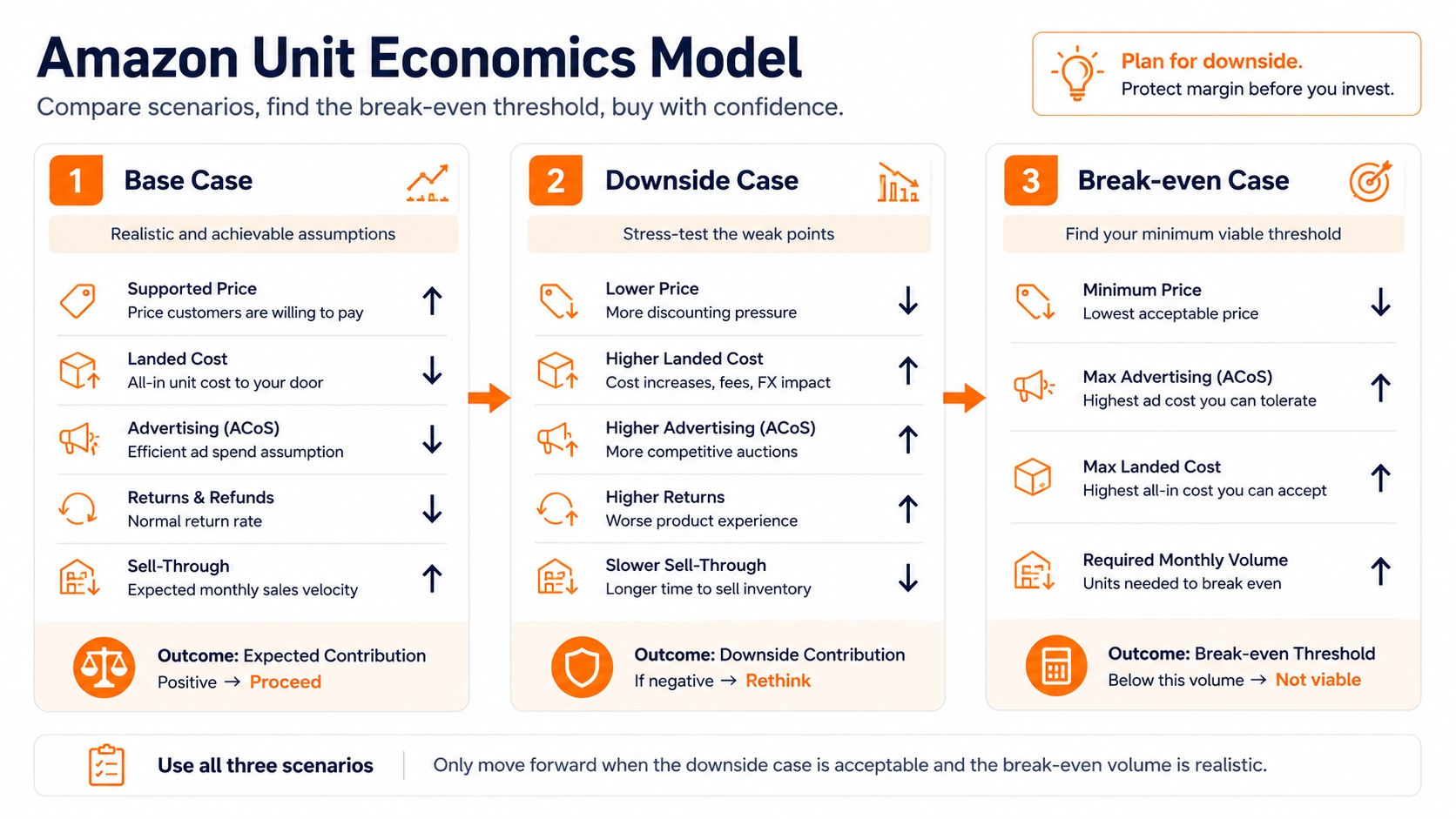
One forecast is not enough. Build a base case, a downside case, and a break-even case using the same cost structure. The purpose is not to predict the future precisely. It is to learn which assumptions control the outcome and whether the business can survive a reasonable error.
Base case
Use the best currently supported assumptions for price, landed cost, fees, ad cost, sell-through, and returns.
Downside case
Lower price and conversion, raise ads and returns, slow sell-through, and include extra storage or financing time.
Break-even case
Solve for the minimum price, maximum ad cost, maximum landed cost, or required volume before contribution reaches zero.
Create a one-page product decision record
| Decision field | Record | Source and date |
|---|---|---|
| Customer and query | Problem, use case, target buyer, core search terms, and purchase criteria | Keyword research, review themes, and category evidence |
| Competitive set | Comparable products, price band, ratings, listing standard, fulfillment mix, and concentration | SellerSprite research snapshot and manual listing review |
| Permission and proof | Category eligibility, supplier rights, invoices, test records, certifications, and IP check | Official policy, laboratory, supplier, attorney, or qualified advisor |
| Base economics | Price, landed cost, Amazon fees, fulfillment, ads, promotions, returns, contribution, and cash days | Dated quotes, fee calculator, and internal operating data |
| Downside and rule | Lower price, higher ad cost and returns, slower sell-through, review date, and scale or stop trigger | Owner, approval date, and next decision date |
How should a new seller launch and decide whether to scale?
Start with enough inventory and traffic to observe conversion, customer questions, returns, fulfillment defects, and contribution margin without creating an aged-stock problem. A launch is a controlled learning period, not proof that the original forecast was correct.
Write the decision rules before the first order. Set a review date, minimum acceptable contribution, maximum return or defect rate, inventory limit, and evidence required to reorder. When the product misses a threshold, diagnose whether the problem is demand, traffic, conversion, price, offer quality, listing accuracy, fulfillment, or the product itself before adding inventory or ad spend.
| Signal | Question | Possible action | Do not assume |
|---|---|---|---|
| Low traffic | Is the product indexed and visible for relevant buyer queries? | Review keyword coverage, category placement, ad targeting, offer eligibility, and availability | That a larger ad budget can fix weak demand or an irrelevant product |
| Traffic without conversion | Does the offer meet buyer expectations on product, price, proof, delivery, and listing clarity? | Audit search intent, images, claims, price, reviews, compatibility, variation, and fulfillment promise | That every conversion problem is caused by the title or bullets |
| Sales without contribution | Which cost or discount is consuming the expected margin? | Recalculate actual fees, ads, returns, inbound, price, and promotion cost before scaling | That revenue growth is evidence of a healthy SKU |
| Returns or defects | Is the problem listing expectation, product quality, packaging, instructions, batch, or fulfillment? | Pause scale, classify themes, isolate affected inventory, and fix the highest-confidence root cause | That negative feedback should be solved only with customer-service messaging |
| Healthy test | Are conversion, contribution, return rate, availability, and customer themes within the written rule? | Reorder in measured stages, monitor assumption drift, and protect cash for the next cycle | That one good period proves stable demand or permanent economics |
What mistakes cause new Amazon selling plans to fail?
Choosing a model from hype
Revenue screenshots do not reveal documentation burden, cash cycle, returns, inventory risk, or seller capability.
Buying before checking restrictions
Demand is irrelevant when the account cannot list the product or the seller cannot supply required evidence.
Using revenue instead of contribution
Sales can grow while fees, ads, returns, discounts, and inventory costs consume the available cash.
Assuming FBA is always best
FBA can reduce operating burden, but size, storage time, margin, and inventory velocity can change the fit.
Scaling before diagnosing
More inventory and ad spend magnify a weak product, inaccurate listing, poor offer, or broken fulfillment process.
Ignoring cash conversion
A profitable spreadsheet can still create a cash shortage when deposits, production, freight, storage, and replenishment overlap.
Amazon seller launch checklist
Move from product ideas to evidence-backed decisions
Use SellerSprite to evaluate category demand, narrow product opportunities, map buyer keywords, and model profitability before you commit inventory.
Frequently asked questions
How much does it cost to start selling on Amazon?
There is no universal startup cost. At minimum, account fees include either $0.99 per item sold on the Individual plan or $39.99 per month on the Professional plan in the US, plus referral fees. Real startup capital may also include product development or inventory, freight, duties, packaging, compliance, fulfillment, storage, advertising, returns, software, and working capital. Build a product-specific base, downside, and break-even model using current Amazon pricing.
Do I need an LLC to sell on Amazon?
Amazon's US registration guide says a seller does not need to be an LLC, registered business, or incorporated entity to open an account. An individual can select the relevant individual business type. That does not determine which legal or tax structure is best for your situation, so obtain qualified advice for your jurisdiction before making that decision.
What is FBA?
FBA stands for Fulfillment by Amazon. Sellers send eligible inventory into Amazon's fulfillment network, and Amazon performs packing, shipping, customer service, and returns for enrolled units. FBA does not source the product, guarantee sales, or remove the seller's responsibility for product compliance, inventory planning, listing accuracy, and profitability.
Is FBA required to sell on Amazon?
No. Sellers can use FBA, FBM, or a combination by eligible product. Compare total operating cost, product dimensions, service levels, storage time, internal capacity, and return handling rather than assuming one method is always cheaper or easier.
Which Amazon business model is best for beginners?
There is no universal beginner model. Private label offers more product and listing control but generally needs more development and inventory commitment. Reselling may begin faster when supply and documentation are strong, while arbitrage can support smaller tests but has inconsistent replenishment. Compliant dropshipping reduces inventory ownership in some workflows but creates supplier, delivery, packaging, and policy risk. Choose the model you can document and test with acceptable downside.
How long does Amazon seller registration take?
Amazon says timelines vary. Its current US registration guide states that many sellers can complete the registration process in a few hours and that identity verification usually takes three business days or less. Mismatched, incomplete, unclear, or additional documents can extend the process, so prepare exact legal and address information before starting.
References
- Amazon: How to sell on Amazon in 2026
- Amazon: Seller registration guide
- Amazon: Standard selling fees
- Amazon: Estimate fees and costs
- Amazon: FBA vs FBM
- Amazon: What is dropshipping?
Scope and limitations: Unless a source states otherwise, Amazon plan, registration, fee, listing, and fulfillment references in this article relate to US public pages reviewed on August 28, 2026. Marketplace, category, product, account, role, tax, legal, and program requirements can differ. Amazon and SellerSprite calculator outputs are estimates, not guarantees of cost, demand, profit, approval, or business performance. This article is educational and is not legal, tax, accounting, trademark, compliance, or financial advice.