A resilient supply chain is built through preparation, not luck. This guide shows how to create a backup supplier plan, confirm compliance, verify certifications, and ensure clear communication so your Amazon business scales with fewer surprises.
Table of Contents
- Key takeaways
- About this guide
- Always have a backup supplier
- Identify your product compliance requirements
- Request and verify supplier certifications
- Market guides: US, EU, and China sourcing notes
- Certification quick reference table
- Case study example
- Use visuals to prevent costly miscommunication
- FAQs
- About the author
- References
Key takeaways
- Backup suppliers protect inventory. Keep a Plan B ready, especially for peak season and factory shutdowns.
- Start compliance before ordering. Confirm Amazon policy and legal standards before paying a deposit.
- Always verify certificates. Check the issuing authority and coverage before listing.
- SellerSprite tools reduce risk. Use Design Patent Search and the Global Brand Database to screen for IP risks, and use Images Downloader to speed up supplier alignment.
About this guide
How we recommend using this page
- Skim the quick reference table first to understand the likely certification path for your category.
- Follow the verification checklist before placing mass production orders.
- If your product touches children, food, cosmetics, electronics, or chemicals, treat compliance as a core deliverable, not a box to check.
If you want peer support, join the SellerSprite communities: SellerSprite Discord and SellerSprite Facebook Group.
Always have a backup supplier
A great supplier is a competitive edge. A backup supplier is insurance. Even if your main factory is reliable, seasonal capacity limits can hit fast, especially around the Chinese New Year and Q4. When your listing is gaining traction, stockouts cost more than most sellers realize.
How to build Plan B without creating chaos
- Keep a short contact list. Maintain reaching out to one or two alternate manufacturers and instruct them to produce the same product for you.
- Standardize your spec. After your main version is finalized, send the same specification sheet or a physical sample to the backup supplier for a match test.
- Test consistency early. Order a sample or a small pilot run so packaging, materials, and finish match your live listing.
- Be realistic about cost tradeoffs. Backup suppliers may quote higher prices or higher MOQ, but faster lead times can save you in a sales surge.
Practical insight: If your backup sample cannot match your main SKU within one revision, treat that supplier as a last resort. Your brand consistency is worth protecting.
Identify your product compliance requirements
Before you invest in inventory, confirm what Amazon and your target market require. Compliance gaps often show up late, right when a seller wants to ship to FBA. That is the worst time to discover a missing test report or labeling rule.
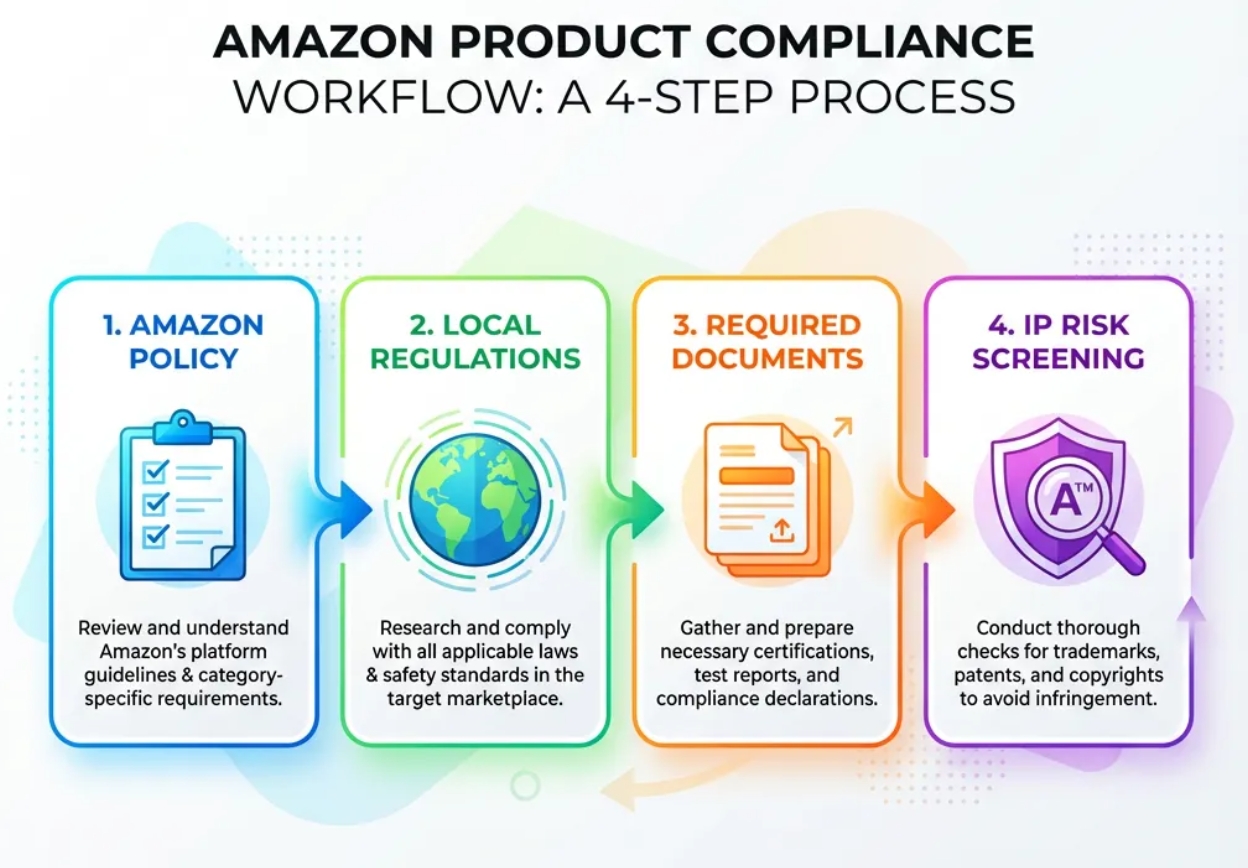
A simple workflow that prevents most compliance surprises
- Start with the Amazon policy. Check category restrictions and listing requirements inside Seller Central. Focus on materials, use cases, and claims you plan to make.
- Cross-check local regulations. Amazon's policy does not replace the law. Confirm government requirements for your destination market.
- List required documents. Write down the exact reports, marks, and labels you will need for your product and packaging.
- Screen IP risk early. Use SellerSprite Design Patent Search and Global Brand Database before you commit to tooling and packaging.
From the field: The most common seller mistake is assuming an international document automatically satisfies US requirements. Treat each market as its own checklist, then align your supplier with it.
Request and verify supplier certifications
A PDF is not proof. Your job is to verify that a certificate is genuine, up to date, and actually covers your product model and materials. This is especially important for products that are ingested, applied to the body, used by children, or contain electronics or batteries.
The 6-step certification verification checklist
- Define the exact requirement. Name the standard, the test method, and the market where it applies.
- Ask the supplier one direct question. Do you already have certification X for this product and material?
- Request documentation. Ask for the full report or certificate, not a cropped screenshot.
- Check scope and dates. Confirm it covers your product model and factory, and that it is not expired.
- Verify the issuer. Confirm the issuing lab or authority is legitimate using their official database or contact channel.
- Archive everything. Store documents, emails, and verification proof. Amazon may request them later.
Tip for faster vetting: Use SellerSprite Images Downloader to pull competitor packaging and label photos from Amazon listings, then compare required markings to your supplier sample photos before you ship to FBA.
Market guides: US, EU, and China sourcing notes
United States requirements
- Common regulators: FDA, CPSC, FCC, plus state-level rules such as California Prop 65 for certain products.
- Typical high-scrutiny categories: children's products, food-contact items, ingestibles, electronics.
- What sellers miss: documentation needs to match the actual importer and factory details, not just a generic certificate name.
European Union requirements
- Common focus: CE marking, chemical restrictions, and product-specific directives and standards.
- What sellers miss: CE documentation must match the correct product scope and the notified body details where applicable.
Special notes when sourcing from China
- Highest risk area: fake, expired, or out-of-scope certificates.
- Best practice: validate certificates directly with the issuer, then confirm the factory's legal name matches Alibaba, invoices, and certificates.
- Operational reality: longer lead times and holiday shutdowns make the backup supplier plan even more valuable.
Product category certification quick reference
Estimates only. Costs and timelines vary by complexity, lab, and required standard.
| Product category | Typical certifications and standards | Typical cost range | Typical timeline |
|---|---|---|---|
| Children toys | CPSIA testing, CPSC rules, labeling | $2,000 to $5,000 | 3 to 6 weeks |
| Food contact items | FDA material compliance, labeling rules | $1,000 to $3,000 | 2 to 4 weeks |
| Electronics | FCC (US), CE (EU), RoHS where applicable | $3,000 to $8,000 | 4 to 8 weeks |
| Cosmetics | FDA and FTC related claims compliance, ingredient and label rules | $2,000 to $6,000 | 4 to 8 weeks |
| Supplements and ingestibles | FDA related rules, lab testing, strict labeling requirements | $5,000 to $15,000+ | 6 to 12 weeks |
Case study example: avoiding a costly certification failure
Scenario (illustrative)
Background: A children's toy seller sourced from a new factory that claimed CPSIA compliance.
Risk: If the report is found to be fake or out of scope, the listing could be removed, leaving the inventory stranded.
Action: The seller followed the verification checklist, contacted the issuing body, and discovered the certificate number did not match the factory name.
Decision: They switched to a verified supplier with a higher unit cost, then updated packaging and documentation to match compliance needs.
Result: They avoided a major launch delay and reduced returns after improving product consistency.
Key lesson: Verification costs time. Failure costs momentum.
Use visuals to prevent costly miscommunication
Specs written in text can be misunderstood. Images and short videos cut through language gaps and reduce rework. When you need a color change, a logo placement, or packaging updates, send a clear annotated image so your supplier can confirm details at a glance.
A fast visual workflow
- Download a clean reference image. You can use SellerSprite Images Downloader to grab competitor listing images for packaging and label inspiration.
- Add arrows and short labels in PowerPoint or Keynote.
- Send the screenshot and ask the supplier to confirm every labeled item in writing.
- If a sample has defects, record a 20-40-second phone video and point out the problem as you explain it.
Stay Compliant, Sell Confidently
Take action with SellerSprite tools now to research compliance risks, validate IP, and plan sourcing for your Amazon business with more confidence. Start strengthening your supply chain today.
FAQs
Do I need supplier certification before selling on Amazon?
It depends on your category and claims. Children's products, many food-contact items, ingestibles, and electronics often require documented testing or certification. For regulated products, certification is mandatory.
What are the most common certifications required?
Common examples include FDA-related compliance for certain materials and consumables, CPSIA for children's products, FCC for electronics in the US, and CE in the EU. Your exact list depends on materials, use case, and market.
How can I verify if a supplier certification is fake?
Request the full document, check the scope and expiry, confirm the issuing authority is legitimate, then verify the certificate number directly with the issuer using their official website or contact channel.
How much does product certification cost?
Costs vary widely by category and complexity. Many sellers charge $500 to $2,000 for simpler items, $2,000 to $5,000 for moderate complexity, and $5,000 to $15,000 or more for higher-risk products.
How long does certification verification take?
Basic document checks can be done in hours. Issuer confirmation can take days, depending on response time. Build a buffer into your production plan so compliance does not delay shipping to FBA.
Which certifications are required for children's products?
Many children's products in the US require testing and compliance documentation under CPSIA. Requirements depend on the product type and age grading. Verify rules with CPSC resources and Amazon policy pages for your category.
About the author
SellerSprite Team. SellerSprite is an Amazon seller platform used by 1.6M+ registered sellers worldwide, with 700K+ browser extension installs, refined over 8+ years of product and workflow iteration. We publish step-by-step playbooks to help sellers move from product validation to supplier execution with fewer mistakes.
References
- FDA regulated products guidance
- CPSIA rules for children products
- FCC equipment authorization
- EU NANDO database for notified bodies
- European Committee for Standardization
- UL safety certification resources
- Amazon Seller Central help and compliance pages
View The SellerSprite Course Directory
Ready for the next step? Open the SellerSprite Academy course directory to continue building your Amazon FBA skills chapter by chapter.
Important legal disclaimer
This content is for informational purposes only and is not legal advice. Compliance requirements vary by product, market, and circumstances. If your product involves children, health, safety, or regulated claims, consult a qualified professional and confirm requirements with official regulators and Amazon policy pages.