Amazon has rolled out several important Amazon FBA policy changes for 2025 that affect fees, returns, and inventory planning. If you sell on the US marketplace, these updates can change your Amazon FBA fees 2025 assumptions, your Q4 cash flow, and how aggressively you can restock.
This guide focuses primarily on Amazon.com (US marketplace). Where relevant, we call out what United States sellers should double-check if they also sell in the EU or UK marketplaces.
You will get a clear action plan for different seller types, plus step-by-step tool workflows to model impacts fast and protect margin using SellerSprite.
Key takeaways
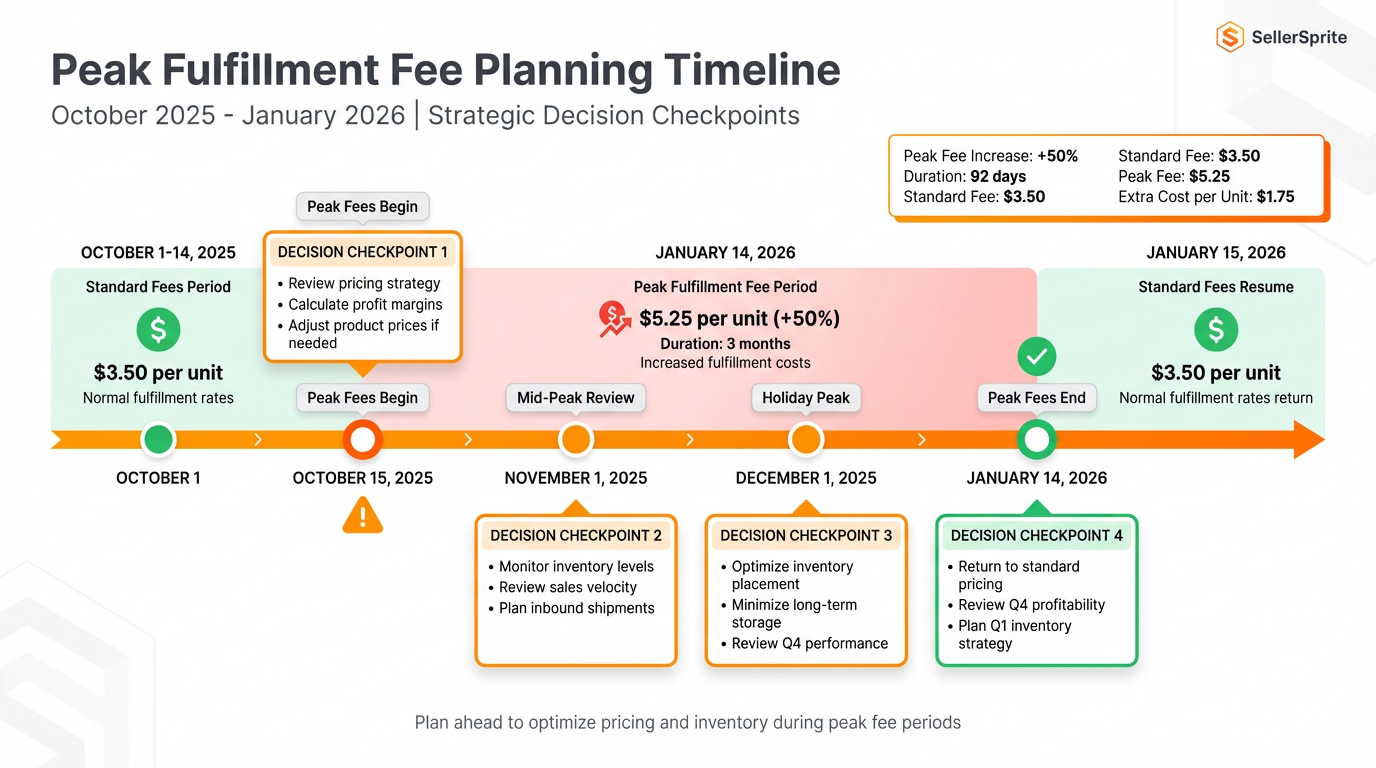
- FBA peak fulfillment fees apply from October 15, 2025, to January 14, 2026, so your Q4 unit economics need a peak vs non-peak view.
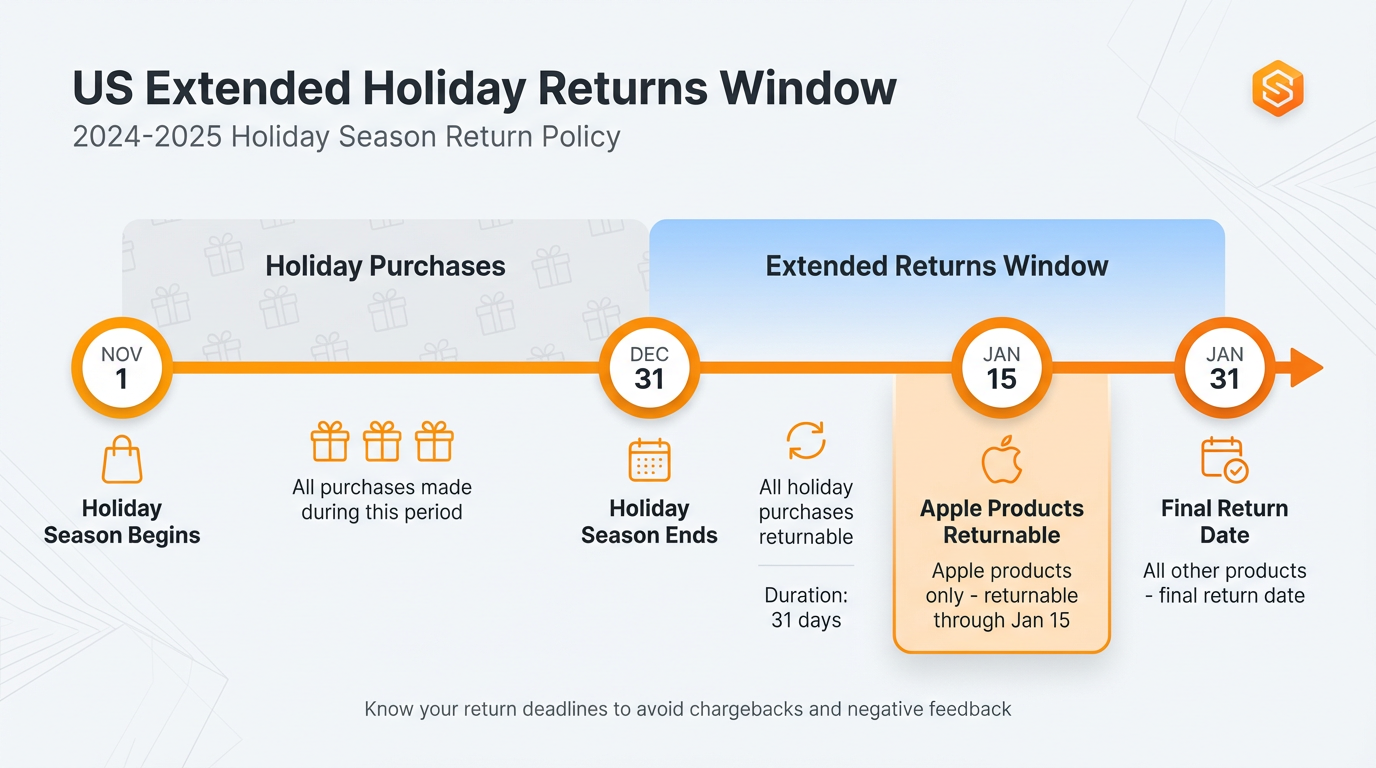
- Extended holiday returns can delay cash and extend return risk into late January, so plan inventory and promotions with a longer tail.
- Coupon fees changed in 2025. If you rely on coupons, re-check promo ROI with the new fee structure and cap timing.
- Capacity limits are a practical constraint for many sellers during Q4. Check the Capacity Monitor early, then align restock cadence to limits.
- Use SellerSprite to simulate profit under peak fees, find lower-fee opportunities, and tighten listing conversion before Q4 traffic spikes.
Table of contents
What Changed in Amazon FBA 2025?
Below are the most practical updates to track for Amazon FBA fees 2025, Q4 operations, and profitability planning. Each section includes: who it impacts, what changes, and what to do next.
Extended holiday returns window
Who it impacts: US marketplace sellers in gift-heavy categories, seasonal products, and electronics. Brands with high return rates will feel the cash timing effect most.
What changes: In the US store, many items purchased from November 1 to December 31 can be returned until January 31. Apple-branded products follow a shorter window (returnable until January 15 for eligible purchases).
Recommended actions
- Adjust Q4 reorder buffers for higher return uncertainty in late December and January.
- If you run aggressive promotions, build a January return-cost buffer into your contribution margin target.
- For electronics, double-check category-specific return rules and communicate condition expectations clearly on the listing.
Do this in SellerSprite: model the cash impact by running a peak-season profit simulation and setting a conservative return-rate scenario.
FBA peak fulfillment fee (October 15, 2025, to January 14, 2026)
Who it impacts: sellers using FBA for Q4 volume, plus anyone using Remote Fulfillment with FBA, Multi-Channel Fulfillment (MCF), or Buy with Prime in that period.
What changes: holiday peak fulfillment fees are in effect from October 15, 2025, to January 14, 2026. Amazon has indicated these peak fees remain unchanged from the prior year and are previewable in the Amazon fee tools.
| What to check | Why it matters | Where to validate |
|---|---|---|
| Your size tier and weight band | Peak add-on differs by tier, so your margin drop is product-specific | Seller Central fee preview tools and fee rate pages |
| Peak vs non-peak contribution margin | Avoid pricing blind spots that turn top sellers into break-even SKUs | Your own unit economics model |
| Promotion stacking risk | Coupons and discounts during peak can compound fee pressure | Campaign-level ROI and net margin tracking |
Recommended actions
- Identify your top 20 peak SKUs and compute peak margin with a conservative return-rate buffer.
- Create a peak pricing rule: raise price, reduce coupon depth, or shift ad mix if margin drops below your floor.
- Check fee previews early, then lock replenishment dates to avoid late inbound cost surprises.
Do this in SellerSprite: run a peak vs non-peak scenario, then decide whether to reprice or shift promo strategy.
FBA storage limits and inventory capacity 2025
Who it impacts: any seller that scales Q4 inventory, especially accounts that hit inbound or storage ceilings. Multi-marketplace sellers should treat capacity as marketplace-specific.
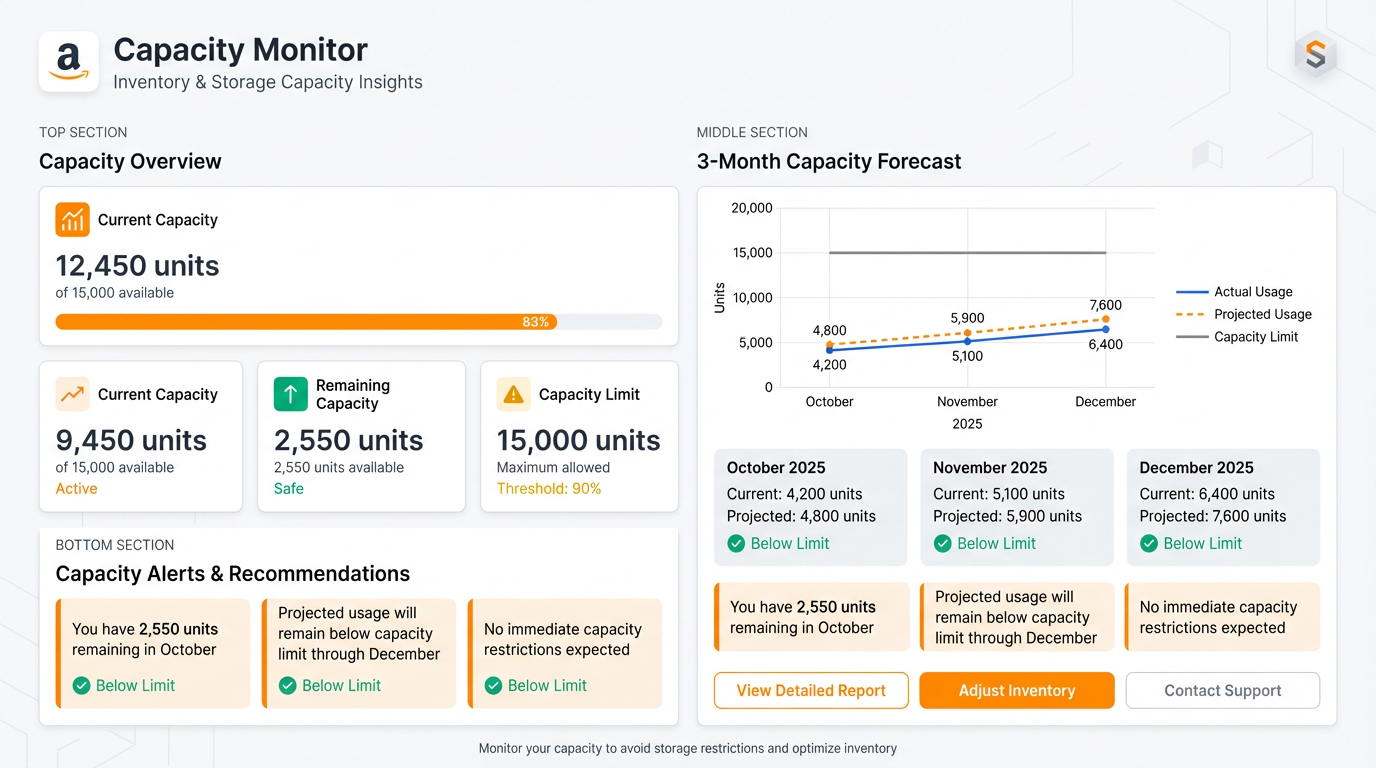
What changes: capacity limits may not be new to you, but they remain a core operational constraint. Amazon highlights that sellers can view capacity usage in the Capacity Monitor on the FBA dashboard, and that professional accounts receive limits based on IPI score and sales performance. If you need more capacity, Capacity Manager can be used to request increases with a reservation fee.
Recommended actions
- Check the Capacity Monitor weekly, starting early Q4, not after you are blocked.
- Prioritize inbound for your highest margin, fastest turning SKUs, then cut long-tail restocks.
- If you sell in the EU or UK too, repeat the same capacity check per marketplace.
Key Q4 dates: Black Friday and Cyber Monday
Who it impacts: all US marketplace sellers planning promotions, inventory cutoffs, and ad budgets.
What changes: the dates are fixed on the calendar, but your planning should shift because peak fees and extended returns extend the period where mistakes cost more. For 2025, Black Friday is November 28, 2025, and Cyber Monday is December 1, 2025.
| Date | Event | Seller focus |
|---|---|---|
| Oct 15, 2025 | Peak fulfillment fees begin | Lock peak pricing rules and margin floors |
| Nov 28, 2025 | Black Friday | Control promo stacking and monitor net margin daily |
| Dec 1, 2025 | Cyber Monday | Avoid stockouts on winners, cut ads on low-margin SKUs |
| Jan 14, 2026 | Peak fulfillment fees end | Review peak learnings and reset pricing strategy |
Coupon fee changes
Who it impacts: brand sellers and growth-stage sellers that use coupons as a core conversion lever.
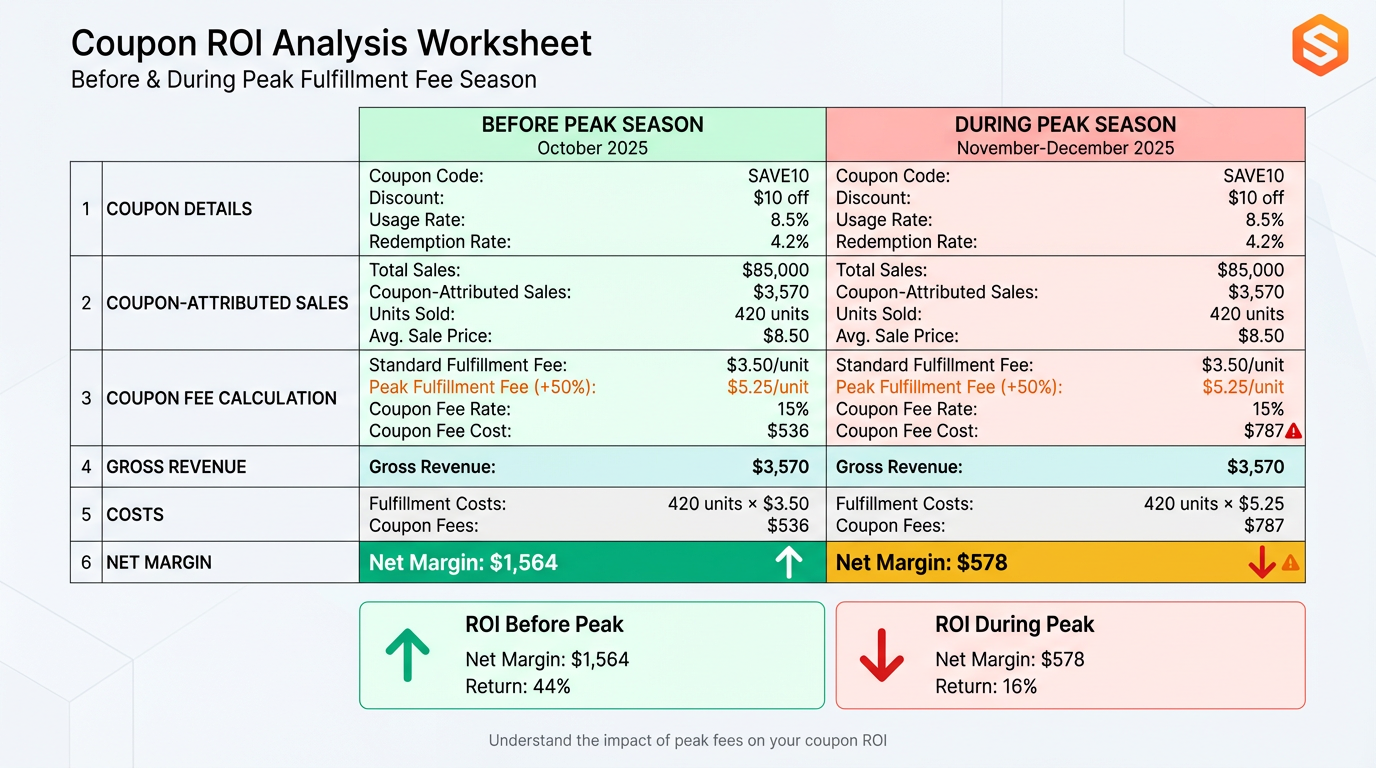
What changes: in the US store, Amazon announced that the coupon fee changed from $0.60 per redemption to $5 per coupon plus 2.5% of sales attributed to the coupon starting June 2, 2025. Amazon also announced a cap where the variable 2.5% portion will be capped at $2,000 per coupon starting November 5, 2025.
| Fee model | How it is calculated | What to watch |
|---|---|---|
| Before June 2, 2025 | $0.60 per redemption | Redemption volume spikes can inflate promo cost |
| From June 2, 2025 | $5 per coupon + 2.5% of coupon-attributed sales | High AOV coupons can cost more, so re-check the net margin |
| From Nov 5, 2025 | 2.5% portion capped at $2,000 per coupon | Top sellers may see more predictable coupon fee ceilings |
Recommended actions
- For each coupon, track a simple KPI: net profit per order after coupon discount, coupon fee, and peak fulfillment fees.
- If the margin is thin, reduce coupon depth or switch to price discount timing outside peak dates.
- If you sell in the EU or UK, do not assume the same coupon fee structure. Validate in each marketplace.
W-8 tax compliance timing
Who it impacts: non-US sellers that submit W-8 forms and anyone who has not checked their tax interview expiry date recently.
What changes: W-8 forms can expire. Seller Central notes the W-8 expiration is tied to December 31 timing after a defined period, so you should verify your specific expiry and renew early to avoid account disruption.
Recommended actions
- Check your tax interview expiry date now, then set a renewal reminder at least 30 days ahead.
- If you manage multiple entities or marketplaces, track expiry per account, not per business.
How These Updates Affect Profit and Cash Flow
Sellers often lose profit in Q4 for one reason: they plan for demand, but not for fee timing and return timing. Below are three realistic scenarios to show the size of the effect. Numbers are illustrative. Plug your exact fee tier and costs into your own model.
Scenario 1: small US seller, one hero SKU during peak
You sell 1,200 units between Oct 15 and Jan 14. Your off-peak profit per unit is $7.44. During peak, your size tier adds an illustrative $0.40 peak fee add-on.
- Off-peak profit: $7.44 per unit
- Peak profit (example): $7.04 per unit
- Peak impact (example): $0.40 x 1,200 = $480 less profit in the season
What to do: raise price slightly, reduce coupon depth, or shift ad spend to protect a minimum contribution margin.
Scenario 2: brand seller, coupon-driven growth
Your coupon drives $100,000 in coupon-attributed sales in a month. Under the 2025 coupon model, the 2.5% portion would be $2,500, and the cap can reduce it to $2,000 after the cap start date.
- From June 2, 2025: $5 + (2.5% x $100,000) = $2,505
- From Nov 5, 2025: $5 + capped $2,000 = $2,005
What to do: track coupon ROI with a net margin view. If your AOV is high, your coupon fee can move materially.
Scenario 3: multi-marketplace seller, capacity and returns squeeze
You carry 9,000 extra units to avoid Q4 stockouts. At $8 landed cost, that is $72,000 in cash tied up. Extended returns can extend the period where inventory and cash are at risk into late January.
What to do: keep inventory lean by prioritizing winners, watching capacity limits per marketplace, and aligning restock cadence to real sell-through.
Common pitfalls to avoid
- Running the same coupon depth during peak fees without recalculating net margin.
- Ignoring the Capacity Monitor until inbound creation is blocked.
- Treating extended returns as a customer policy only, not a cash-flow policy.
- Missing tax form renewal windows and dealing with avoidable account interruptions.
Action Plan: What Different Types of Sellers Should Do Now
The best response is not generic. Use a simple SOP based on your seller profile and constraints.
SOP for small sellers (cash-sensitive)
3 steps
- Set a margin floor: decide the minimum contribution margin you will accept during peak.
- Reprice before Oct 15: small price changes beat last-minute panic discounting.
- Inventory discipline: restock winners, cut long-tail, and avoid tying cash in slow movers.
SOP for brand sellers (promo and conversion focused)
3 steps
- Coupon ROI reset: re-check coupon fees and net margin with peak fees included.
- Conversion upgrades: improve images and copy so you buy fewer clicks for the same sales.
- Returns reduction: align expectations in the listing and address top review complaints.
SOP for multi-marketplace sellers (US plus EU or UK)
3 steps
- Separate models by marketplace: do not assume identical fee rules or timelines.
- Capacity check per marketplace: your US plan can fail if EU inbound is constrained.
- Compliance calendar: track renewals and deadlines by account.
How to Use SellerSprite to Respond to These Changes
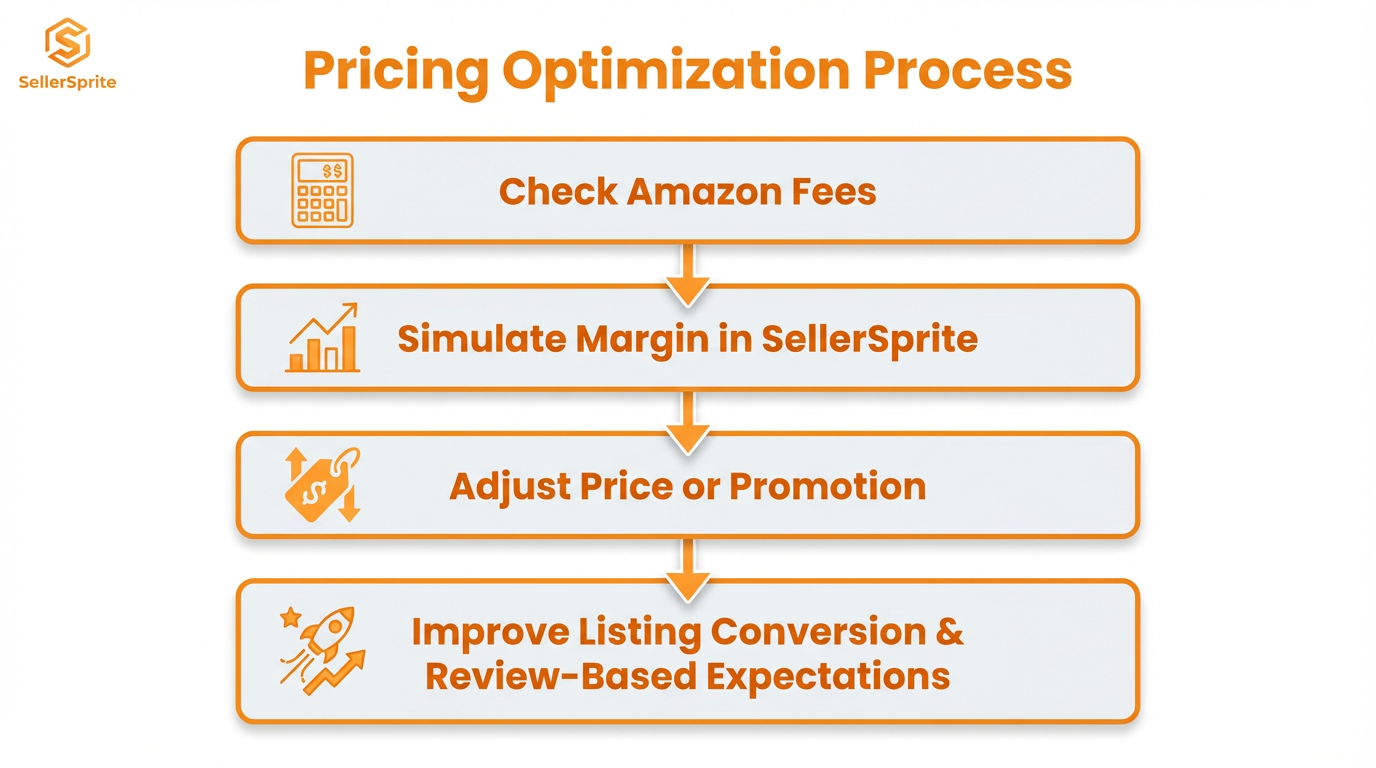
Here is a practical workflow to handle Amazon FBA policy changes 2025 fast: check fees, simulate profit, then improve conversion and category strategy.
Workflow A: fee and profit simulation (15 minutes)
- Step 1: Open SellerSprite Profit Calculator and input size, weight, costs, and target price.
- Step 2: Save two scenarios: peak season (Oct 15 to Jan 14) and non-peak. Compare gross profit per unit.
- Step 3: Decide your move: price adjustment, coupon depth change, or ad mix change.
Workflow B: find fee-friendly opportunities (30 minutes)
- Step 1: Use Product Research to shortlist niches with healthier pricing bands.
- Step 2: Use ABA Opportunity Finder to validate keyword demand and traffic potential.
- Step 3: Only pursue products that still work under peak fee stress tests.
Workflow C: reduce returns and lift conversion (before Q4 traffic spikes)
- Step 1: Open Review Analysis to find the top return and complaint drivers (size, quality, missing parts, expectations).
- Step 2: Use Listing Builder to strengthen images, bullets, and clarity around common issues.
- Step 3: If ads are a major lever, validate keyword and placement efficiency using Ads Insights.
Pro tip
Build a single dashboard view for Q4 decisions: peak margin per unit, return rate trend, capacity usage, and stock cover (weeks). This prevents you from scaling the wrong SKU just because it is selling.
Share Your Sourcing Journey With SellerSprite Community
Join the SellerSprite community on the Facebook Group to share your sourcing journey, ask questions, and get support from fellow Amazon sellers.
FAQ
What is the FBA peak fulfillment fee period for 2025?
For the 2025 to 2026 holiday period, Amazon indicates peak fulfillment fees apply from October 15, 2025, to January 14, 2026. Verify your exact rate by size tier in Seller Central fee tools.
How do the 2025 updates affect small sellers the most?
Small sellers feel the squeeze when peak fees reduce unit margin, and extended returns delay cash. The fix is a tight margin floor, disciplined restocks, and fewer promo stacks during peak.
How can I protect margins under the new coupon fee structure?
Track net profit per order after coupon discount, coupon fee, and peak fee timing. If ROI drops, reduce coupon depth or shift promos to non-peak weeks.
Where should I check storage limits and capacity?
Amazon points sellers to the Capacity Monitor on the FBA dashboard to view limits and usage. Check weekly during Q4 and prioritize inbound for your fastest turning SKUs.
7-day implementation checklist
- Day 1: Identify your top 20 Q4 SKUs and set a peak-season margin floor.
- Day 2: Run peak vs non-peak simulations in Profit Calculator.
- Day 3: Review coupon campaigns and re-forecast coupon ROI using the 2025 fee logic.
- Day 4: Check Capacity Monitor and map inbound dates to capacity constraints.
- Day 5: Use Review Analysis to find top return drivers and fix listing expectation gaps.
- Day 6: Upgrade listings with Listing Builder to improve conversion before Black Friday week.
- Day 7: Create a simple weekly cadence: margin check, capacity check, return trend check, and stock cover check.
View The SellerSprite Course Directory
Ready for the next step? Open the SellerSprite Academy course directory to continue building your Amazon FBA skills chapter by chapter.
Create your free account for access to tools like Trend, Profit Calculator, Listing Audit, and Review Insights.
Already a user? Log in here to explore all features.
About the author
SellerSprite Team (replace with a named author if desired). We publish step-by-step playbooks to help Amazon sellers translate policy updates into clear fee models, inventory decisions, and listing improvements.
Credibility notes: SellerSprite has published an overview of joining Amazon SPN and also publishes annual Amazon data reports. See links in References.
References
- Amazon Seller Forums: Peak Season Fulfillment Fees (Oct 15, 2025 to Jan 14, 2026) (official announcement)
- Amazon Seller Forums: FBA Capacity Limits and Capacity Monitor overview (official post)
- Amazon Seller Central Help: Extended Holiday Returns (US store) (help center)
- Amazon Seller Central Help: Coupons fee updates (US store) (help center)
- About Amazon: Black Friday 2025 date and Cyber Monday 2025 date (official newsroom)
- Amazon Seller Central Help: W-8 expiration overview (help center)
- SellerSprite: Amazon SPN guide (credential article)
- SellerSprite Report: Amazon 2024 seller trends (report)