TL;DR: Understanding how Amazon Merch royalties are calculated is the first step to setting profitable prices. This guide breaks down the royalty formula, explores pricing strategies for different goals, and shows how to estimate your earnings per design, so you can stop guessing and start earning more from your Merch by Amazon store.
Key Takeaways
- Amazon Merch royalties are a percentage of the list price after Amazon subtracts its own costs and applicable taxes, which means they are not your gross revenue.
- Royalty groups (Creator, Plus, Premium) determine your royalty rate; product type and marketplace significantly impact earnings.
- Pricing strategy must balance competitiveness, volume, and profit margin; low, mid, and premium tiers each have unique trade-offs.
- Use competitor research and demand signals to set prices; tools like SellerSprite make this process data‑driven and repeatable.
- Royalty rates and Amazon costs change over time; regularly revisit your prices to protect margins.
Table of Contents
Note on marketplaces: This guide is specifically optimized for the US market.
Quick Answer
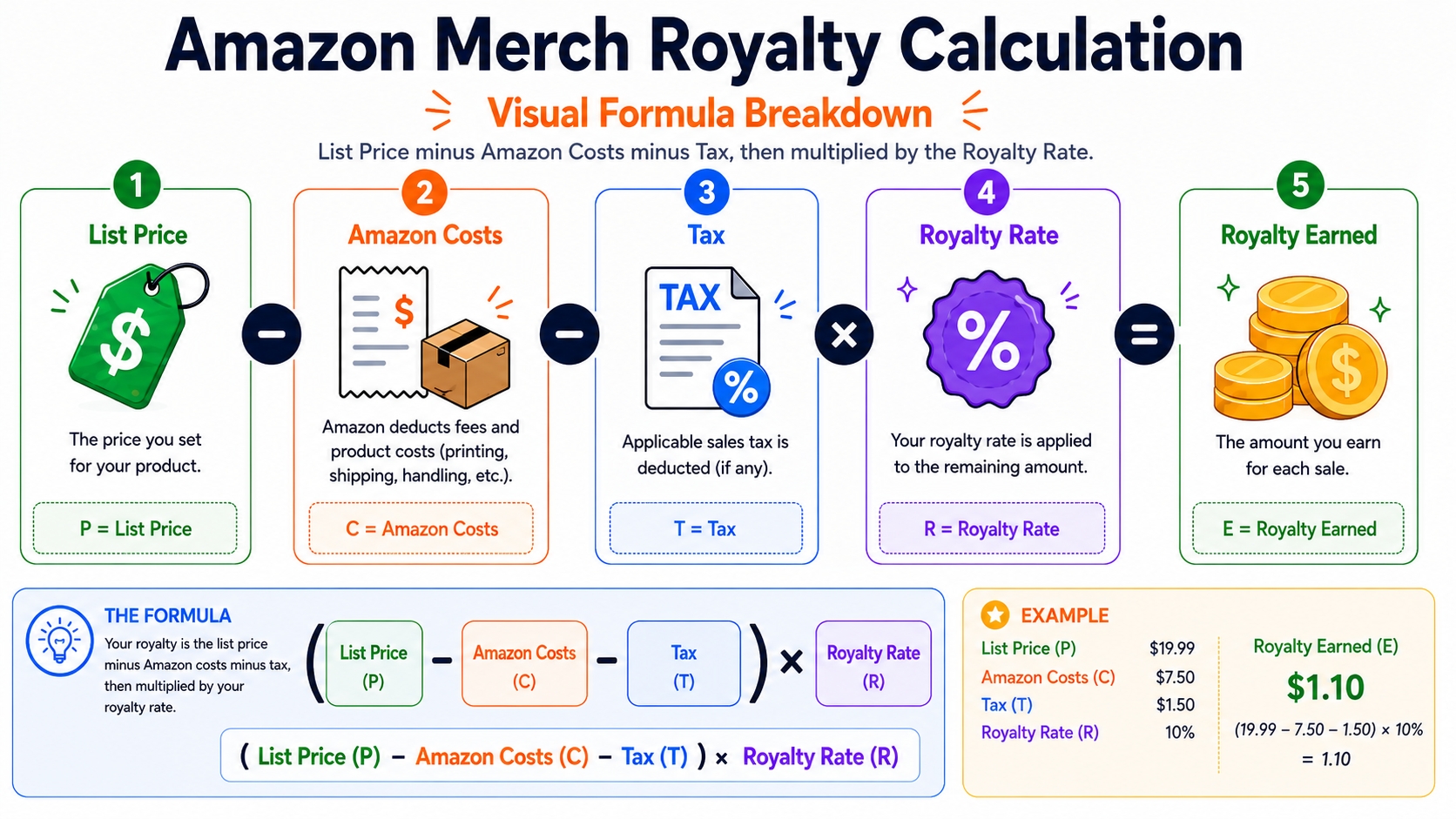
Your Amazon Merch royalty is not the sticker price a customer pays. Amazon deducts production costs, fulfillment fees, and taxes before applying a royalty rate based on the product's royalty group. The result is a net earning per sale that can be much smaller than the list price. The exact royalty formula is:
Royalty = (List Price – Amazon Costs – Applicable Tax) × Royalty Rate
This formula is the same across all Amazon Merch products, but the values for each variable change depending on what you sell and where you sell it. In the next section, we'll peel back each layer so you can calculate potential earnings before listing a design.
How Amazon Merch Royalties Work
To price confidently, you need a firm grasp of the four components that shape your royalty. Each one can lift or sink your bottom line, and mastering them doesn't require a spreadsheet wizard, but just a few minutes of focused reading. Let's examine each piece in turn, starting with the number you control directly.
Offer price
The offer price is the list price you set for a product, that is, the dollar amount customers see before any discounts or promotions. This is your starting point and the most direct profit lever in your hands. A higher offer price usually means a higher royalty, but only up to a point: demand can drop if you price too far above competitors. That's why most successful Merch sellers treat price setting as a strategic balancing act, not a "set it and forget it" decision.
Applicable tax
Amazon automatically deducts any marketplace-specific taxes (such as U.S. state sales tax or international VAT) from the list price before calculating your royalty. Since tax rates vary by jurisdiction, the same product sold on Amazon.com versus Amazon.co.uk can yield different royalties even at the same list price. Always factor in the tax rate of your primary marketplace when modeling potential earnings.
Amazon costs
These are the printing, shipping, and fulfillment fees Amazon charges to produce and deliver your product. Costs are fixed per unit type, such as heavy hoodies cost more to make and ship than thin tees, and vary by marketplace as well. For example, a standard U.S. t-shirt might carry roughly $7.00 in combined production and fulfillment costs, while a premium sweatshirt could exceed $12.00. Because these figures can update annually, you should double-check Amazon's current cost schedule at least once a quarter.
Royalty group / multiplier rules
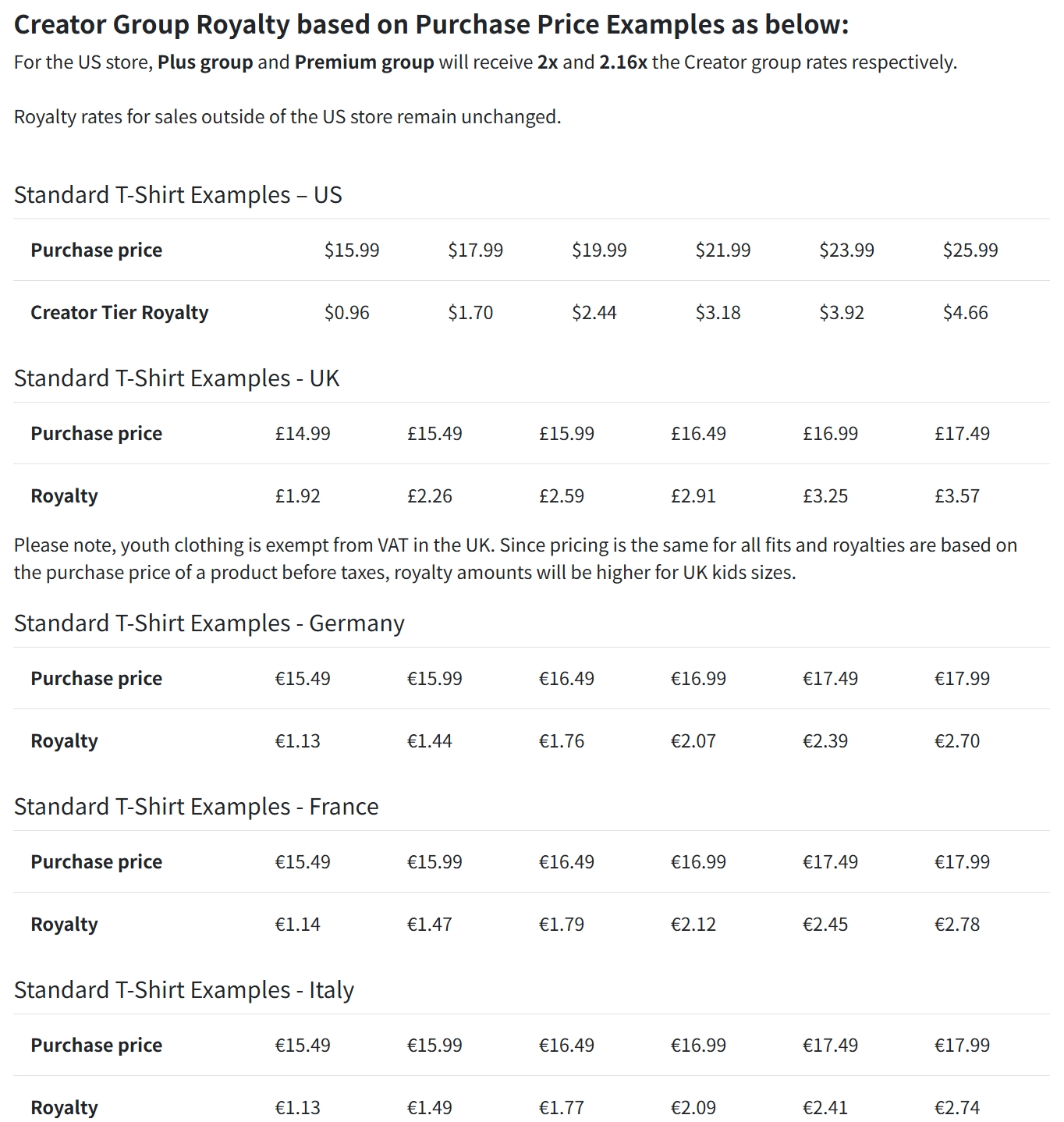
Beginning June 1, 2026, Amazon moved away from its previous fixed royalty structure and introduced three performance-based payout levels, with the royalty earned on each sale now determined by the source of the customer traffic. The current three-tier royalty groups are:
| Royalty tier | Reported qualification rule | $19.99 standard T-shirt royalty | Relative payout |
|---|---|---|---|
| Creator | Default tier, primarily Amazon-organic traffic | $2.44 | Base rate |
| Plus | At least 15% of monthly unit sales from qualifying non-organic traffic | $4.88 | 2× Creator |
| Premium | Approximately 35% or more of monthly sales from qualifying external traffic | $5.27 | 2.16× Creator |
*Actual rates vary by marketplace and product. Always consult Amazon's current royalty schedule.
Why this section needs regular updates
Amazon can and does tweak royalty groups, cost structures, and marketplace tax rules. For instance, in the past, certain apparel items moved from one group to another, changing seller earnings overnight without a corresponding list-price change. To stay ahead, bookmark the official Merch resources to stay informed about updates.
Pricing Inputs to Track
Before you land on a price, you need to gather four critical inputs. Skipping any one of them is like cooking a recipe without tasting; you might get lucky, but you'll rarely nail it consistently. Here's what to capture before you publish your next design.
Product type
The physical item you choose, such as classic tee, premium hoodie, phone case, drives your costs and royalty rate. A design that prints beautifully on a $14.99 tee might underperform on a $24.99 hoodie because the audience's willingness to pay differs. You should always map a design to the product type likely to deliver the best return, not just the most expensive one. For help deciding, see our Merch on Demand toolkit for competitive data.
Marketplace
Amazon Merch operates in multiple country-specific marketplaces, each with distinct customer bases, tax rates, and shipping costs. The U.S. market often tolerates higher list prices, while European markets may have tax-inclusive listed prices that compress nominal royalties. As a best practice, set prices per marketplace separately: what works on .com rarely works identically on .co.uk.
Suggested list price
Your initial list price should be informed by data, not guesswork. Research the top 10 sellers for your target keyword; look at their prices, review counts, and trending patterns. If everyone clusters around $16.99, a $26.99 listing will likely be ignored, while a $12.99 one may raise suspicions about quality. Aim to enter the conversation at a price point customers already trust.
Expected conversion rate
Lower prices can boost conversion rates, but the relationship isn't linear. A $2 drop may lift sales by 15% on a niche design, but a $2 drop on a trending pop-culture tee might have no effect. Use Amazon's own reporting or SellerSprite's demand indicators to estimate the conversion uplift you need for a price cut to make up for lost margin. Sometimes a higher price with slightly lower volume yields more total profit.
Pricing Checklist: Before committing to a price, you've confirmed the product type and marketplace, researched competitor price bands, estimated your royalty using Amazon's latest cost schedule, and projected whether volume or margin better serves your growth goal. Have you touched all four bases? Good, and then you can move on to choosing a scenario.
Pricing Scenarios
Not every seller pursues the same goal. Some want rapid cash flow, others want a passive income asset, and still others want to build a premium brand. Your pricing strategy should match your objective. Here are three common scenarios, each with its own risk/reward profile.
Low-price volume strategy
Setting a list price at the lower end of your niche (e.g., $13.99–$15.99 for a standard tee) aims to capture the Buy Box through aggressive pricing. This can kickstart reviews and organic visibility, especially for new, trend-agnostic designs. The trade‑off? Thin per-unit royalties, perhaps only $1.00–$1.50, which means you need dozens of daily sales just to replace a $50/day profit target. This strategy works best when you have multiple designs in the same niche and can afford to use a few as traffic drivers.
Mid-price balanced strategy
Most long-term sellers land here. List prices between $17.99 and $22.99 position you neither as the cheapest nor the most expensive option. This range typically yields royalties of $1.70–$3.00 per unit on apparel, striking a balance between steady volume and meaningful profit per sale. The balanced strategy also gives you room to run occasional promotions or coupons without dipping into negative territory, which is critical for sustaining a store over time.
Premium niche strategy
If your design targets a passionate, underserved audience, such as fitness enthusiasts, medical professionals, specific fandoms, you can often command $24.99 and above. Because customers in these niches value authenticity over price, conversion rates hold up at higher price points, and per-unit royalties can exceed $4.00. However, the addressable market is smaller, so this strategy requires exceptional keyword targeting and compelling designs. Many successful sellers reserve premium pricing for their best, most differentiated work.
Example scenario table (for illustration only)
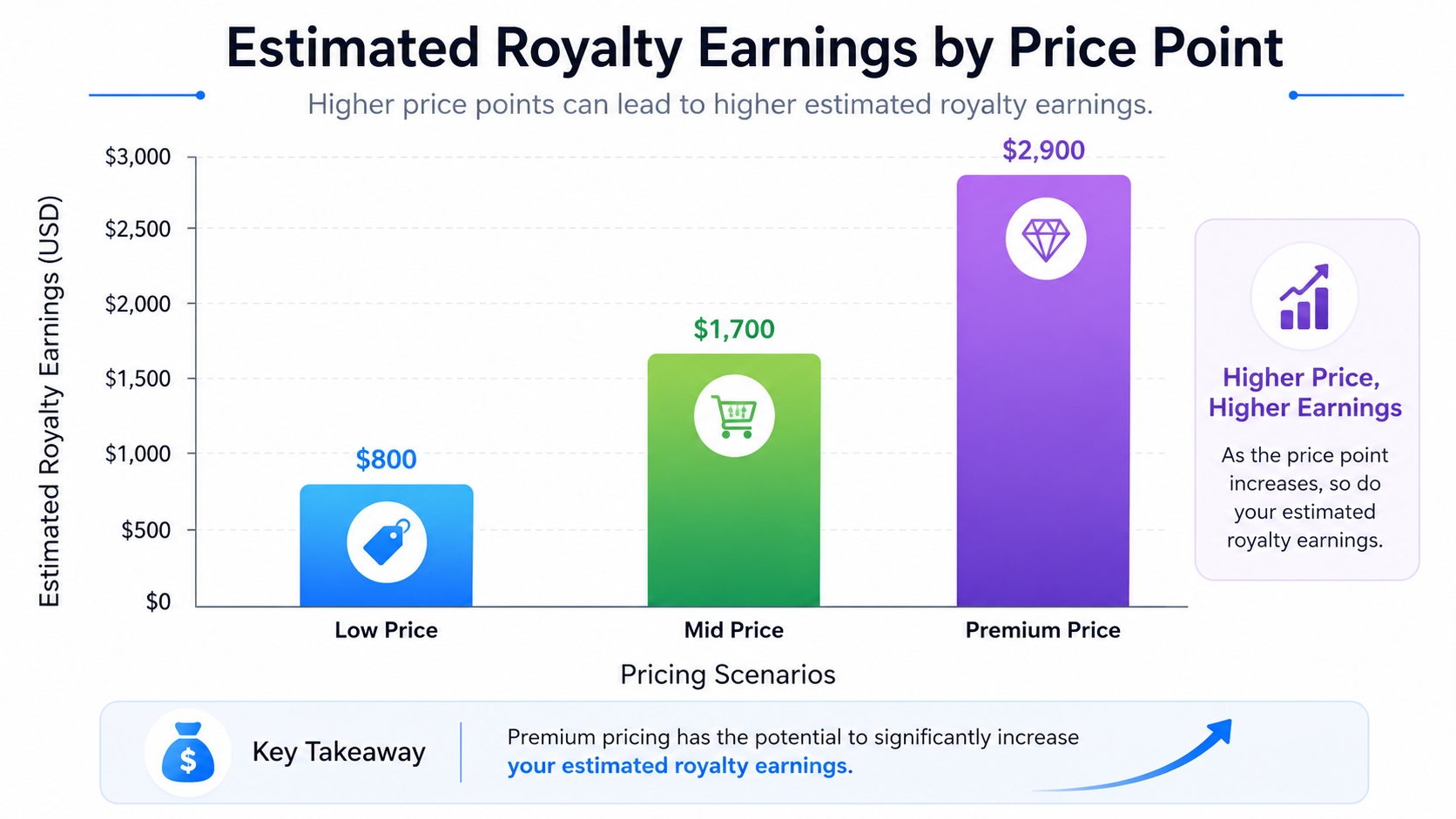
The numbers below assume a standard U.S. t-shirt within the creator tier. These are not guaranteed earnings; your actual results will vary based on current Amazon costs, marketplace taxes, and the specific royalty group. Use this as a conceptual guide, not a promise.
| Scenario | List Price | Est. Royalty |
|---|---|---|
| Low‑price | $15.99 | $0.96 |
| Mid‑price | $19.99 | $2.44 |
| Premium | $25.99 | $4.66 |
*Costs and rates are hypothetical and for illustration only; they do not reflect current Amazon charges. Always verify using Amazon's official documentation.
How SellerSprite Can Support Pricing Decisions
Data‑driven pricing eliminates the guesswork that sinks most new Merch accounts. SellerSprite's Amazon toolset surfaces the competitive intelligence you need to pick a price point grounded in reality, not hope. Here are three ways it sharpens your pricing decisions.
Competitor price bands
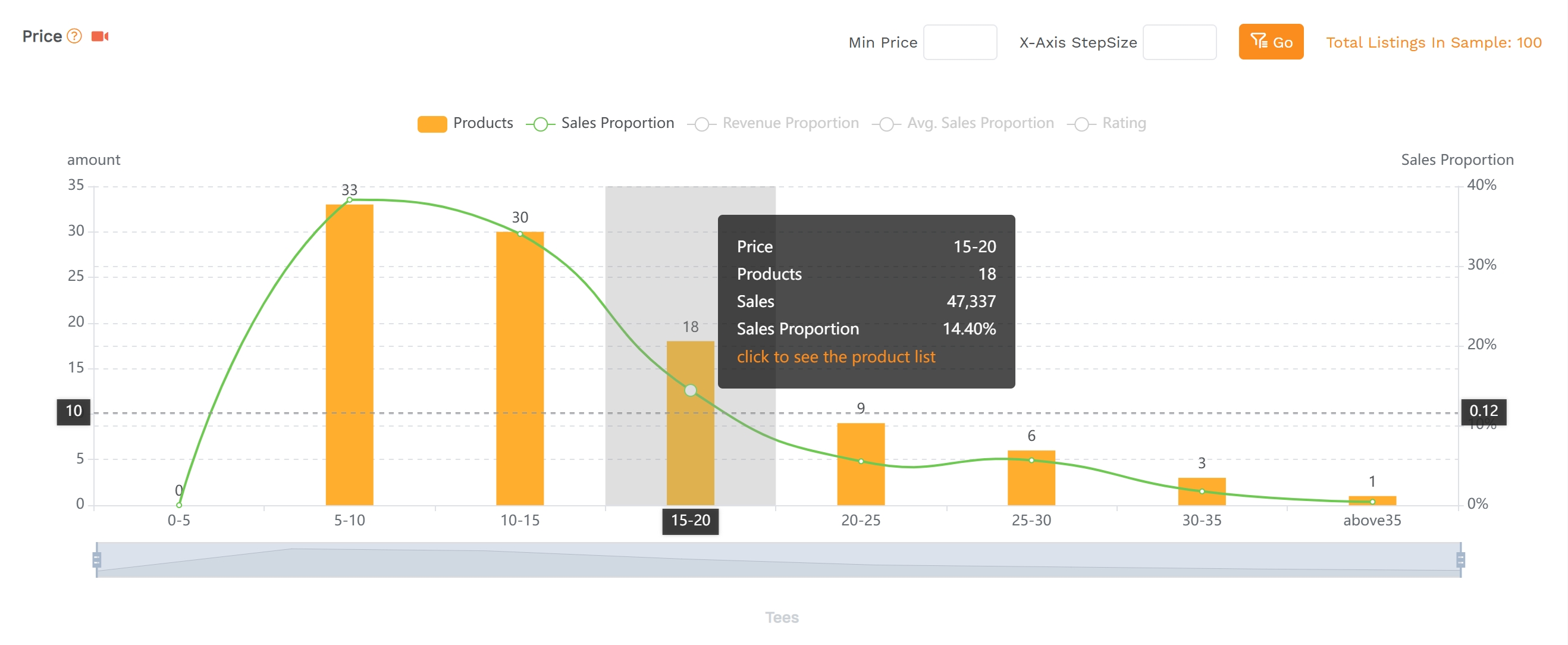
Instead of manually scrolling through search results, use SellerSprite to pull the price range of the top 20 sellers for any keyword. If 80% of them cluster between $15.99 and $18.99, you have a clear band to target. The high‑priced listings with low BSR may signal an underserved premium segment you can enter. This instant snapshot replaces hours of manual research so you can price with confidence.
Review depth and demand signals
Reviews are a proxy for sales velocity and market demand. SellerSprite aggregates review counts, star ratings, and growth trends across competing listings. A niche where top sellers have 500+ reviews indicates established demand and often more price sensitivity. A niche with few reviews but high search volume may tolerate higher prices because customers have fewer alternatives. Layering this demand data onto your pricing plan helps you anticipate conversion rates before you invest in design time.
Product expansion decisions
Once you've validated a winning design on a standard tee, SellerSprite helps you spot the next logical product type (be it a premium t-shirt, tank top, or phone case) by revealing which products in your niche already sell and at what price. This way, you're not guessing which variant will yield the best royalty; you're expanding methodically onto products with proven demand. Combined with SellerSprite's Merch on Demand guide, this approach turns royalty estimation into a repeatable system.
FAQ
How do Amazon Merch royalties work?
Amazon Merch royalties are calculated as (List Price – Amazon's costs – applicable taxes) × the royalty rate assigned to your product's royalty group. Amazon automatically handles the deduction and deposits your earned royalty into your account.
Is Amazon Merch royalty the same as profit?
No. The royalty is your income from a sale, but profit is what remains after you subtract your own expenses such as design costs, advertising spend, subscription fees, and taxes. Always budget these costs before viewing royalties as take‑home income.
What affects Amazon Merch royalty earnings?
Six factors influence your royalty: the list price you set, the Amazon marketplace, the product type, the royalty group, Amazon's production and fulfillment costs, and any applicable taxes. Changes in even one of these can noticeably shift your earnings per unit.
How should I price Amazon Merch products?
Start by analyzing the price points of top‑ranking competitors in your niche. Choose a price that aligns with your volume‑vs‑margin goal: low for maximum sales velocity, high for premium perception, or somewhere in between for balance. Always re‑evaluate pricing as you gather sales data and as Amazon updates its cost structure.
Do Amazon Merch royalties change by marketplace or product type?
Absolutely. Each marketplace has its own tax rate and fulfillment costs, and each product type belongs to a specific royalty group with its own rate. A standard t‑shirt on Amazon.com will almost always yield a different royalty than the same design on Amazon.co.uk or on a premium long‑sleeve tee.
Next Steps
- Start your free SellerSprite trial to unlock competitor pricing data and demand insights for your Amazon Merch niche. Sign up here.
- Bookmark Amazon's Merch royalty resource page and set a recurring calendar reminder to review it every 3 months.
References
- Amazon Merch on Demand Resource Center View
- SellerSprite: Ultimate Amazon Merch on Demand Guide View
- SellerSprite: Amazon Merch on Demand Toolkit View
By SellerSprite Success Team
The SellerSprite Success Team combines years of Amazon marketplace experience with data‑science expertise, helping sellers of all sizes dominate search results through proven operational strategies and cutting‑edge tooling.
Last updated: 2026-07-14