TL;DR: Reselling on Amazon means sourcing an existing product and offering it to customers through the Amazon store. Retail and online arbitrage can uncover one-time deals; wholesale can offer repeatable stock; supplier-direct fulfillment shifts inventory handling but not seller responsibility. The real business test is whether you can source the same eligible item again, document it, win enough orders at a defensible price, and fund the next purchase without relying on the first discount.
Key Takeaways
- Permission comes before price. Verify the exact product, condition, brand restrictions, and required sourcing evidence before committing inventory.
- The source determines the business model. A profitable clearance find and an authorized, reorderable wholesale SKU create different long-term opportunities.
- BSR does not allocate orders to you. Your realized sales depend on competing offers, total price, delivery, stock, and seller performance.
- Set a price floor and a reorder gate. Keep selling fees, fulfillment, losses, sourcing labor, supplier lead time, and cash exposure visible.
Table of Contents
- The Deal and the Business Are Not the Same
- Choose a Supply Model Before You Chase Margins
- Three Checks Before Paying a Supplier
- An ASIN Can Sell Well While Your Offer Does Not
- Stress-Test the Deal at the Price You Might Actually Get
- Fulfillment Changes Costs, Not Accountability
- The Second-Order Test: Supply, Lead Time, and Cash
- What to Learn From the First Batch
- When to Walk Away
- FAQs
- References
Market and evidence note: This article focuses on the US Amazon marketplace. Any sample sales, costs, and lead times are hypothetical illustrations, not verified category averages. The source framework references an external search-volume CSV and numerical scores, but no underlying dataset or scoring method was supplied; those figures are not treated as established facts.
The Deal and the Business Are Not the Same
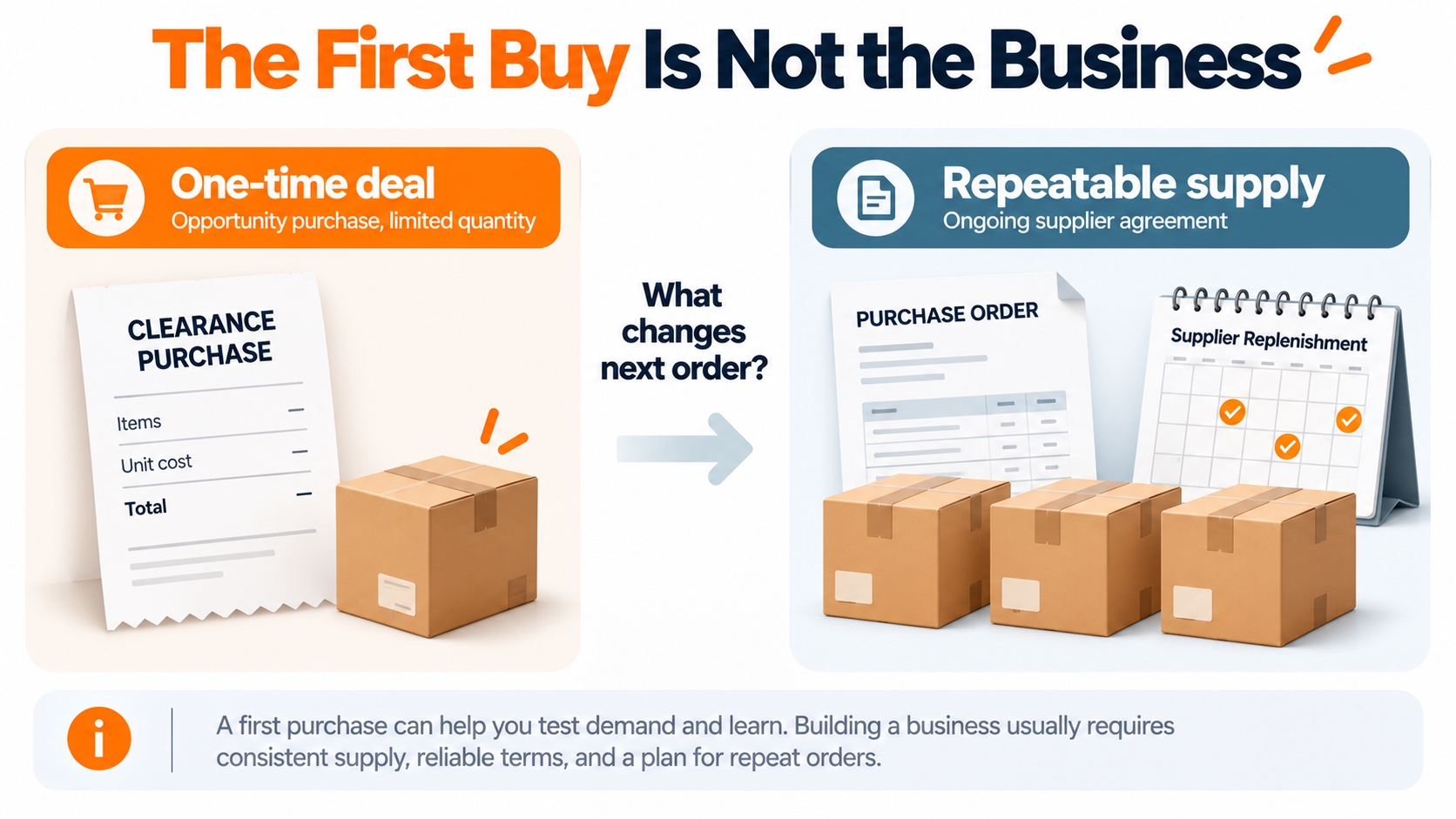
Quick answer: An Amazon reselling business acquires products from external sources and sells them through eligible offers in Amazon's store. The first profitable purchase proves only that one batch may work. A repeatable business must also establish ongoing sourcing rights, reliable documentation, offer competitiveness, positive contribution after fees, and a cash cycle that can support replenishment.
The phrase "Reselling and Amazon Resale Business" also mixes two different ideas. Reselling on Amazon is a seller business model. Amazon Resale is Amazon's own consumer-facing offer for inspected used or open-box inventory. This article addresses the seller business, not Amazon Resale's condition-grading program. A separate condition and refurbishment assessment is needed when sourcing pre-owned goods.
The temptation is to judge the opportunity from the first margin spreadsheet. Yet the price you paid may have been a short-lived clearance, the seller holding the Featured Offer may return, or the next shipment may require a higher minimum order. That is why the second purchase, not the first sale, is the more revealing test.
The decision in one sentence: Can you buy it again, prove where it came from, and profitably sell through the next batch at a realistic competing price?
Choose a Supply Model Before You Chase Margins
Retail and online arbitrage, wholesale, and dropshipping often appear together in seller discussions, but they are not identical operating choices. Arbitrage and wholesale describe where stock comes from; dropshipping describes who fulfills an order and how the seller controls that shipment. Keep sourcing and fulfillment distinct when comparing costs.
For a fuller structural comparison, including where private label fits, see SellerSprite's comparison of four Amazon reselling business models. Here, the emphasis is on whether the source can support the next order rather than on choosing a model from a checklist.
| Route | What makes the first deal attractive | What can break the second deal |
|---|---|---|
| Retail or online arbitrage | Clearance pricing, small batches, and fast testing | The discount vanishes, purchase records do not meet a requested standard, or manual sourcing costs exceed the margin |
| Wholesale from an established supplier | Invoices, commercial terms, and a potential reorder path | Higher minimum orders, weak brand access, thinner prices, stock allocations, or supplier price changes |
| Supplier-direct fulfillment (compliant dropshipping) | Lower need to hold inventory upfront | Wrong pack slips, inaccurate supplier stock, missed dispatch, item substitution, and return-handling failures |
Private label is a useful alternative to evaluate, but developing and selling your own branded product is not the same as reselling an existing third-party product. If the attraction is a distinctive product with control over its detail page, analyze that route on its own terms rather than blending the cost of product development into an arbitrage model.
Three Checks Before Paying a Supplier
Amazon selling eligibility, product identity, and supply-chain evidence are independent questions. An active listing answers none of them for your seller account. Make all three pass before the purchase order becomes binding.
1. Does your account have access to the exact product?
In Seller Central, search the specific product and intended condition through Catalog and Add Products. A Sell this product option and an Apply to sell process mean different things; applicable restrictions can depend on category, product, brand, and account. Amazon explains the steps and documentation in its branded-product selling approval guidance. Depending on the application, a manufacturer or distributor invoice or brand authorization may be required. Do not order against an approval you have not received.
2. Can the supplier substantiate the goods?
Keep the original invoice, supplier legal details, dated product identifiers, quantities, and payment or shipment trail together. A retailer checkout confirmation, liquidation manifest, or supplier promise is not necessarily a substitute for the documents Amazon may request. Responsible Sourcing reviews may seek the chain back to the manufacturer, whereas a listing application may ask for different evidence. Check the exact notice rather than assuming one document is universally accepted.
3. Can you list and ship the exact item described?
Check variation, size, model generation, quantity, condition, and included components. Do not alter a shared product page to make a near-match appear identical. If sourcing from retail, remove price labels and inspect packaging where necessary, but do not treat repackaging as a substitute for legitimate condition claims or traceability.
Evidence gate
Verified selling eligibility and a correct product match for this account and marketplace.
Source gate
Genuine, traceable inventory and records capable of supporting the likely approval or review request.
Delivery gate
A supply and fulfillment arrangement that can deliver the described product on time, every time.
Amazon's official reselling overview also emphasizes verifying authenticity, safety and product functionality, retaining records, and using legitimate sources. Deal scanning without this examination is only a shortlist, not a buying authorization.
An ASIN Can Sell Well While Your Offer Does Not
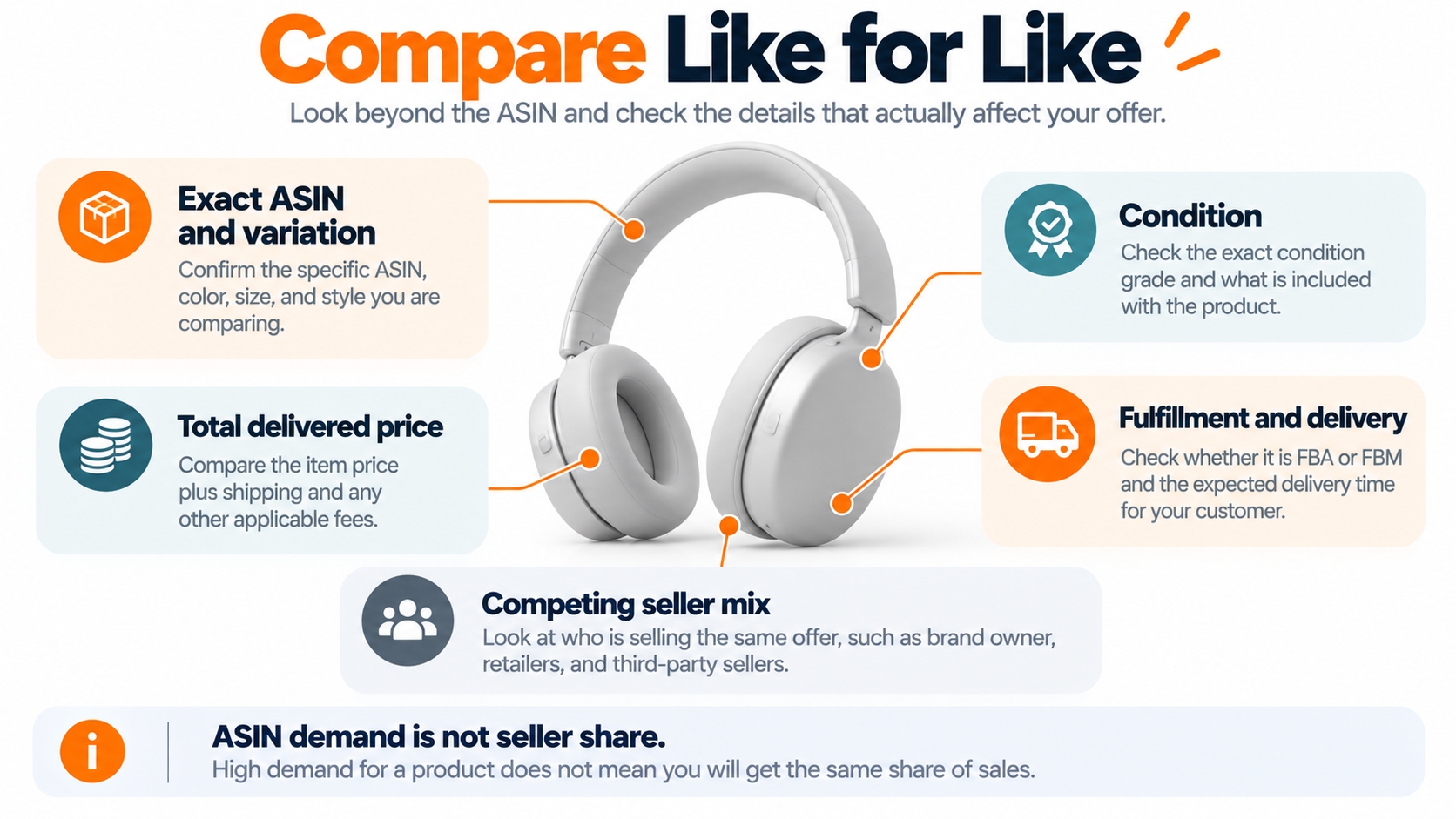
Best Sellers Rank measures relative product sales performance within a category. It does not show how many units an individual reseller will receive from that demand, and an estimated ASIN sales count is not a guaranteed allocation of orders. Multiple offers can share a product page while differing in condition, shipping, and total price.
Replace a rank snapshot with a matched offer comparison
- Confirm the same product: Compare the exact ASIN, variation, pack quantity, condition, and applicable marketplace.
- Observe the offer stack: Note the number and kinds of competing sellers, Amazon or brand presence, seller-fulfilled versus FBA offers, and total price including delivery.
- Review history: Compare BSR, historical selling price, promotions, and estimated sales across relevant time periods, not a single high-demand week.
- Test the lower-price scenario: A competitor can cut its price or return to stock before your shipment arrives; model the price you might actually need to charge.
SellerSprite Product Research and the browser extension can help compare BSR and estimated sales, price history, ratings, and available trend fields. These are research indicators, not proof of your supplier, product authenticity, future Buy Box share, or true sales for your own offer. Keep the tool's update timestamps in view when making fast-moving decisions.
Amazon lists competitive total pricing, inventory availability, shipping experience, and seller performance among the considerations around the Featured Offer. It is not a reward automatically won by the lowest listed price or by FBA enrollment alone.
Stress-Test the Deal at the Price You Might Actually Get
The headline spread between purchase cost and selling price is not margin. A reseller must recover inbound costs, preparation, referral and fulfillment fees, expected returns and losses, advertising where used, and the labor required to source and process the inventory. Allocate one-time research or subscription overhead separately, then reconcile the business result without double-counting it.
Contribution per unit: Selling price minus unit landed cost, applicable Amazon fees, fulfillment and prep, variable advertising, and expected net post-sale costs. This is contribution before fixed overhead and tax, not net profit.
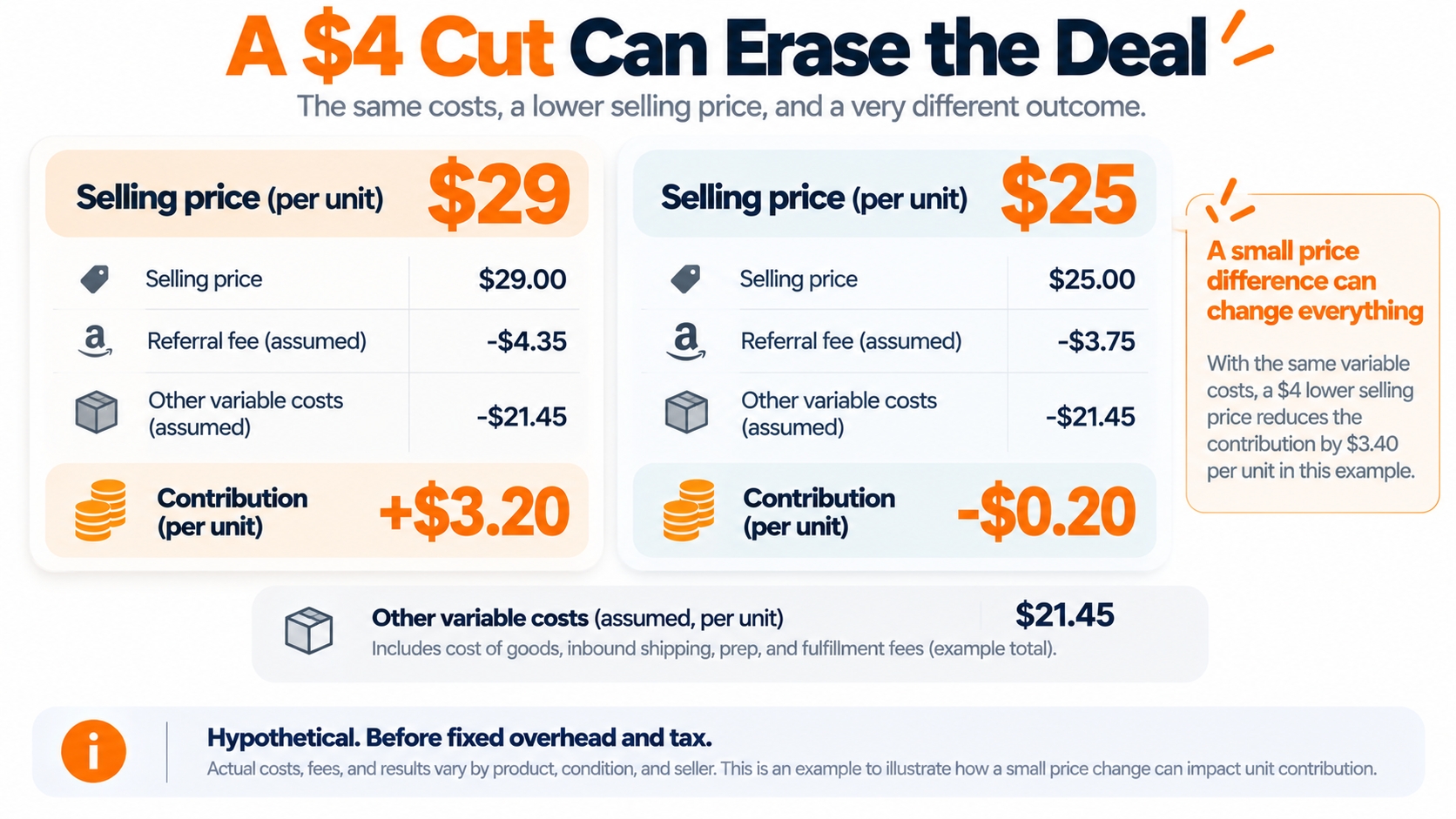
Hypothetical case: A permitted, new-condition product sells for $29. Assume $14 landed product cost (including acquisition and inbound/prep), $5.25 fulfillment, $1.20 advertising, $1 expected net post-sale adjustment, and a 15% referral fee for illustration only. Actual Amazon rates depend on category, fulfillment dimensions, fee period, and other conditions.
| Assumed cost per unit | At $29.00 | At $25.00 |
|---|---|---|
| Selling revenue | $29.00 | $25.00 |
| Landed inventory cost | $14.00 | $14.00 |
| Referral fee at assumed 15% | $4.35 | $3.75 |
| Fulfillment cost | $5.25 | $5.25 |
| Variable advertising | $1.20 | $1.20 |
| Expected net post-sale adjustment | $1.00 | $1.00 |
| Contribution before overhead and tax | $3.20 | -$0.20 |
A $4 selling-price drop reduces contribution by $3.40 in this example because the referral fee falls by only $0.60. This is why a deal that looks workable at the current Featured Offer price may fail when a larger seller discounts. Do not reuse the assumed 15% category rate as a universal Amazon fee.
The approximate price that preserves $3 contribution under these specific assumptions is ($14 + $5.25 + $1.20 + $1 + $3) / (1 - 0.15) = $28.77, rounded up to the nearest cent. This simplified formula requires adjustment when category fees have bands or minimums, when return losses change, or when additional price-linked charges apply.
Use Amazon's Revenue Calculator to replace invented assumptions with the relevant ASIN's current fee estimate; then reconcile actual transaction charges after sale. Costing the average expected lot is not enough if the item has a high unsellable rate or a low resale value after returns.
Fulfillment Changes Costs, Not Accountability
Wholesalers and arbitrage sellers may use FBA, merchant fulfillment, or a mix, subject to their offer and product requirements. FBA may simplify order handling, but storage, inbound placement and other applicable charges still matter. Merchant fulfillment transfers shipping and support execution to your own operation. Neither option makes poor sourcing or incomplete product information disappear.
Supplier-direct shipping is possible only with the right controls
Amazon's drop shipping policy on seller-of-record responsibility requires it to be clear that you are the seller of record. Buying from another retailer and letting its identity appear on packing slips, invoices, or external packaging is not compliant retail-to-retail dropshipping. You remain responsible for processing returns and the customer-facing experience. A supplier promise alone is insufficient: verify package identity, exact SKU mapping, stock synchronization, shipping performance, and exceptions before listing.
If supplier stock visibility is delayed, promise dates are unreliable, or substitutions occur without control, the lack of inventory on your shelf can turn into excess cancellations and negative customer experiences. Build a hold-or-pause rule when the supplier cannot substantiate available stock.
The Second-Order Test: Supply, Lead Time, and Cash
A repeat purchase is a new underwriting decision, not an automatic reorder of the first spreadsheet. A wholesale supplier can be legitimate and still be unable to reserve stock, maintain the original price, or deliver within the same lead time. For retail arbitrage, the original promotion may simply be gone.
Your reorder point may arrive before your trial is finished
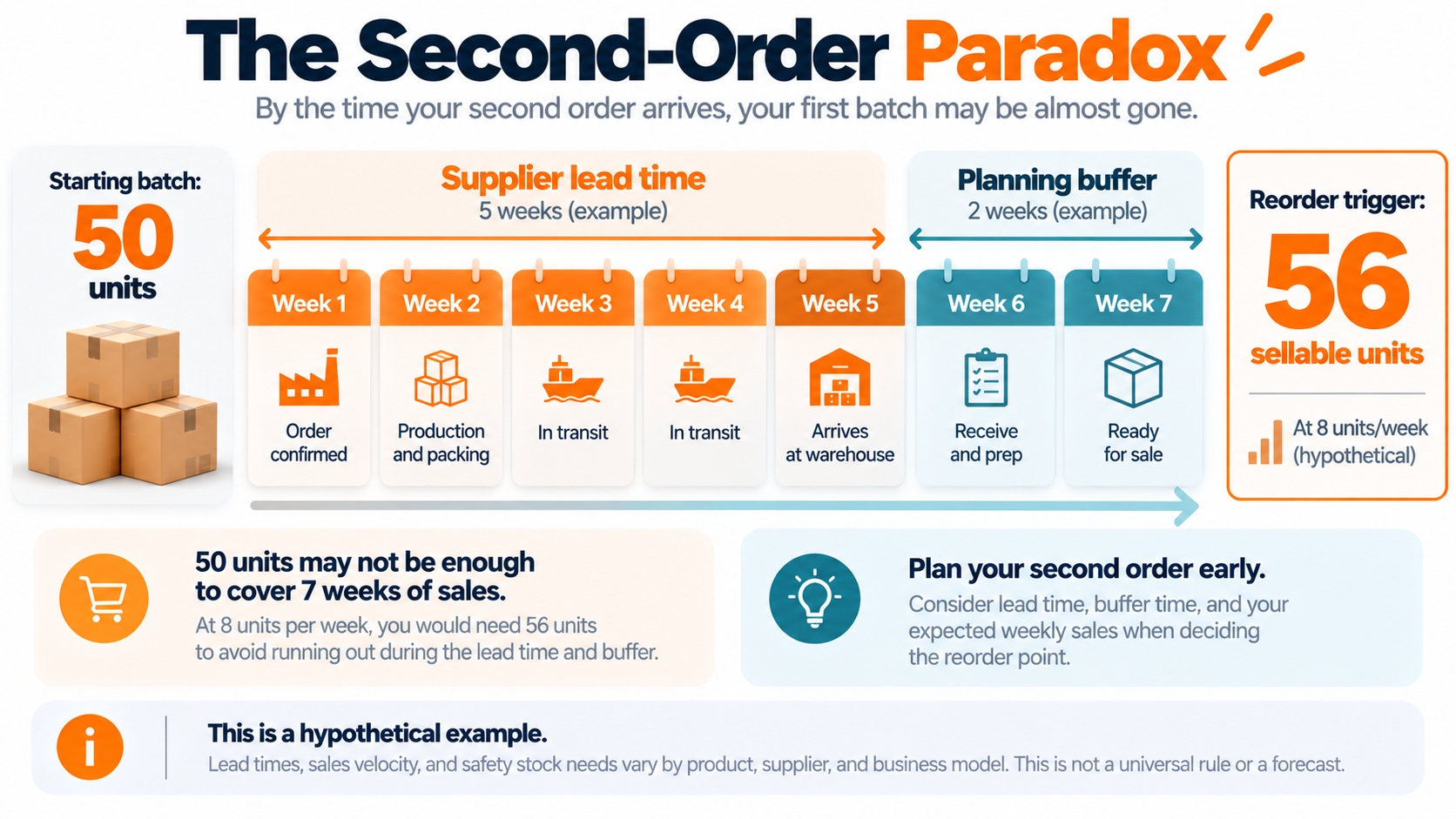
Illustrative inventory arithmetic: If your business sells eight units per week, confirmed supplier replenishment takes five weeks, and you choose a two-week buffer, your planning reorder point is roughly (5 + 2) × 8 = 56 sellable units. A first batch of 50 units starts below that assumed reorder point. That is not an Amazon threshold; it shows why a long-lead-time SKU may need additional cash before a seller has learned enough from the first sell-through period.
For volatile demand, use actual sales and lead-time distributions rather than a fixed weekly average. Separate stock you can sell from inbound, reserved, or unsellable units, and model seasonality. A restock must also survive the latest competitor price and supplier quotation.
Inventory exposure
How much cash remains in stock or inbound inventory when the next purchase must be funded?
Reorder reliability
Will the same permitted SKU, pack configuration, invoice detail, and source relationship recur?
Margin survival
Does the new landed cost still support a viable price if competing offers fall?
What to Learn From the First Batch
A small permitted batch can answer more than a category-average score if you record the inputs and failures consistently. The first batch should be designed to expose the model's primary uncertainty, not to maximize the appearance of top-line revenue.
- Before buying: Save the exact listing and condition, approval status, supplier quotation and original documents, delivered cost assumptions, and worst-case price.
- On receipt: Record quantity received, defects, item mismatches, processing time, and how many units become eligible to list.
- While selling: Observe your own actual orders, price realized, offer competition, fees, advertising, cancellations, and inventory aging. Keep estimates separate from order records.
- After a suitable follow-up window: Match returns and fees back to the original batch, compare realized contribution with the purchase estimate, and ask the supplier to quote the next order.
For wholesale, the decision is whether the SKU deserves an opening or repeat order at the next supplier price and minimum. For arbitrage, determine whether the profit justified sourcing time without assuming the deal returns. For supplier-direct fulfillment, verify order accuracy and service standards across actual test orders and returns before expanding exposure.
The pilot is successful only when: The selling route is permitted, supplier records are defensible, customers receive the right product, realized contribution is acceptable, and the next inventory decision can be made with new evidence.
When to Walk Away
Stop or defer buying if you cannot substantiate eligibility, the actual source, product identity, or a compliant way to fulfill the offer. A margin calculator should not outrank those conditions. The deal also deserves rejection when its profit depends on one exceptional retail coupon, a temporarily absent competitor, or a supplier who cannot repeat the shipment.
The best reseller is not necessarily the seller finding the largest sticker-price gap. The stronger business is one that can reproduce a documented purchase, hold its own in the offer stack, fund replenishment, and still make sense after fees and ordinary mistakes.
FAQs
What is an Amazon reselling business?
It is a business that sources products and sells them in the Amazon store, usually on an existing eligible product detail page. The exact sourcing route, seller approvals, inventory ownership, and fulfillment method change the costs and risks. Amazon Resale is a separate consumer-facing used and open-box offer, not the generic name for the business.
Is retail arbitrage allowed on Amazon?
Reselling retail-purchased products can be possible when the product, source, documents, brand rights and offer meet Amazon requirements. A retail receipt does not guarantee acceptance for a restricted brand or later supply-chain review. Check eligibility before acquiring inventory.
Does wholesale guarantee access to a branded ASIN?
No. A commercial supplier relationship and the ability to purchase authentic goods do not automatically resolve account-level listing restrictions. Follow any product or brand approval request in Seller Central and retain suitable source documents.
Can I buy an item from another online store and have it shipped to my Amazon customer?
Retail-to-retail shipping that identifies the other retailer as seller, or carries its identity on invoices, packing slips, or external packaging, violates Amazon's dropshipping policy. Supplier-direct fulfillment requires you to be the seller of record and responsible for delivery and returns.
Does a strong Best Sellers Rank mean the reseller will win sales?
No. BSR describes relative sales performance for the product, not how orders will be divided across competing sellers. Check offer conditions, delivery, stock, seller performance, and the exact variation before projecting your own sales.
What should I count as profit from a resale deal?
Start with revenue less actual product, inbound, marketplace, fulfillment, prep, variable advertising, and expected net post-sale costs. That produces contribution, not final net profit; allocate overhead, sourcing labor, and tax consistently when evaluating the business.
What makes wholesale more scalable than a one-time flip?
A verifiable supplier relationship, repeatable product configuration, stable documentation, sufficient inventory and lead times, and margins that still work at the next landed cost can create a repeatable path. A larger initial purchase alone does not make the model scalable.
How can SellerSprite help evaluate a potential reseller ASIN?
Product Research and the extension can provide historical BSR, price, ratings, sales estimates, and other supported competitor signals. Use them to narrow research and monitor price behavior, then verify selling privileges, source records, fee estimates, and actual offer-level performance outside those tools.
References
- Amazon: Guide to Reselling in Amazon Stores. View
- Amazon: What Amazon Resale Means for Shoppers. View
- Amazon: How to Find Wholesalers. View
- Amazon: Sell Branded Products and Apply for Approval. View
- Amazon Seller Central: Responsible Sourcing Documentation. View
- Amazon Seller Central: Drop Shipping Policy. View
- Amazon: Selling Fees and Plans. View
- Amazon: Estimate Fees with Revenue Calculator. View
- Amazon: Featured Offer and Pricing Strategies. View
- SellerSprite: Four Amazon Reselling Models Compared. View
- SellerSprite: Product Research Guide. View
- SellerSprite: Competitor Research Guide. View
By SellerSprite Content Team
The SellerSprite Content Team includes professionals focused on Amazon marketplace research, data analysis, and ecommerce content. Its ongoing work examines product and seller competition, pricing patterns, sourcing strategy, marketplace search behavior, and inventory risk. By studying these connected areas, the team develops evidence-led resources for operators making sourcing and growth decisions across Amazon marketplaces.
Last reviewed: October 20, 2026