By SellerSprite Content Team | Last Updated: November 25, 2026
Amazon sellers have access to more marketplace data than ever before. Yet finding the right information, interpreting it correctly, and turning it into profitable business decisions remain some of the biggest challenges in ecommerce.
A product with impressive monthly sales may belong to a market dominated by established brands. A keyword with substantial search volume may attract shoppers who rarely convert. A competitor with thousands of reviews may still leave important customer needs unmet.
These are the kinds of questions SellerSprite is designed to help sellers answer.
SellerSprite is an AI-powered Amazon seller software platform that combines product research, category intelligence, keyword analysis, competitor research, advertising insights, review analysis, listing optimization, and performance monitoring.
But what does that combination actually mean for your Amazon business? How useful are its sales estimates and keyword data? Which features deserve your attention in 2026? And is the subscription worth the investment?
This comprehensive SellerSprite review examines the platform's capabilities, practical applications, recent improvements, pricing, strengths, and limitations to help you make an informed decision.
SellerSprite Review 2026: Quick Verdict
SellerSprite is worth considering for Amazon sellers who need comprehensive product research, keyword intelligence, competitive analysis, AI-powered consumer insights, and ongoing market monitoring within one platform.
- Best for: Private label sellers, Amazon FBA businesses, established brands, product development teams, and agencies.
- Core strength: Connecting market demand, competitor performance, customer needs, keyword opportunities, and profitability analysis.
- Pricing: Paid subscriptions start at $39 per month.
- Free trial: Three days without a credit card.
- Marketplace coverage: Full feature availability across 10 core Amazon marketplaces, with selected features available in additional markets.
- Biggest consideration: The extensive range of research modules requires some initial learning to use effectively.
- Overall assessment: A particularly strong choice for sellers who make recurring product, keyword, advertising, and competitive research decisions.
Table of Contents
- What Is SellerSprite?
- What's New in SellerSprite in 2026?
- SellerSprite Features: An In-Depth Review
- SellerSprite Browser Extension Review
- SellerSprite MCP and API: Research Beyond the Dashboard
- How Accurate Is SellerSprite?
- SellerSprite in Practice: From Market Discovery to Product Launch
- Supported Amazon Marketplaces
- SellerSprite Pricing: Plans, Limits, and Value for Money
- SellerSprite Pros and Cons
- Who Should Use SellerSprite?
- How to Evaluate SellerSprite During Your Free Trial
- Final Verdict: Is SellerSprite Worth It in 2026?
- Frequently Asked Questions
What Is SellerSprite?
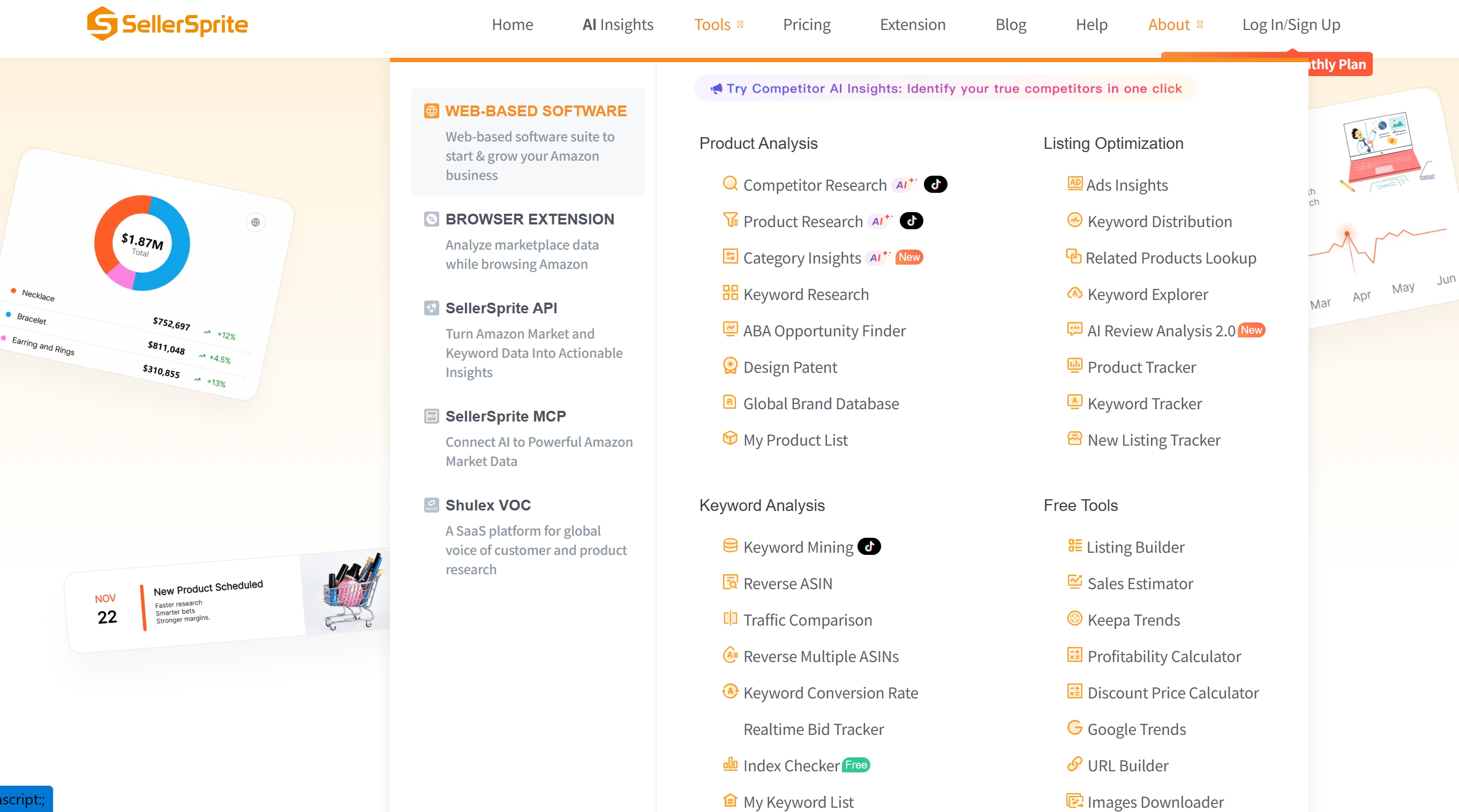
SellerSprite is a comprehensive Amazon marketplace intelligence platform designed to help sellers discover product opportunities, understand customer demand, analyze competitors, optimize listings, research advertising strategies, and monitor market performance.
The platform operates through a web-based software suite and a browser extension, allowing sellers to conduct detailed research within a dedicated dashboard or access product and keyword insights while browsing Amazon directly.
According to its official website, SellerSprite has attracted more than 2 million registered users worldwide, reflecting its adoption among individual sellers, established ecommerce businesses, and professional Amazon research teams.
Its value comes from bringing several types of marketplace intelligence together. Instead of analyzing a product's sales performance, keywords, customer reviews, and competitive positioning independently, sellers can connect these signals throughout the product lifecycle.
SellerSprite at a Glance
The following overview summarizes the platform's main characteristics and the business decisions it supports.
| Category | Details |
|---|---|
| Product Type | Amazon seller research and marketplace intelligence software |
| Core Capabilities | Product research, market analysis, keyword research, competitor analysis, PPC insights, consumer intelligence, and monitoring |
| Access Methods | Web application, browser extension, and separately available MCP and API services |
| AI Capabilities | AI Review Analysis, Category AI Insights, competitor insights, historical trend analysis, and listing assistance |
| Core Marketplaces | US, JP, UK, DE, FR, IT, ES, CA, IN, and MX |
| Starting Price | $39 per month |
| Free Access | Free utilities, limited feature access, free browser extension installation, and a three-day trial |
| Ideal Users | Amazon FBA and FBM sellers, private label brands, product researchers, and agencies |
What's New in SellerSprite in 2026?
SellerSprite's development in 2026 reflects a broader change in ecommerce software: research platforms are becoming more focused on interpreting marketplace signals and connecting them to specific business decisions.
Several current capabilities and recent updates illustrate how SellerSprite is evolving beyond conventional product discovery and keyword databases.
More Detailed Category and Consumer Intelligence
The updated Category Insights experience provides a more comprehensive view of Amazon subcategories, combining market performance, competitive concentration, listing distributions, search behavior, and purchasing indicators.
Available demand-related metrics, including search performance, return rates, and search-to-purchase ratios, help sellers examine how consumer interest translates into actual shopping behavior.
AI Review Analysis 2.0 complements this market-level perspective by helping sellers investigate the customer experiences behind product ratings. Its value is particularly evident during product development, when recurring complaints and unmet expectations can inform design, packaging, and feature decisions.
Stronger Keyword and Advertising Research
SellerSprite's keyword research ecosystem now places greater emphasis on conversion potential and advertising economics alongside traditional search volume and competition metrics.
Keyword Conversion Rate provides additional insight into purchasing behavior associated with search terms, while Realtime Bid Tracker helps sellers investigate suggested advertising bids before making campaign adjustments.
Together, these capabilities make it easier to distinguish high-volume keywords from commercially attractive keywords and investigate whether the cost of acquiring traffic is compatible with a product's margins.
A More Configurable Browser Extension
The November 17, 2026 release of SellerSprite Chrome Extension version 5.0.7 introduced several practical improvements documented in the official browser extension guide.
- Performance Settings: Users can enable or disable selected data modules according to their research needs, reducing unnecessary information on Amazon pages.
- Product Highlight History: Keepa Trends now allows sellers to examine historical changes to product highlights and compare previous and updated content.
- More Focused Product Research: The extension's Product Research view displays best-selling variations, while Competitor Research remains available for examining the broader variation family.
- Improved AI Review Analysis Navigation: Users can switch between the available analysis modes more conveniently.
These improvements address practical research challenges, including information overload, variation-level interpretation, and monitoring how competitors modify their listings over time.
Amazon Data Access Through AI Assistants
SellerSprite MCP extends marketplace research into compatible AI environments, allowing users to retrieve SellerSprite data through natural language requests rather than manually navigating individual dashboards.
Alongside its Open API services, MCP creates additional research possibilities for teams that want to incorporate Amazon intelligence into AI-assisted analysis, internal reporting, or customized business workflows.
For conventional sellers, the web application and browser extension remain the most direct ways to use SellerSprite. MCP and API access become particularly relevant when research needs extend beyond the existing software interface.
SellerSprite Features: An In-Depth Review
SellerSprite offers a broad collection of tools, but the most useful way to evaluate them is through the decisions Amazon sellers face at different stages of their business.
From selecting a market to monitoring an established listing, the following feature groups represent the platform's core commercial value.
1. Product Research and Market Intelligence
Product discovery is one of SellerSprite's foundational capabilities. Its research tools allow users to explore potential products at both individual ASIN and broader market levels.
This distinction matters because a successful product and an attractive market are not necessarily the same thing. A bestselling ASIN can perform exceptionally well within a category that offers limited opportunities for new entrants.
Product Research
SellerSprite Product Research allows sellers to filter Amazon products using commercially relevant criteria such as estimated sales, revenue, selling price, BSR, rating count, listing age, product dimensions, and weight.
Instead of relying on a universal definition of a winning product, sellers can build research criteria around their available capital, sourcing capabilities, preferred product characteristics, and launch strategy.
For example, a seller working with a limited initial inventory budget might prioritize compact products with manageable sourcing costs, while an established home goods brand might focus on related products that complement its existing catalog.
The ability to customize discovery criteria makes Product Research useful for both exploratory research and the systematic screening of product ideas.
Category Insights and Market Analysis
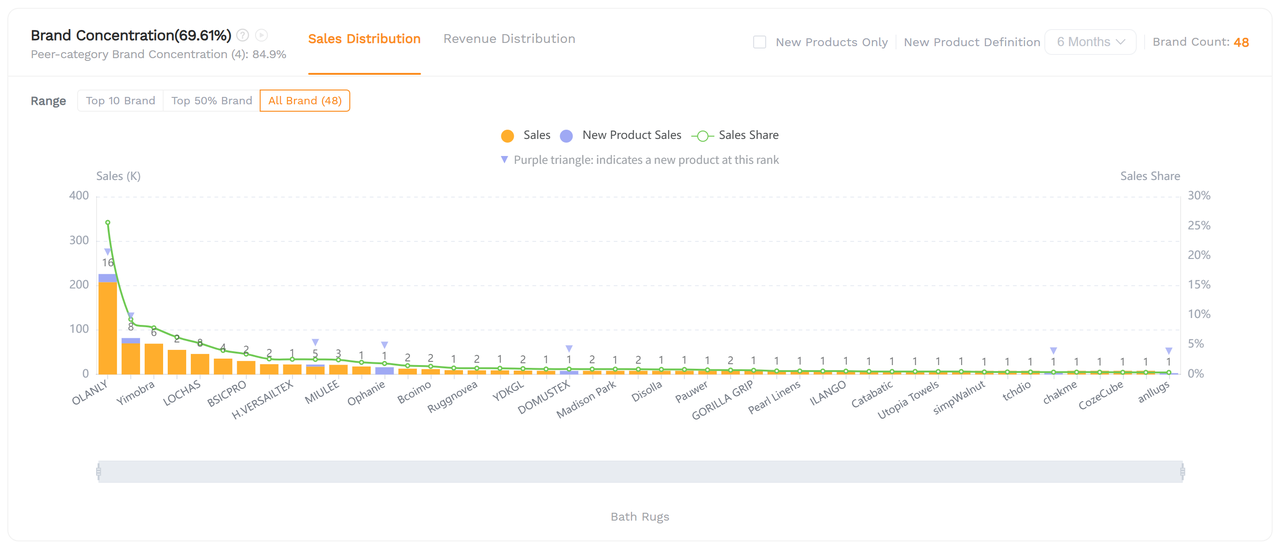
Category Insights takes a broader approach by helping sellers examine the structure and performance of Amazon categories and subcategories before committing to individual product ideas.
The updated Category Insights and Market Analysis workflow supports research into several commercially important dimensions:
- Estimated market size and historical sales trends.
- Brand, seller, and product concentration.
- New product performance and listing age distribution.
- Price ranges, ratings, and review count distributions.
- Search demand, seasonality, and purchasing behavior.
- Return rates and search-to-purchase ratios, where available.
Consider two niches with similar estimated monthly revenue. If the first is dominated by a handful of established brands while the second contains multiple recently launched products generating meaningful sales, the second may offer a more accessible competitive environment.
This is where category-level research provides insights that individual sales estimates alone cannot deliver.
Amazon's own Product Opportunity Explorer also emphasizes customer demand, competition, reviews, and returns when identifying unmet market needs. SellerSprite complements this approach with additional product-level filters, competitive analysis, historical insights, and keyword research workflows.
Competitor Research and Variation Analysis
Competitor Research allows sellers to move from market-level opportunities to the performance of individual Amazon listings and their variations.
Users can investigate estimated monthly sales, revenue, historical pricing, BSR, listing characteristics, ratings, and available variation-level performance data.
Variation analysis is particularly valuable for products sold in multiple colors, sizes, quantities, or configurations. A product family may generate substantial revenue while demand is heavily concentrated in only one or two variations.
Understanding that distribution can influence initial SKU selection, inventory allocation, product design, and sourcing decisions.
Review Assessment: Product Research
SellerSprite's product research capabilities are particularly valuable when sellers need to investigate both market attractiveness and individual product performance. Combining Category Insights, Product Research, and Competitor Research creates a more complete assessment of market entry potential than relying on a single product finder.
2. Keyword Research and Traffic Intelligence
Product research explains what customers may want to buy. Keyword research explains how those customers search for products and how competing listings become visible to them.
SellerSprite's keyword tools cover both the discovery of new search terms and the investigation of existing competitors' search visibility.
Keyword Mining and Keyword Research
Keyword Mining helps sellers expand seed keywords into related search terms, including more specific product attributes, customer use cases, and long-tail phrases.
The resulting keyword lists can support market research, listing development, advertising campaign planning, and the identification of adjacent product opportunities.
For example, a broad search term such as "desk organizer" may lead to more specific opportunities involving adjustable compartments, compact office spaces, cable storage, or particular desk configurations.
These search patterns can reveal meaningful differences in customer intent that are less obvious when researching products through category rankings alone.
Reverse ASIN and Competitor Traffic Analysis
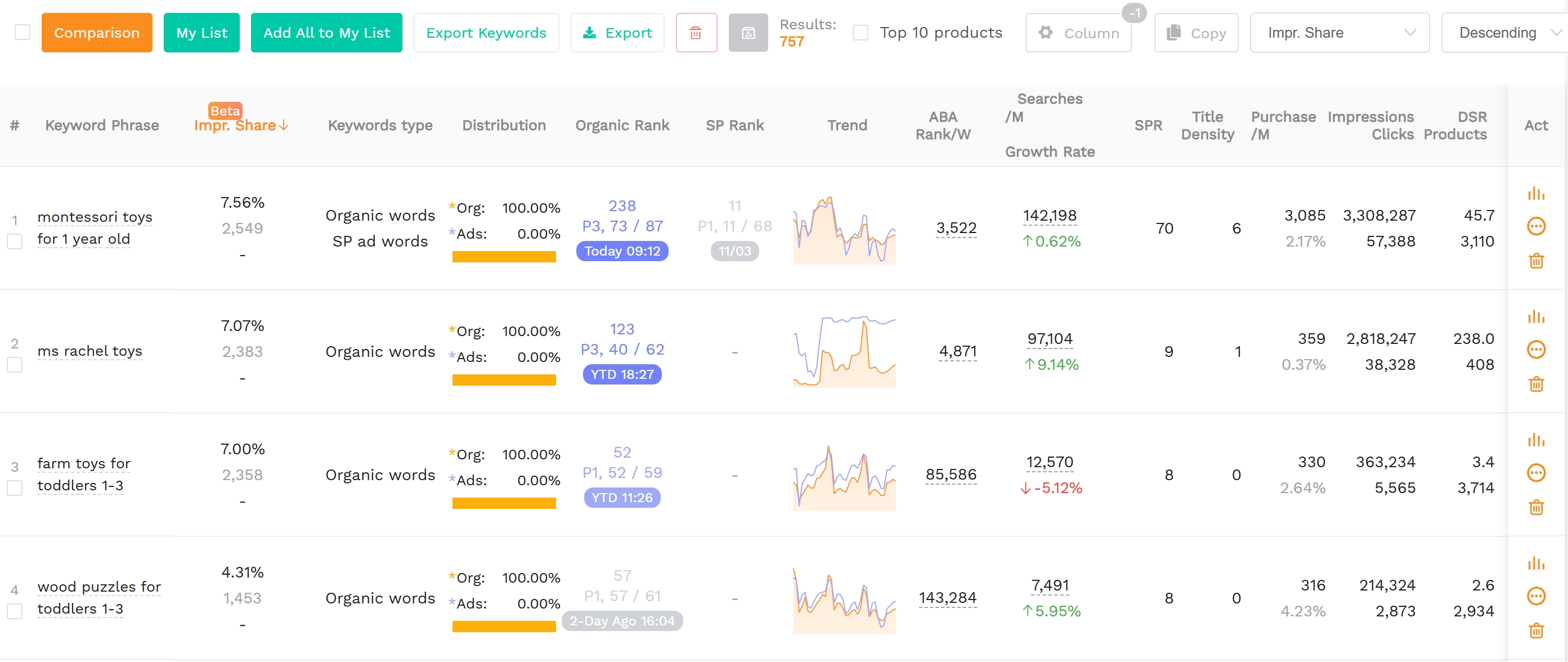
Reverse ASIN is one of SellerSprite's most useful competitive intelligence features. It allows sellers to enter a competitor's ASIN and investigate the search terms associated with its visibility on Amazon.
According to the official Reverse ASIN guide, the tool identifies keywords for which a product appeared within the first three pages of Amazon search results during the preceding 30 days.
These insights can help sellers examine:
- The search terms contributing to competitor visibility.
- Organic and sponsored search presence.
- Keyword search demand and relevance.
- Traffic distribution across important search terms.
- Differences in keyword visibility among product variations.
Reverse Multiple ASINs extends this process by combining keyword research across several competing products. This is particularly useful when developing a keyword strategy based on the broader competitive landscape rather than a single successful listing.
A seller can identify terms shared by multiple competitors, discover keyword gaps, and investigate specific searches that may offer alternative traffic acquisition opportunities.
Keyword Conversion Rate and Brand Analytics Insights
Search volume indicates the scale of customer interest, but purchasing behavior helps determine the commercial quality of that interest.
SellerSprite's Keyword Conversion Rate and related keyword analysis capabilities provide additional ways to investigate how search demand translates into buying activity.
Amazon's Brand Analytics similarly includes search query, impression, click, cart addition, and purchase data to help eligible brands understand customer behavior throughout the shopping journey.
SellerSprite brings relevant marketplace-level keyword indicators into a broader research workflow, making it easier to assess search terms alongside competitor visibility, keyword relevance, and potential advertising costs.
A Better Way to Evaluate Keywords
Assess a keyword using four dimensions: product relevance, search demand, purchasing behavior, and traffic acquisition cost. A highly relevant search term with moderate volume may offer greater commercial value than a broad keyword with substantial traffic but weak purchase intent.
3. AI Review Analysis and Product Development
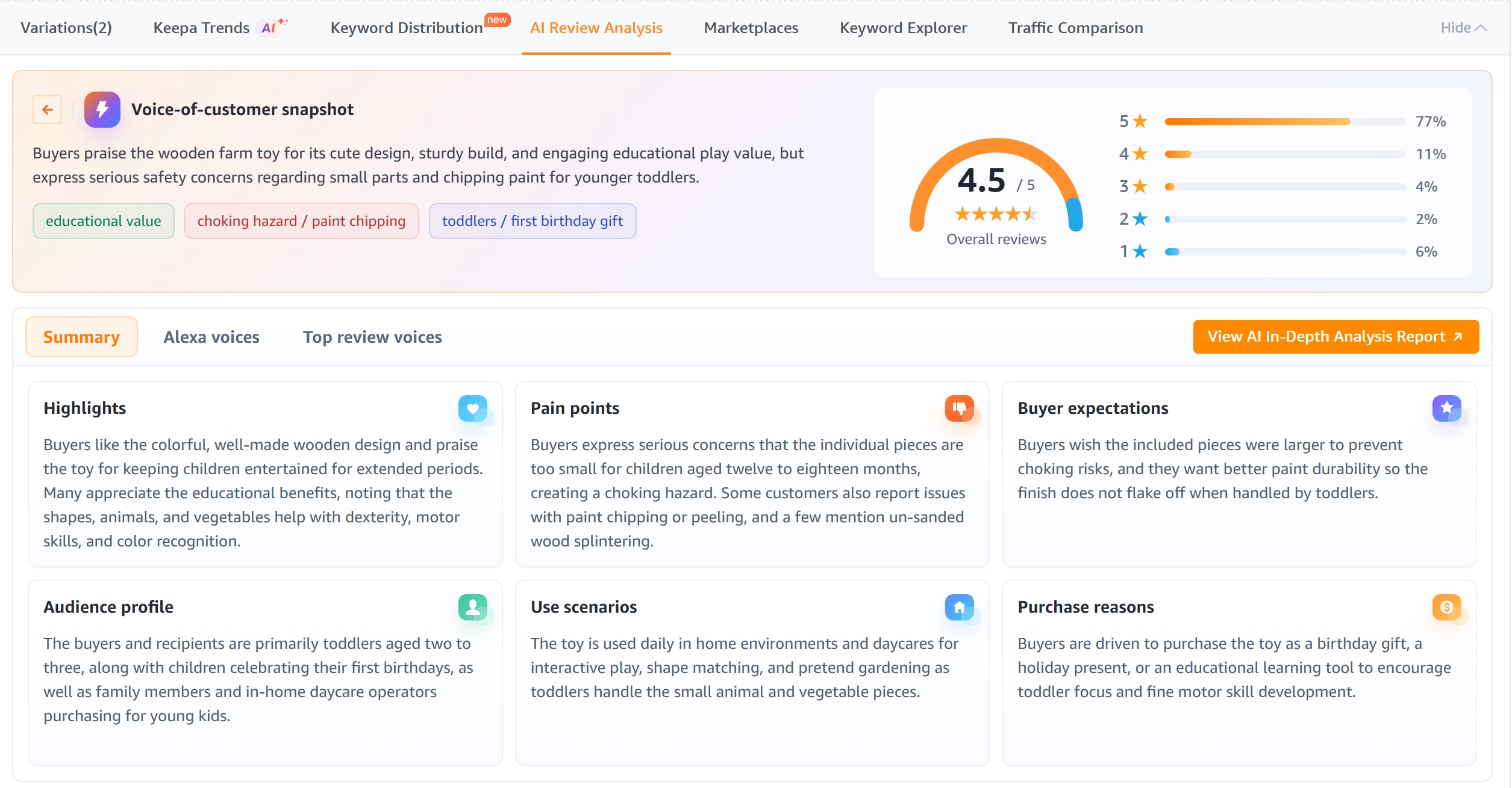
AI Review Analysis is one of SellerSprite's most commercially meaningful features because it helps sellers understand the customer experiences behind product performance.
Traditional product research metrics can show that a listing has a 4.2-star rating or several thousand reviews. AI-assisted review analysis can help explain why customers are satisfied or dissatisfied and which improvements might matter most.
SellerSprite AI Review Analysis 2.0 helps organize customer feedback into actionable research dimensions, including product strengths and weaknesses, purchase motivations, usage scenarios, expectations, and recurring pain points.
Rather than reading hundreds of reviews individually, sellers can use structured analysis to identify themes worth investigating and then examine the underlying customer feedback in greater detail.
Turning Customer Feedback Into Product Specifications
The strongest use case for review analysis is translating consumer feedback into specific product development decisions.
Consider a seller researching reusable lunch containers. Potentially important review themes might include leaking lids, difficulty opening compartments, retained food odors, or problems cleaning particular materials.
These observations could lead to different product development priorities, such as improving sealing mechanisms, redesigning closures, changing materials, or simplifying cleaning instructions.
The commercial value comes from solving a recurring customer problem and making that improvement visible to prospective buyers through product images, demonstrations, and listing content.
Beyond New Product Development
Review analysis is equally useful for improving products that are already selling.
An established seller can examine recurring complaints, identify whether particular variations generate disproportionate dissatisfaction, and discover gaps between customer expectations and listing communication.
For example, a product may receive negative feedback because customers misunderstand its dimensions rather than because the product itself is defective. In this situation, improved listing images and clearer specifications may address the problem more efficiently than changing the manufacturing process.
AI Review Analysis therefore supports product design, quality improvement, listing optimization, and more informed customer experience decisions.
4. PPC and Competitor Advertising Intelligence
Advertising research is becoming increasingly important during the product selection stage. A potentially attractive product can become commercially difficult if the cost of winning relevant search traffic consumes most of its available margin.
SellerSprite provides several tools that help investigate competitive advertising activity and potential keyword acquisition costs.
Ads Insights
Ads Insights helps sellers investigate competitors' observable sponsored advertising activity, including keyword targeting patterns, advertising placements, and changes in sponsored visibility.
By organizing observed marketplace advertising signals into inferred campaign and ad group structures, the tool provides context for understanding how competing listings pursue search traffic.
For example, sellers can investigate whether a competitor maintains a consistent advertising presence across a broad range of search terms or concentrates its visibility around a smaller group of product-specific keywords.
These observations can inform keyword selection, campaign organization, competitor targeting, and advertising opportunity research.
Competitors' private campaign budgets, actual bids, and confidential advertising reports are not directly visible. Ads Insights is most valuable for understanding observable advertising behavior and developing research hypotheses.
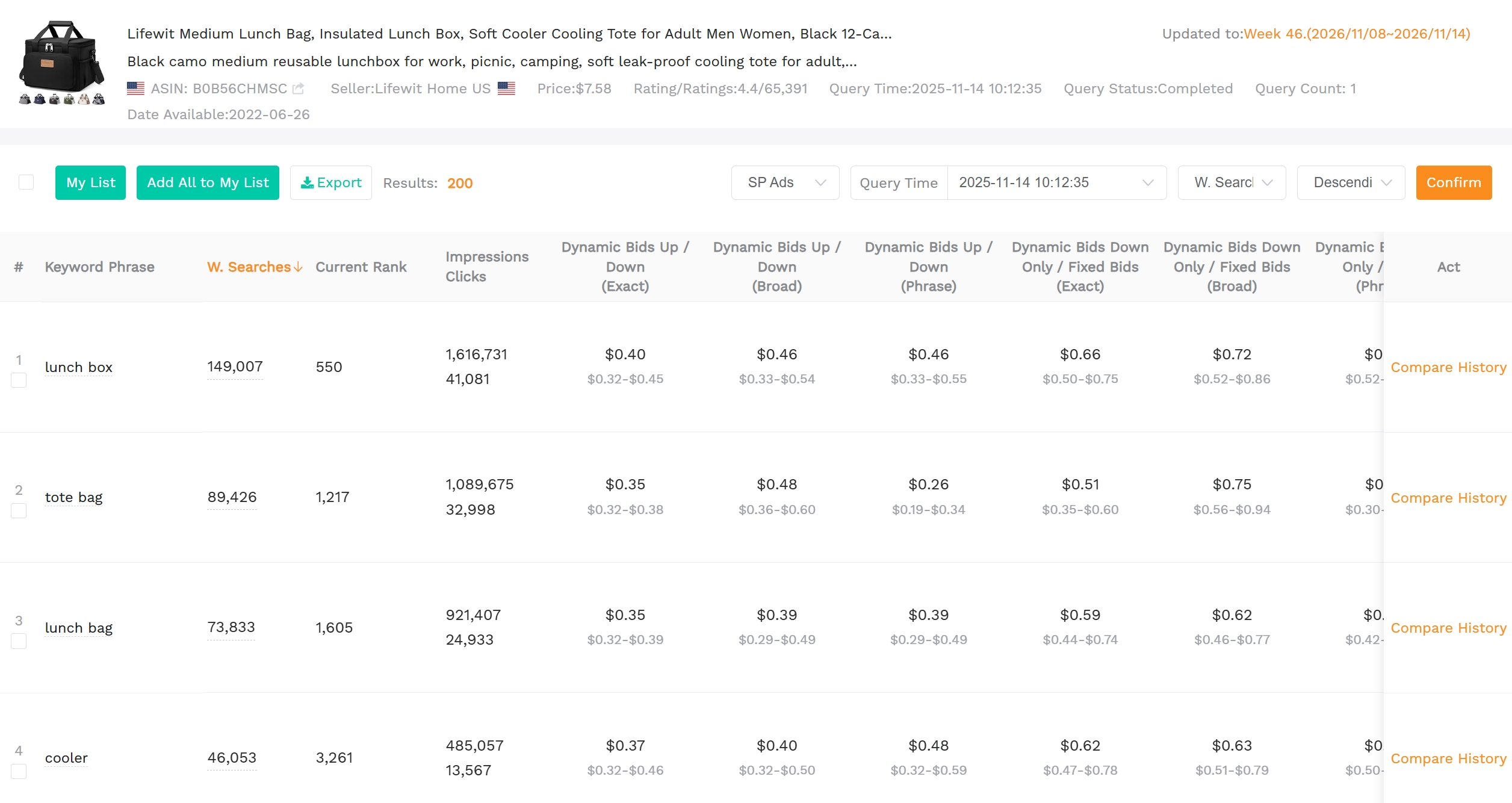
Realtime Bid Tracker
The Realtime Bid Tracker helps sellers investigate current suggested advertising bids associated with relevant products and keywords.
This information is useful when evaluating potential advertising expenses during product research or reviewing keyword targeting decisions for existing campaigns.
Because Amazon Sponsored Products uses a cost-per-click advertising model, the relationship between click costs and conversion rates has a direct impact on advertising profitability.
Key Formula: Break-Even CPC
Break-even CPC = Contribution per unit before advertising × Expected advertising conversion rate
For example, if a product generates $10 in contribution before advertising and its expected advertising conversion rate is 12%, the break-even CPC is $1.20.
A suggested bid close to or above this level deserves further investigation, particularly because sellers also need sufficient contribution to cover fixed operating expenses and generate profit.
Combining Realtime Bid Tracker with keyword research and conversion assumptions allows sellers to investigate traffic economics before committing to an advertising strategy.
5. Listing Optimization and Keyword Indexing
Once sellers have identified a product opportunity and researched relevant keywords, the next challenge is creating a listing that communicates product value while remaining discoverable through Amazon search.
SellerSprite provides tools for organizing keyword research, developing listing content, evaluating keyword relevance, and investigating search visibility.
- AI Listing Builder: Helps transform keyword research and product information into structured Amazon listing content.
- Index Checker: Helps investigate whether a product is indexed for selected search terms.
- Relevance Check: Supports keyword screening by examining the relationship between search terms and selected products.
- Keyword Explorer: Provides additional insight into relevant Brand Analytics search terms and available click and conversion share indicators.
- Keyword Distribution: Helps examine product visibility across different search terms and placement types.
These tools are particularly useful when sellers need to prioritize relevant keywords rather than simply insert as many search terms as possible into their listings.
A strong listing should communicate why the product is appropriate for the shopper's specific need. Keyword optimization works most effectively when it supports that communication rather than competing with it.
6. Product, Keyword, and New Listing Tracking
Research is most useful when it continues after the initial product selection or listing launch. Changes in pricing, rankings, competitor activity, and market demand can quickly alter the conditions under which a business decision was made.
SellerSprite provides dedicated monitoring tools to help sellers follow these developments over time.
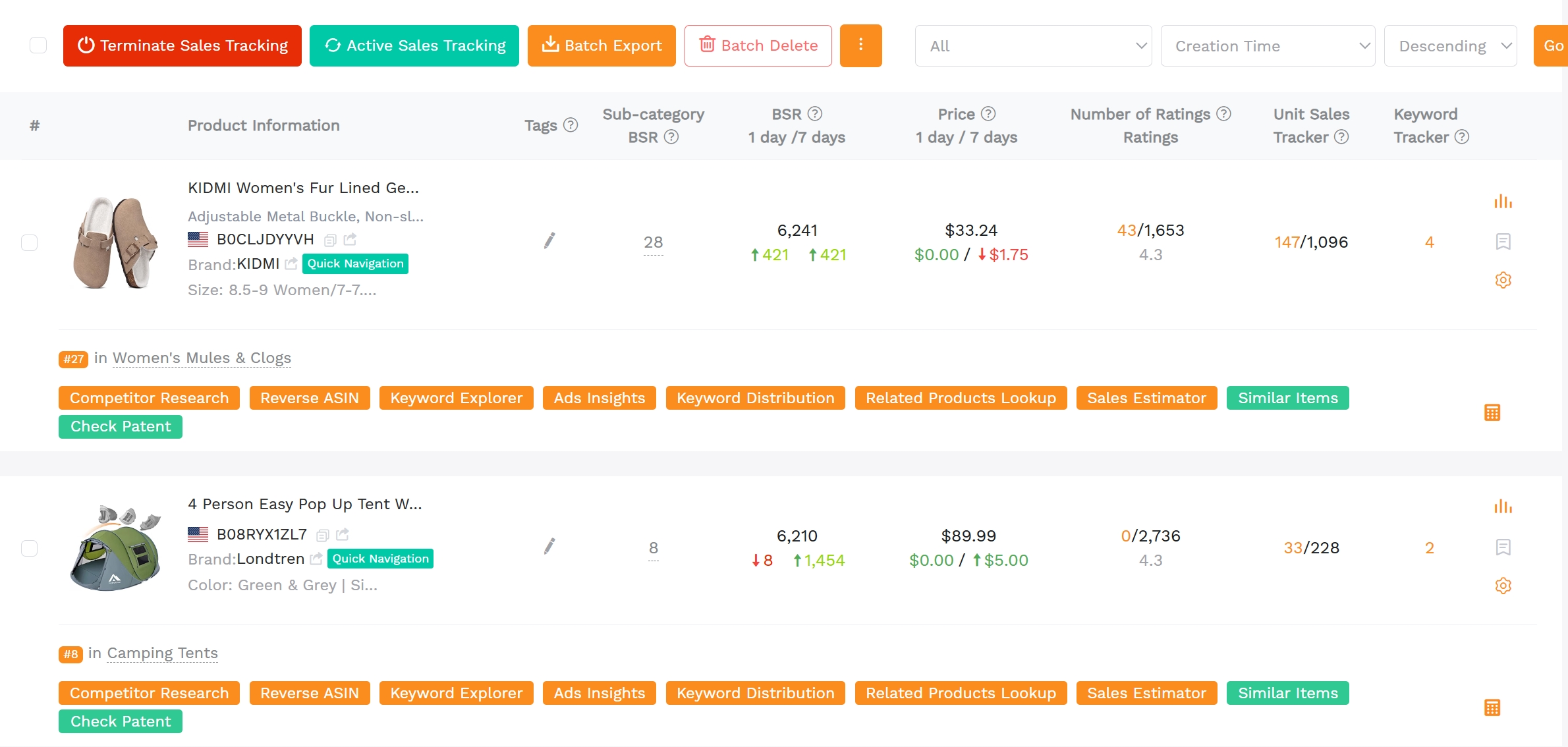
Product Tracker
Product Tracker helps sellers monitor selected Amazon products and examine changes in available performance indicators, including BSR, pricing, ratings, and sales trends.
It is particularly useful for maintaining a shortlist of products under consideration, following direct competitors, and identifying changes that warrant further research.
Keyword Tracker
Keyword Tracker allows sellers to monitor the search visibility of their own or competing products for selected keywords.
By examining ranking changes over time, sellers can investigate the potential impact of listing updates, advertising adjustments, competitor activity, and seasonal changes in search demand.
It also supports more disciplined keyword optimization by helping sellers focus on performance trends rather than isolated search result observations.
New Listing Tracker
New Listing Tracker helps sellers monitor new products introduced by selected competing stores.
For businesses operating in competitive or fast-changing niches, following new competitor listings can reveal product line extensions, emerging product configurations, and potential changes in market positioning.
This is particularly valuable for brands that regularly expand their catalogs and need to recognize new competitive threats before they become established bestsellers.
7. AI Insights and Profitability Tools
SellerSprite also offers analytical tools that help users interpret complex market information and evaluate the financial viability of potential products.
Category AI Insights, AI Competitor Insights, and Keepa AI Insights help summarize relevant marketplace data and identify patterns that may deserve further investigation.
These features can be particularly useful when comparing several products or markets and preparing structured research findings for colleagues, clients, or management teams.
The Profitability Calculator supports the financial side of product evaluation by allowing sellers to enter relevant costs and examine estimated product economics. The Sales Estimator, Google Trends integration, Listing Builder, and other utilities support additional stages of the research process.
For a complete financial assessment, sellers should combine these tools with current supplier quotations and the applicable Amazon selling fee schedules, including referral fees, fulfillment expenses, and other relevant charges.
Where SellerSprite's AI Tools Add the Most Value
AI is most useful when it connects relevant evidence to a specific business question. Reviewing market concentration, explaining changes in competitor performance, summarizing recurring customer complaints, and organizing product development priorities are practical applications that complement SellerSprite's underlying marketplace data.
SellerSprite Browser Extension Review
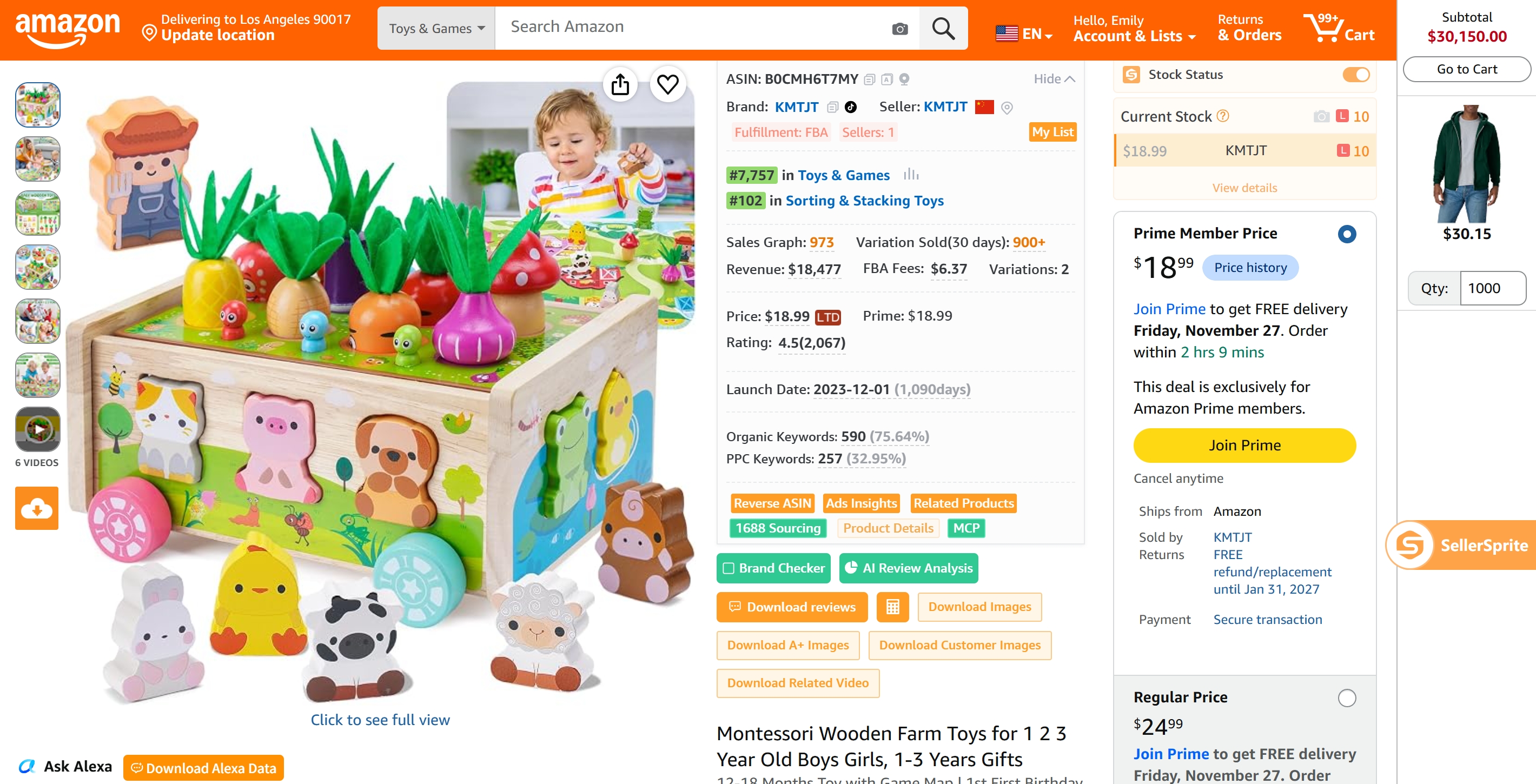
SellerSprite's browser extension is one of the platform's most convenient research capabilities because it brings Amazon marketplace data directly into the browsing experience.
Instead of repeatedly copying ASINs and switching between Amazon and a separate dashboard, sellers can examine relevant product information while viewing search results, product detail pages, rankings, and other supported Amazon pages.
The extension is available through the official Chrome Web Store, where users can also review its publisher information, permissions, and publicly submitted ratings.
What Can You Do With the SellerSprite Extension?
The extension supports several types of research directly within the Amazon shopping interface.
- Quick View: Access product data and relevant performance indicators while browsing Amazon search results.
- Product and Competitor Research: Compare competing listings and investigate product family performance.
- Keepa Trends: Examine historical changes in product pricing, BSR, reviews, and other supported listing indicators.
- Variation Sales: Investigate available variation-level sales estimates and identify potentially important product configurations.
- Stock Status: Check available competitor inventory information on supported product pages.
- Reverse ASIN and Keyword Explorer: Investigate product-related keywords and available search performance indicators.
- AI Review Analysis: Examine customer experiences and product improvement opportunities.
- Design Patent and Brand Research: Access additional information that supports preliminary product and intellectual property research.
Historical Trends and Competitor Listing Changes
Keepa Trends adds historical context to the information displayed on Amazon product pages. Sellers can investigate how product pricing, sales rankings, reviews, and selected listing attributes have changed over time.
The ability to examine changes to product highlights is particularly relevant for competitive intelligence. A seller can identify when competing listings modified important product messaging and investigate whether other performance indicators changed around the same period.
These observations can help generate hypotheses about competitor optimization strategies and provide useful context for planning listing improvements.
Browser Extension vs. Web Application
The extension and web application are complementary research environments rather than competing products.
The extension is especially useful for investigating specific products, reviewing Amazon search results, and accessing data within the marketplace browsing experience.
The web application is more suitable for large-scale product screening, detailed category analysis, multi-ASIN keyword research, structured data exports, and ongoing monitoring workflows.
Extension Performance Tip
Use the Performance Settings introduced in version 5.0.7 to enable only the modules relevant to your current research task. Store Overview and Stock Status are disabled by default in this version and can be enabled whenever needed.
SellerSprite MCP and API: Research Beyond the Dashboard
One of the most significant developments in Amazon research software is the ability to connect structured marketplace data with external AI assistants and custom applications.
SellerSprite offers two additional access methods for businesses interested in these workflows: MCP and Open API.
What Is SellerSprite MCP?
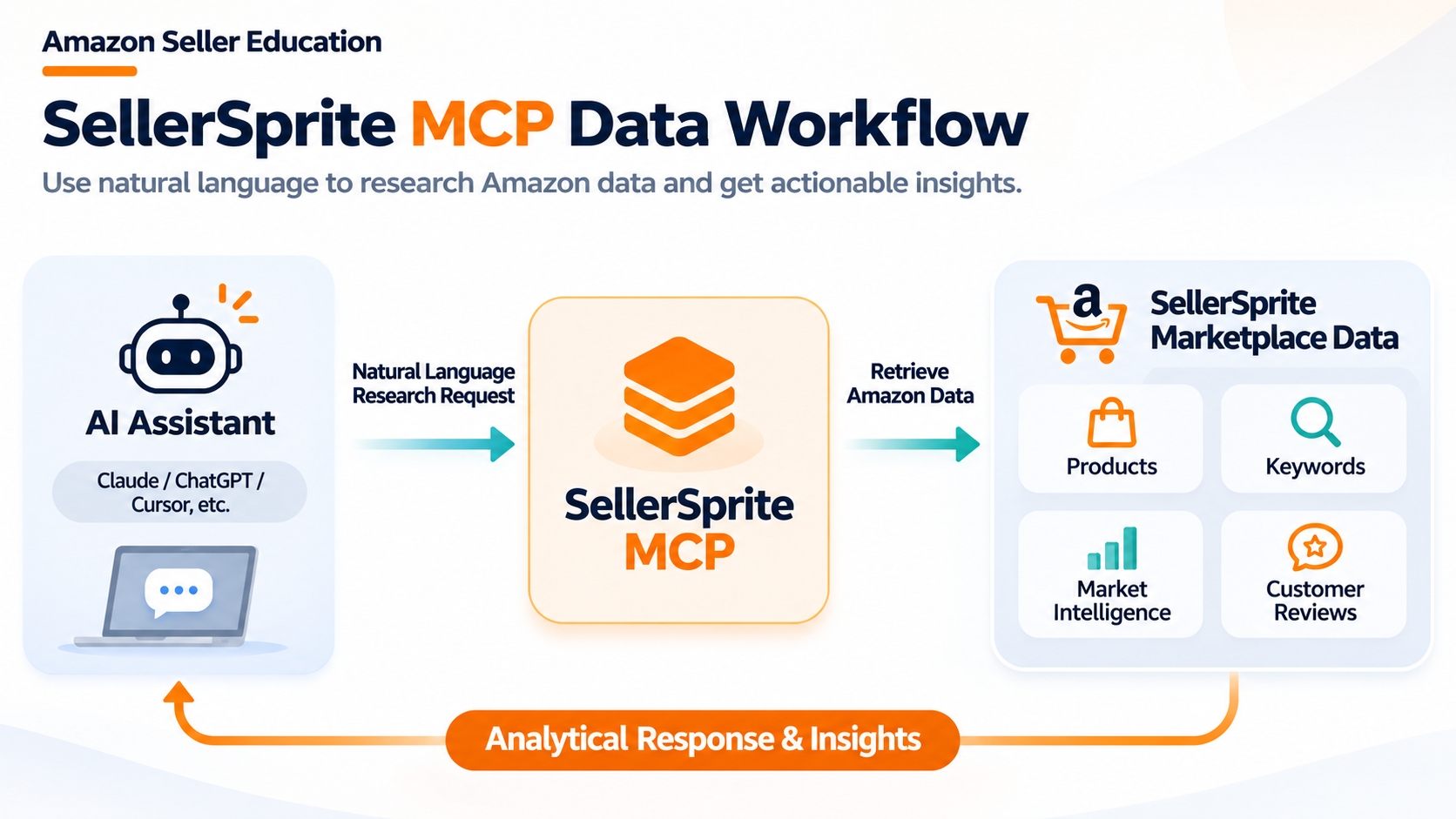
SellerSprite MCP uses the Model Context Protocol, an open standard that allows compatible AI applications to connect with external tools and data sources.
Once configured in a supported AI client, SellerSprite MCP allows users to retrieve available Amazon marketplace data using natural language requests. The AI assistant can then use the returned information to support analysis, answer follow-up questions, and organize findings.
Potential applications include:
- Comparing relevant Amazon products based on estimated sales and pricing.
- Researching competitor keywords and search demand.
- Investigating market size and competitive concentration.
- Analyzing customer review data.
- Preparing structured product research reports.
For example, instead of manually researching several competing products and combining the results into a separate document, a user could ask a compatible AI assistant to retrieve available SellerSprite data and organize the findings according to specific research criteria.
SellerSprite Open API
SellerSprite Open API is intended for developers and businesses that want to retrieve Amazon marketplace data programmatically.
It is particularly relevant for custom dashboards, internal analytics systems, structured data processing, automated reporting, and research applications requiring direct control over requests and returned data.
The appropriate access method depends on the intended workflow. MCP is designed around AI-assisted interactions, while API access is more suitable for software integration and programmatic data processing.
Which SellerSprite Access Method Should You Use?
Web Application and Extension: Best for interactive marketplace research and everyday seller workflows.
MCP: Best for retrieving available SellerSprite data through compatible AI assistants and natural language research.
Open API: Best for developers, customized integrations, and structured programmatic analysis.
MCP and API services have separate subscriptions or usage arrangements. They are not automatically included with a conventional SellerSprite software subscription, and available tools, fields, update frequencies, and marketplace coverage can differ.
How Accurate Is SellerSprite?
Data accuracy is one of the most important questions when evaluating any Amazon seller research tool.
SellerSprite combines marketplace observations, historical data, available Amazon search intelligence, and estimation models. Understanding the nature of each metric helps sellers determine how to interpret the information and apply it to business decisions.
Understanding Different Types of Amazon Data
Amazon research metrics can broadly be divided into observed marketplace information, historical observations, model-based estimates, and derived analytical insights.
These categories have different characteristics and should be interpreted according to the decision being made.
| Data Type | Examples | How to Use It |
|---|---|---|
| Marketplace Observations | Price, BSR, ratings, listing content, observed search positions | Examine product positioning and marketplace conditions at the relevant observation time. |
| Historical Observations | Historical pricing, BSR changes, rating trends, ranking history | Identify changes, seasonality, and longer-term competitive patterns. |
| Model-Based Estimates | Estimated product sales, revenue, and selected keyword demand metrics | Compare commercial opportunities and assess relative market performance. |
| Derived Intelligence | Competitive concentration, traffic distribution, review themes, AI insights | Interpret relationships between data points and identify actionable research opportunities. |
For competitor research, sales estimates are especially valuable because competitors' actual order records are generally unavailable to other sellers.
When these estimates are interpreted together with historical trends, BSR, price changes, customer feedback, and variation information, they can provide a useful foundation for market analysis.
How to Evaluate SellerSprite Sales Estimates
Amazon explains in its Best Sellers Rank guide that BSR reflects a product's sales performance relative to other products within its category.
Category differences, changing demand, promotions, stock availability, and product variations can all influence how marketplace indicators relate to actual sales volume.
Existing sellers who want to evaluate estimation performance can conduct their own comparison using products for which they have verified order data.
A Practical Sales Estimation Test
- Select several of your own ASINs across different sales volumes and product categories.
- Retrieve SellerSprite's sales estimates for a clearly defined period.
- Export your actual sales data for the corresponding marketplace and period from Seller Central.
- Confirm that both datasets refer to the same parent or child ASIN scope and comparable units sold.
- Calculate the difference between estimated and actual sales for each product.
- Examine whether the estimates consistently capture meaningful differences in sales volume and historical performance.
For a quantitative comparison, calculate the absolute percentage error for products with nonzero actual sales.
Absolute Percentage Error
| Estimated sales − Actual sales | ÷ Actual sales × 100%
For example, if a product records 500 actual units sold and the corresponding estimate is 460 units, the absolute percentage error is 8%.
This illustrative calculation shows how an individual estimate can be evaluated. Running the same test across multiple ASINs and time periods provides a more informative assessment of estimation performance.
Why Keyword Rankings May Differ From Your Amazon Search Results
Amazon search results can vary according to location, delivery address, device, personalization, inventory availability, and the time a search is performed.
SellerSprite's keyword tracking provides a consistent research reference based on its own marketplace observations. Individual manual searches may therefore display different ranking positions.
For ongoing optimization, trends across comparable observations are generally more informative than attempting to reproduce an isolated ranking position at a particular moment.
SellerSprite in Practice: From Market Discovery to Product Launch
The value of SellerSprite becomes clearer when its features are applied to a connected business decision rather than evaluated individually.
Consider a hypothetical private label seller exploring a cable management product for the Amazon US marketplace. The seller wants to develop a differentiated product while maintaining a manageable initial inventory investment.
The following scenario illustrates how SellerSprite can support research from market discovery through launch planning and ongoing monitoring.
Stage 1: Identify an Accessible Market
The seller begins with Category Insights to investigate relevant home office and cable management niches.
Instead of focusing only on estimated category revenue, the seller examines brand concentration, new product performance, price distribution, and historical demand trends.
The objective is to find a product segment where demand is commercially meaningful and smaller or newer listings appear capable of generating sales.
Decision supported: Which market segment deserves deeper product research?
Stage 2: Investigate the Competitive Landscape
Product Research and Competitor Research help narrow the opportunity to commercially relevant products, compare variation configurations, and understand the pricing and sales performance of direct competitors.
The seller identifies a group of comparable products rather than including every product associated with cable management.
Decision supported: Which products represent the actual competitive environment for the proposed offer?
Stage 3: Discover Specific Customer Needs
The seller uses Reverse Multiple ASINs, Keyword Mining, and AI Review Analysis to investigate how shoppers search for competing products and which customer problems remain unresolved.
In this illustrative scenario, the research points toward renters and remote workers who want under-desk cable organization without drilling into furniture.
Potential improvement opportunities include stronger attachment mechanisms, compatibility with different desk thicknesses, and clearer installation instructions.
Decision supported: What product design and customer positioning could create a meaningful reason to purchase?
Stage 4: Evaluate Keyword Acquisition Economics
The seller investigates relevant product-specific keywords and uses Realtime Bid Tracker to examine potential advertising costs.
Suppose the proposed product can generate $10 in contribution per unit before advertising. The seller compares several advertising scenarios to understand how acquisition costs could affect profitability.
| Metric | Scenario A | Scenario B | Scenario C |
|---|---|---|---|
| Average CPC | $0.60 | $0.90 | $1.20 |
| Advertising Conversion Rate | 12% | 12% | 10% |
| Advertising Cost per Attributed Order | $5.00 | $7.50 | $12.00 |
| Contribution After Advertising | $5.00 | $2.50 | −$2.00 |
Illustrative calculations assuming one unit per attributed order, consistent product contribution before advertising, and no additional fixed operating expenses. These are hypothetical scenarios, not live SellerSprite or Amazon advertising results.
The comparison demonstrates why advertising research should be part of product validation. Even a product with healthy contribution before advertising can become unprofitable if click costs increase while conversion performance declines.
Decision supported: Which keyword opportunities are financially compatible with the proposed product?
Stage 5: Develop the Product and Listing Strategy
Using the research findings, the seller prepares a product specification focused on the identified customer needs, requests supplier samples, and evaluates manufacturing and packaging costs.
The product concept is assessed with the Profitability Calculator. Keyword research and AI Listing Builder then support the development of relevant listing content.
The seller can also conduct preliminary intellectual property checks using available design patent and brand research tools, followed by relevant official databases such as the United States Patent and Trademark Office patent search resources.
Decision supported: Does the differentiated product remain commercially and operationally feasible?
Stage 6: Monitor the Market After Launch
Following launch, Product Tracker and Keyword Tracker help the seller investigate changes in competitor performance and monitor relevant search rankings.
Stock Status provides additional context about available competitor inventory information, while AI Review Analysis can support ongoing product improvement as new customer feedback becomes available.
The research process now becomes a recurring operational activity rather than a one-time product selection exercise.
Decision supported: Which changes in the market, competition, or customer experience require action?
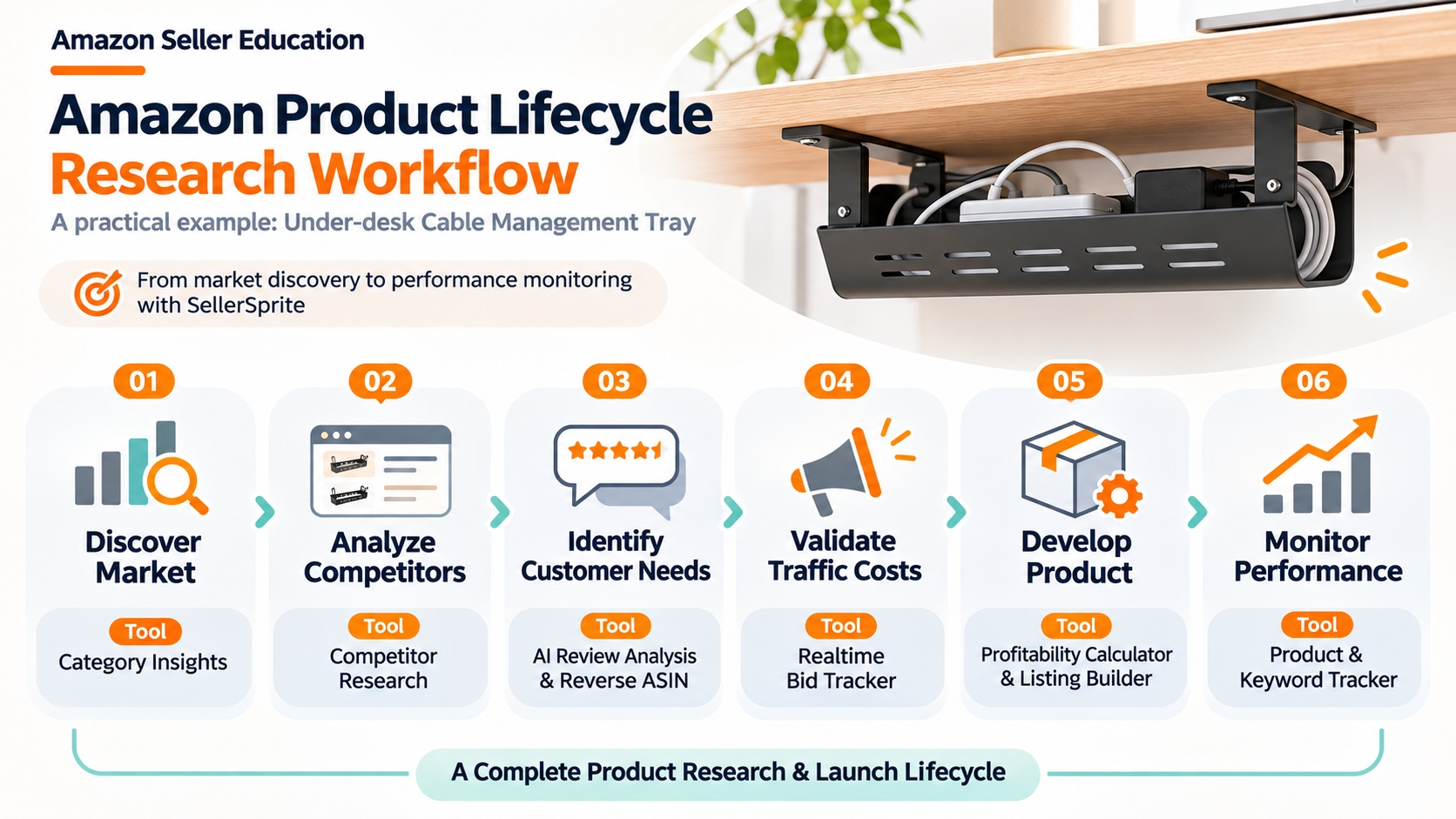
What This Workflow Demonstrates
SellerSprite's greatest practical value comes from connecting related research decisions. Product discovery identifies an opportunity, keyword analysis investigates how customers find it, review analysis reveals how it could be improved, profitability tools test its economics, and monitoring helps sellers respond as market conditions change.
Supported Amazon Marketplaces
SellerSprite provides full feature coverage across 10 core Amazon marketplaces. Additional marketplaces have selected feature availability.
The supported core marketplaces include:
- United States (US)
- Japan (JP)
- United Kingdom (UK)
- Germany (DE)
- France (FR)
- Italy (IT)
- Spain (ES)
- Canada (CA)
- India (IN)
- Mexico (MX)
Selected keyword data capabilities are also available in additional marketplaces, including the United Arab Emirates and Brazil.
This international coverage is particularly valuable for Amazon sellers considering expansion beyond their existing markets.
A product that performs well in the United States may encounter different pricing expectations, customer preferences, search behavior, competitive conditions, and logistics costs in Japan or Germany.
SellerSprite allows businesses to investigate these differences using marketplace-specific research rather than applying the same demand assumptions to every region.
International Expansion Tip
When comparing marketplaces, evaluate local keyword demand, achievable selling prices, brand concentration, customer expectations, applicable fees, and operational requirements separately. Currency conversion alone cannot determine whether a product opportunity is commercially attractive in another country.
SellerSprite Pricing: Plans, Limits, and Value for Money
SellerSprite offers monthly and annual subscription options designed for different research workloads, catalog sizes, and team requirements.
One of the platform's attractive pricing characteristics is that its subscription structure includes broad access to core research tools, with higher-tier plans primarily accommodating greater monitoring capacity and team requirements.
The following prices reflect the publicly displayed SellerSprite pricing page reviewed on November 25, 2026.
How Much Does SellerSprite Cost?
SellerSprite's four paid subscription tiers range from $39 to $189 per month. Annual billing provides approximately 16.7% savings compared with paying the displayed monthly subscription price for 12 months.
| Plan | Monthly Billing | Annual Billing | Effective Monthly Cost on Annual Plan |
|---|---|---|---|
| Basic | $39 | $390 | $32.50 |
| Standard | $79 | $790 | $65.83 |
| Advanced | $129 | $1,290 | $107.50 |
| VIP | $189 | $1,890 | $157.50 |
All prices are in USD. Annual subscriptions are billed upfront. Promotional pricing, taxes, and available subscription arrangements may vary.
SellerSprite Subscription Limits Compared
For sellers who monitor competitors and keyword rankings regularly, tracking capacity is an important factor when selecting a subscription.
The following table summarizes the tracking allowances and account configurations shown for annual subscriptions.
| Feature | Basic | Standard | Advanced | VIP |
|---|---|---|---|---|
| Product Tracker | 50 | 100 | 300 | 500 |
| Keyword Tracker | 250 | 500 | 1,000 | 2,000 |
| New Listing Tracker | 25 | 50 | 100 | 200 |
| Additional Sub-Accounts | 0 | 3 | 6 | 10 |
| Data Exports per User | 50/day | 50/day | 50/day | 50/day |
| Keepa AI Insights | Up to 100 reports per account per day | |||
Tracking allowances are shared between the main account and associated sub-accounts. At the time of review, the Basic monthly subscription does not include Product Tracker, Keyword Tracker, or New Listing Tracker allowances, while the Basic annual subscription includes the allowances shown above. Review the live pricing page for the latest billing-specific entitlements.
Which SellerSprite Plan Offers the Best Value?
The best-value subscription is the one that accommodates your regular research activities without requiring you to pay for capacity you rarely use.
Basic: Suitable for individual sellers primarily interested in product discovery, keyword research, competitor analysis, and opportunity validation. The annual option is also worth evaluating if you need entry-level tracking capacity.
Standard: A practical starting point for growing Amazon businesses that require comprehensive research alongside regular product and keyword monitoring.
Advanced: More suitable for established brands managing larger catalogs, multiple research projects, or increased competitive monitoring workloads.
VIP: Designed for agencies, larger ecommerce teams, and businesses requiring the highest tracking capacity and additional sub-accounts.
For many active private label sellers, Standard provides a useful balance between subscription cost and ongoing monitoring capabilities.
Evaluating the Return on Your SellerSprite Subscription
Research software should be evaluated according to the commercial decisions it improves, not simply the number of tools included in the subscription.
One way to assess subscription value is to consider three sources of potential return:
- Research efficiency: Time saved collecting, organizing, and comparing marketplace information.
- Risk reduction: Avoiding unsuitable product opportunities, weak keywords, poorly differentiated products, or commercially difficult markets.
- Operational improvement: Identifying product development opportunities, listing improvements, competitive changes, and more informed advertising decisions.
A Simple Subscription Break-Even Calculation
Suppose your monthly SellerSprite subscription costs $79 and you value one hour of productive research time at $25.
$79 ÷ $25 = approximately 3.2 hours
If the software saves approximately 3.2 hours of research per month that can be redirected toward productive business activities, its subscription cost would be offset under this illustrative time-value model. Any additional improvements in product selection, advertising research, or competitive decisions would represent further potential value.
For established sellers, avoiding a single costly inventory or product development mistake may be considerably more valuable than the time saved through routine research.
Does SellerSprite Offer a Free Trial?
Yes. SellerSprite offers a three-day free trial without requiring a credit card. Users can also access free utilities and selected features, including the ability to install its browser extension at no cost.
The trial is particularly useful for evaluating the platform with an actual product idea, competitor ASIN, or keyword research task before committing to a subscription.
SellerSprite Pros and Cons
SellerSprite's extensive feature set provides significant value for businesses that rely on Amazon marketplace intelligence. Its suitability nevertheless depends on the user's research priorities, preferred workflow, and operational requirements.
SellerSprite Pros
The platform's strongest advantages relate to research depth, integrated analytical capabilities, international marketplace coverage, and subscription flexibility.
- Comprehensive product and market research: Supports discovery and validation at both individual product and broader category levels.
- Detailed keyword intelligence: Combines keyword discovery, Reverse ASIN, traffic analysis, conversion indicators, and search visibility research.
- AI-powered consumer insights: Helps translate customer reviews into product development and listing improvement opportunities.
- Advertising research capabilities: Connects observable competitor advertising behavior and suggested bid information with keyword planning.
- Useful browser extension: Provides research information directly within supported Amazon pages.
- Broad international coverage: Offers full feature availability across 10 core Amazon marketplaces.
- Flexible subscription structure: Accommodates different research workloads, monitoring requirements, and team sizes.
- Additional AI and developer integrations: MCP and API services support research workflows outside the conventional software dashboard.
SellerSprite Cons
The main considerations involve the learning curve, the interpretation of research metrics, and the difference between marketplace intelligence and operational execution.
- Initial learning curve: New Amazon sellers may need time to understand the relationships between the platform's extensive research modules and metrics.
- Estimated competitor sales data: As with other third-party research platforms, model-based sales and revenue estimates require appropriate interpretation.
- Tracking capacity varies by subscription: Sellers monitoring larger catalogs or extensive keyword lists may need higher-tier plans.
- Different marketplace feature availability: Additional marketplaces outside the 10 core regions have selected rather than complete feature coverage.
- Separate developer services: MCP and API access require their own subscription or usage arrangements.
- Research-focused advertising tools: Advertising intelligence supports campaign planning and analysis, while actual campaign management and execution take place through the appropriate Amazon Ads or operational systems.
For sellers whose primary requirement is comprehensive marketplace research, these considerations are generally manageable through an appropriate subscription and a structured research workflow.
Who Should Use SellerSprite?
SellerSprite can support several types of Amazon businesses, although different users will find different parts of the platform most valuable.
| Seller Type | Most Relevant Features | Primary Value |
|---|---|---|
| New Amazon Sellers | Product Research, Category Insights, Sales Estimator, Profitability Calculator | Validate initial product ideas and understand market conditions. |
| Private Label Sellers | Competitor Research, AI Review Analysis, Reverse ASIN, Keyword Mining | Identify differentiated product opportunities and develop launch strategies. |
| Established Brands | Category Insights, AI Competitor Insights, Keyword Tracker, New Listing Tracker | Expand product portfolios and monitor competitive developments. |
| PPC Specialists | Ads Insights, Realtime Bid Tracker, Keyword Conversion Rate, Reverse ASIN | Research competitive targeting strategies and keyword acquisition economics. |
| Amazon Agencies | Market Analysis, Tracking Tools, Data Exports, Sub-Accounts | Standardize client research and monitor multiple competitive environments. |
| Developers and AI Research Teams | SellerSprite MCP and Open API | Integrate available marketplace data into customized applications and AI workflows. |
Who May Need a Different Type of Software?
SellerSprite is primarily designed around marketplace intelligence and research-driven optimization.
Businesses whose main requirements involve accounting, purchase order management, warehouse operations, automated advertising execution, or other specialized back-office activities may also need dedicated operational software.
Similarly, a seller who only needs occasional basic product sales estimates may find free research utilities sufficient for their immediate requirements.
The most useful software stack reflects the actual frequency and complexity of the decisions a business needs to make.
How to Evaluate SellerSprite During Your Free Trial
A software trial is most informative when you use it to investigate real business questions rather than simply browse the available features.
SellerSprite's three-day free trial provides an opportunity to evaluate the platform through a structured research process.
Day 1: Validate a Product Opportunity
Choose one product idea or category that is relevant to your business. Use Category Insights, Product Research, and Competitor Research to investigate its market size, demand trends, competitive concentration, and individual product performance.
By the end of the first day, aim to have a clearly defined market assessment and a shortlist of commercially relevant competitors.
Day 2: Analyze Keywords and Customer Needs
Run Reverse ASIN or Reverse Multiple ASINs using the selected competitors. Investigate relevant keyword opportunities, then use AI Review Analysis to examine customer complaints, expectations, and valued product characteristics.
The objective is to develop an initial product positioning and differentiation strategy supported by marketplace research.
Day 3: Examine Economics and Ongoing Research Needs
Investigate relevant suggested advertising bids, calculate potential product profitability, and explore the available browser extension and monitoring capabilities.
Use the results to determine whether SellerSprite provides enough actionable insight and research efficiency to justify an ongoing subscription.
SellerSprite Free Trial Evaluation Checklist
Before choosing a subscription, consider whether you can answer the following questions:
- ☐ Can I identify commercially relevant products more efficiently?
- ☐ Can I distinguish attractive markets from markets with high entry barriers?
- ☐ Can I discover relevant competitor keywords and traffic opportunities?
- ☐ Does review analysis reveal meaningful customer needs?
- ☐ Can I investigate advertising costs before making product decisions?
- ☐ Does the platform support my target Amazon marketplaces?
- ☐ Do the tracking allowances match my expected monitoring workload?
- ☐ Can the research outputs improve decisions or save enough time to justify the subscription?
For additional guidance, the SellerSprite Help Center provides feature tutorials, workflow explanations, video guides, and answers to common usage questions.
Final Verdict: Is SellerSprite Worth It in 2026?
SellerSprite is a strong Amazon seller software option for businesses that want to make product, keyword, advertising, and competitive decisions using a connected marketplace research environment.
Its most distinctive value lies in combining several research perspectives that are commercially related but often evaluated separately: market attractiveness, individual product performance, keyword demand, customer expectations, advertising competition, and profitability.
For private label sellers, this combination can help transform product research into a more structured product development process. For established brands, it supports catalog expansion, competitive monitoring, and ongoing listing optimization. For agencies and professional research teams, it provides a shared environment for investigating multiple markets and competitors.
The continued development of AI-powered research capabilities, improved category intelligence, advertising research tools, and external AI integrations also makes SellerSprite particularly relevant to the evolving needs of Amazon businesses in 2026.
Ultimately, SellerSprite is most valuable to sellers who use marketplace intelligence regularly and translate the information into specific business actions.
Its three-day free trial provides a practical way to determine whether those capabilities match your own research priorities and commercial objectives.
Make Your Next Amazon Decision With Better Data
Discover promising markets, uncover competitor strategies, understand customer needs, and validate product opportunities with SellerSprite's comprehensive Amazon research tools.
3-day free trial. No credit card required.
Frequently Asked Questions
The following answers address common questions about SellerSprite's functionality, pricing, data, marketplace coverage, and suitability for different Amazon seller workflows.
Is SellerSprite legit?
Yes. SellerSprite is an established Amazon marketplace research software provider offering a web application, browser extension, and additional developer services. Its browser extension is available through the Chrome Web Store, and the company provides publicly accessible product documentation, subscription information, and feature guides.
Is SellerSprite worth it for Amazon sellers?
SellerSprite is particularly worthwhile for Amazon sellers who regularly conduct product research, keyword analysis, competitive intelligence, consumer research, and performance monitoring. Its value is strongest when these capabilities contribute to recurring business decisions, reduce research time, or help identify and avoid commercially unsuitable opportunities.
What is SellerSprite used for?
SellerSprite is used for Amazon product discovery, category analysis, competitor research, keyword discovery, Reverse ASIN analysis, advertising research, customer review analysis, listing optimization, profitability estimation, and product and keyword tracking.
How much does SellerSprite cost in 2026?
SellerSprite's displayed monthly subscription prices are $39 for Basic, $79 for Standard, $129 for Advanced, and $189 for VIP. Annual subscriptions are available at $390, $790, $1,290, and $1,890 respectively, providing approximately 16.7% savings compared with the corresponding monthly prices over 12 months.
Can I use SellerSprite for free?
Yes. SellerSprite provides free utilities, limited feature access, and free browser extension installation. New users can also access a three-day free trial without providing a credit card. Full research access and ongoing tracking capabilities depend on the selected subscription.
How accurate are SellerSprite sales estimates?
SellerSprite provides model-based sales estimates using available Amazon marketplace information and estimation methods. Accuracy can vary according to the product category, sales volume, marketplace, variation structure, and research period. Sellers can assess estimation performance using their own verified sales data and corresponding SellerSprite estimates for comparable products and periods.
Is SellerSprite better than Helium 10?
SellerSprite is particularly attractive for sellers who prioritize comprehensive product and market research, keyword intelligence, AI-powered consumer insights, and international marketplace analysis. Helium 10 is especially relevant to businesses seeking research integrated with a broader seller operations ecosystem. The better choice depends on your required features, workflow, and subscription budget.
Is SellerSprite suitable for beginners?
Yes. Beginners can start with Product Research, Category Insights, the Sales Estimator, and the Profitability Calculator before exploring more advanced keyword, competitor, advertising, and monitoring tools. SellerSprite also provides tutorials and feature guides to help new users develop structured research workflows.
Does SellerSprite work for both Amazon FBA and FBM sellers?
Yes. SellerSprite's marketplace research, keyword intelligence, competitor analysis, review analysis, and monitoring capabilities can support both FBA and FBM business models. Sellers should incorporate the fulfillment costs and operational requirements specific to their chosen method when evaluating profitability.
Which Amazon marketplaces does SellerSprite support?
SellerSprite provides full feature coverage across Amazon US, Japan, UK, Germany, France, Italy, Spain, Canada, India, and Mexico. Selected features are available in additional marketplaces, such as United Arab Emirates, Brazil, and Australia.
Can SellerSprite help with Amazon PPC?
Yes. SellerSprite provides advertising research capabilities through Ads Insights, Realtime Bid Tracker, Reverse ASIN, Keyword Conversion Rate, and related keyword tools. These capabilities help sellers investigate competitive advertising behavior, identify relevant targeting opportunities, examine suggested bids, and develop more informed PPC strategies.
Can SellerSprite analyze Amazon customer reviews?
Yes. SellerSprite AI Review Analysis helps sellers examine customer feedback, including product advantages and disadvantages, recurring pain points, purchasing motivations, customer expectations, and usage scenarios. These insights support product development, differentiation, listing optimization, and quality improvement.
Does SellerSprite offer an API or MCP integration?
Yes. SellerSprite offers Open API services for programmatic marketplace data retrieval and MCP services for compatible AI-assisted research environments. Both are separate from conventional SellerSprite software subscriptions and have their own access arrangements, supported capabilities, and usage limits.
What is the difference between SellerSprite's web application and browser extension?
The web application is designed for structured research, market analysis, large-scale product screening, keyword analysis, data exports, and ongoing monitoring. The browser extension provides convenient access to product, keyword, historical, review, and competitor insights directly within supported Amazon pages. The two access methods complement each other throughout the research process.
Can multiple team members use SellerSprite?
Yes. Eligible SellerSprite subscriptions support additional sub-accounts for team members. The annual Standard, Advanced, and VIP plans include 3, 6, and 10 additional sub-accounts respectively. Tracking allowances are shared across the main account and associated sub-accounts.
About the Author
SellerSprite Content Team
The SellerSprite Content Team focuses on Amazon marketplace intelligence, ecommerce analytics, product development, consumer research, keyword strategy, advertising optimization, and international seller education. Our ongoing work explores how marketplace data, customer behavior, and emerging AI technologies can support more informed commercial decisions for Amazon sellers and ecommerce businesses.
References and Further Reading
- Amazon. Product Opportunity Explorer.
- Amazon. Amazon Brand Analytics.
- Amazon. Guide to Amazon Sales Rank: Best Sellers Rank (BSR).
- Amazon. How Much Does It Cost to Sell on Amazon?.
- Amazon Ads. Sponsored Products.
- United States Patent and Trademark Office. Search for Patents.
- Google Chrome Web Store. SellerSprite Amazon Research Tool.
- SellerSprite. Plans and Pricing.
- SellerSprite. Browser Extension Guide and Release Notes.
- SellerSprite. Category Insights and Market Research Guide.
- SellerSprite. Official Help Center.
Product features, subscription details, and software release information were reviewed on November 25, 2026.