By SellerSprite Content Team | Updated November 25, 2026
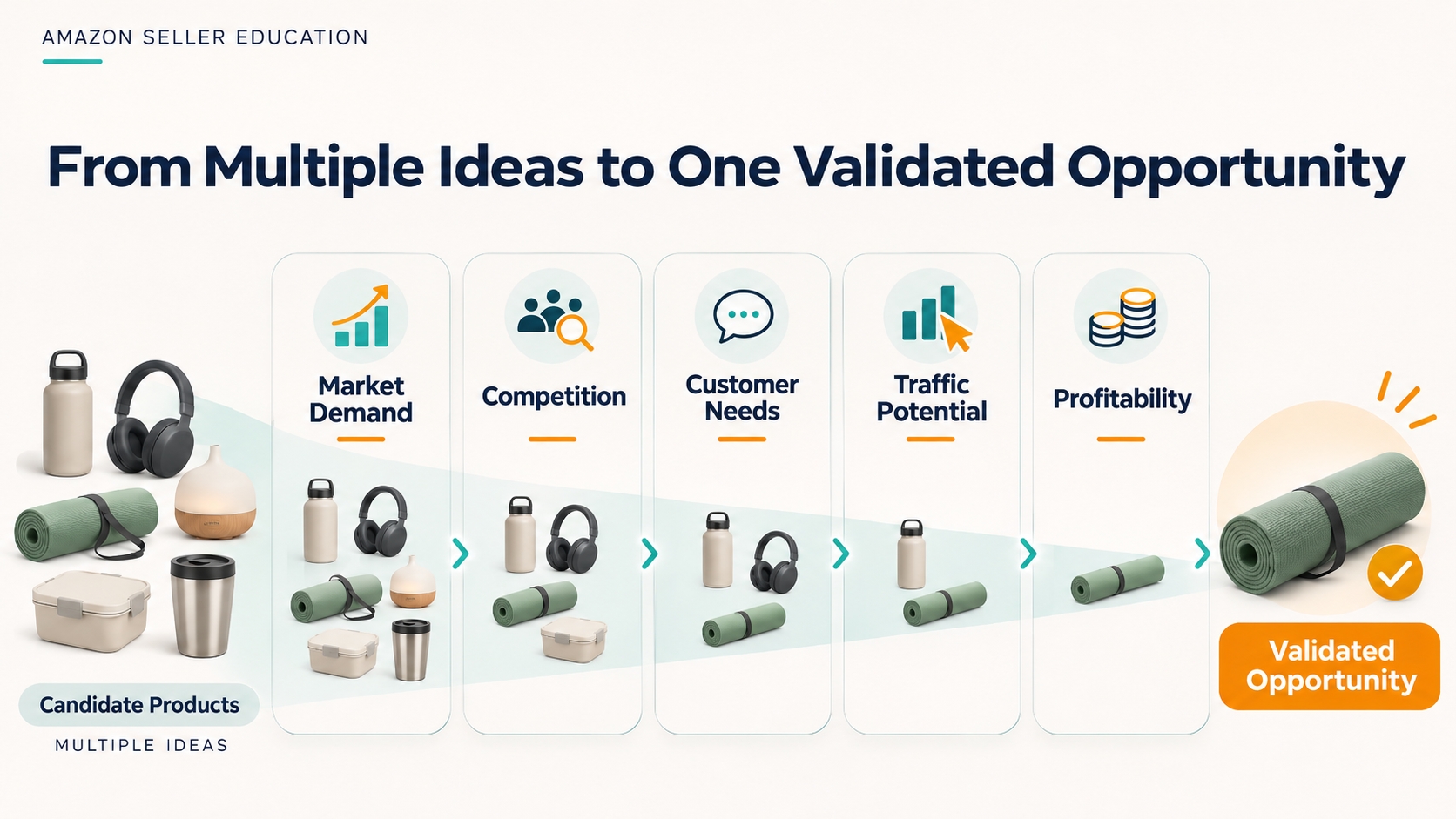
Finding a product that sells well on Amazon is relatively easy. Finding one that you can realistically compete with, differentiate, source, advertise, and sell at a sustainable profit is a much more demanding task.
Amazon product research tools help sellers make that distinction. They bring together estimated sales, historical trends, keyword demand, competitor performance, customer feedback, and other market signals that would otherwise take hours to collect manually.
However, different tools approach product discovery from different angles. Some specialize in finding promising individual products, while others are more effective at evaluating entire categories, identifying suppliers, or understanding how established brands capture market share.
The five best Amazon product research tools covered in this guide are SellerSprite, Helium 10, Jungle Scout, AMZScout, and SmartScout. Each offers a distinct research experience depending on your business model, budget, and the type of opportunity you are looking for.
Key Takeaways
- SellerSprite is our top recommendation for comprehensive Amazon product research, combining product discovery, market intelligence, keyword analysis, AI review analysis, and profitability evaluation.
- Helium 10 is particularly useful for sellers who want product research integrated with a broader suite of listing, advertising, and business management tools.
- Jungle Scout is a strong choice for private label sellers who want to connect product discovery with supplier research and product tracking.
- AMZScout is well suited to beginners and sellers who prefer straightforward product validation directly on Amazon.
- SmartScout stands out for brand research, market share analysis, wholesale opportunities, and understanding Amazon's broader competitive landscape.
- The most valuable product research combines demand with achievable market share, realistic customer acquisition costs, meaningful product improvements, and sustainable margins.
Table of Contents
- What Are Amazon Product Research Tools?
- 5 Best Amazon Product Research Tools at a Glance
- The 5 Best Amazon Product Research Tools
- What Makes an Amazon Product Research Tool Effective?
- Product Research in Practice: From Opportunity to Profitability
- How to Research Products on Amazon with SellerSprite
- Common Amazon Product Research Mistakes
- Which Amazon Product Research Tool Should You Choose?
- Frequently Asked Questions
What Are Amazon Product Research Tools?
An Amazon product research tool is a software application that helps sellers discover, analyze, and validate product opportunities using marketplace data, sales estimates, search demand, competitive intelligence, and historical performance indicators.
These tools typically allow users to search Amazon products through customizable filters, compare competing listings, estimate monthly sales and revenue, evaluate keyword opportunities, and assess whether a potential product fits their business objectives.
For example, instead of manually browsing hundreds of listings in the Home & Kitchen category, a seller could narrow the market to products within a specific price range, sales volume, package weight, review count, and competition level.
The resulting shortlist becomes the starting point for more detailed research.
Amazon itself encourages sellers to investigate customer demand, competitive conditions, reviews, and returns through its Product Opportunity Explorer. Third-party research platforms complement this first-party resource by providing additional ways to explore products, competitors, keywords, historical trends, and commercial opportunities.
Product Research vs. Product Validation
Product research identifies what might be worth selling. Product validation determines whether you have a commercially viable way to sell it. A high-volume product is a research lead; a differentiated product with accessible demand and sustainable economics is a validated opportunity.
5 Best Amazon Product Research Tools at a Glance
The following comparison highlights where each platform provides the most value. Rather than treating every tool as interchangeable, it considers the specific research questions each platform is particularly well equipped to answer.
| Tool | Best For | Core Research Strengths | Monthly Plan Example |
|---|---|---|---|
| SellerSprite | Comprehensive product and market research | Product discovery, category insights, keyword intelligence, AI review analysis, competitor research | Basic: $39 |
| Helium 10 | Integrated seller operations | Black Box, Xray, historical trends, launch planning | Platinum: $129 |
| Jungle Scout | Private label research and sourcing | Product Database, Opportunity Finder, Product Tracker, Supplier Database | Starter: $49 |
| AMZScout | Beginners and browser-based research | PRO AI Extension, product database, niche evaluation | AI Bundle: $59.99 |
| SmartScout | Brand, wholesale, and category intelligence | Brand analytics, seller research, subcategory data, Traffic Graph | Basic: $49 |
Pricing in USD, based on publicly displayed monthly plans reviewed on November 25, 2026. The plans shown are pricing examples rather than equivalent feature packages. Advanced features, tracking allowances, historical data, and marketplace coverage may vary by subscription.
How We Evaluated These Tools
This comparison, published by SellerSprite, evaluates publicly documented platform capabilities across product discovery, historical data, competitive intelligence, keyword research, profitability analysis, marketplace coverage, and practical seller workflows. Recommendations reflect suitability for different business needs rather than a measured head-to-head sales estimation accuracy benchmark.
The 5 Best Amazon Product Research Tools
Although all five platforms help sellers identify potential opportunities, their differences become more apparent once you move beyond basic sales estimates. Here is a closer look at their capabilities, practical applications, strengths, and considerations.
1. SellerSprite: Best for Comprehensive Product and Market Research
SellerSprite is an all-in-one Amazon research and competitive intelligence platform that connects product discovery with market validation, keyword demand, consumer insights, and profitability analysis.
Its central strength is the ability to evaluate an opportunity from multiple perspectives. Instead of starting exclusively with individual products, sellers can begin with an Amazon category, a search term, a competing ASIN, or a customer need and progressively narrow their research.
This makes SellerSprite particularly useful for private label businesses developing new products, established brands expanding into adjacent categories, and sellers researching multiple Amazon marketplaces.
Key Product Research Features
SellerSprite offers several connected research modules that address different stages of an Amazon product selection decision.
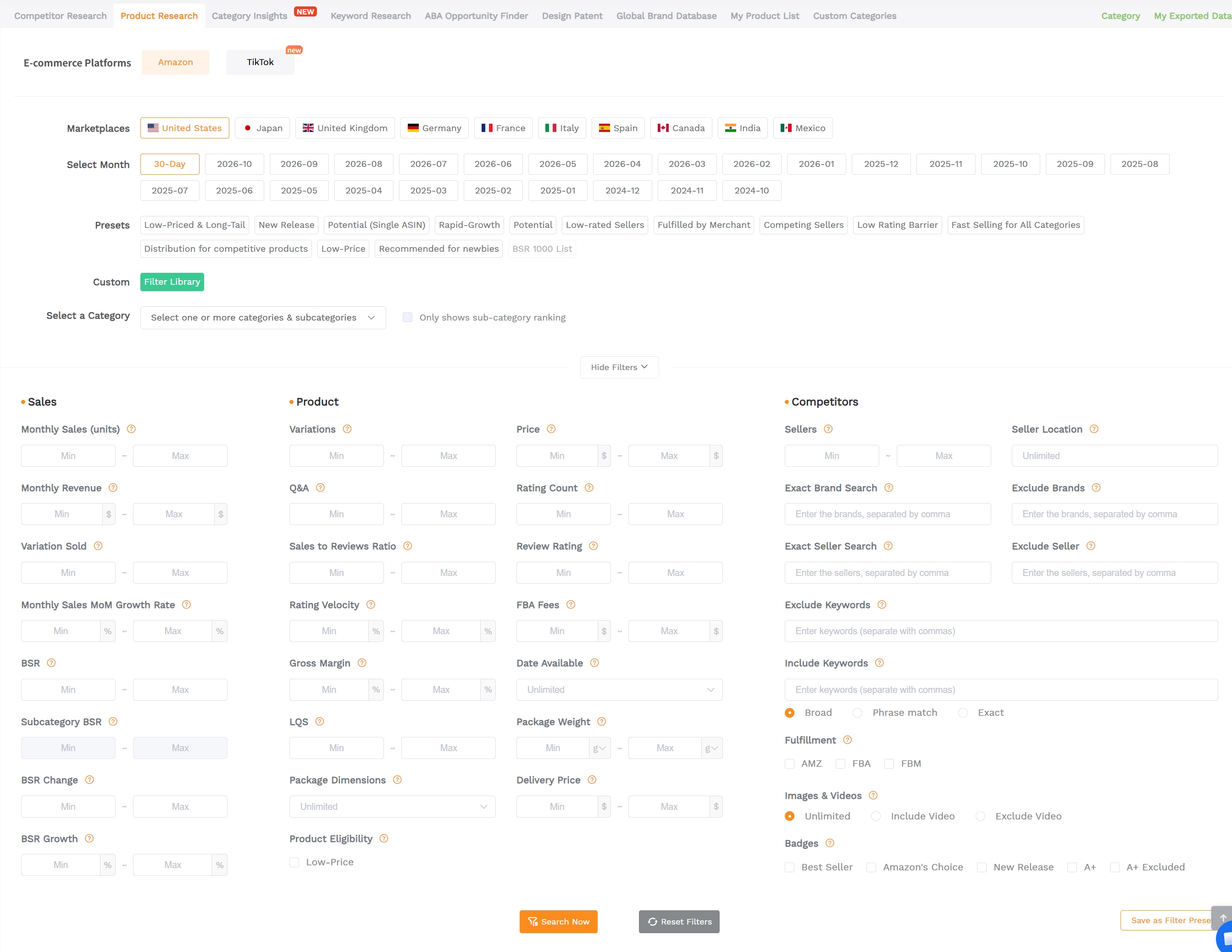
- Product Research: Discover potential products using more than 50 selection criteria, including sales, revenue, price, BSR, reviews, listing age, package weight, and other commercial indicators. The Product Research guide explains how to build and refine these searches.
- Category Insights: Explore Amazon categories and subcategories using market size, growth trends, competitive conditions, and other indicators to identify attractive markets before selecting individual products.
- Market Analysis: Evaluate market structure through sales distribution, brand concentration, price segments, seasonality, listing characteristics, and competitive entry barriers.
- Competitor Research: Investigate individual ASINs and competing products, compare their historical sales performance, and study how established listings and variations perform.
- Keyword Research and Reverse ASIN: Identify relevant search terms, estimate keyword demand, analyze competitors' search visibility, and determine whether potential products have multiple realistic traffic sources.
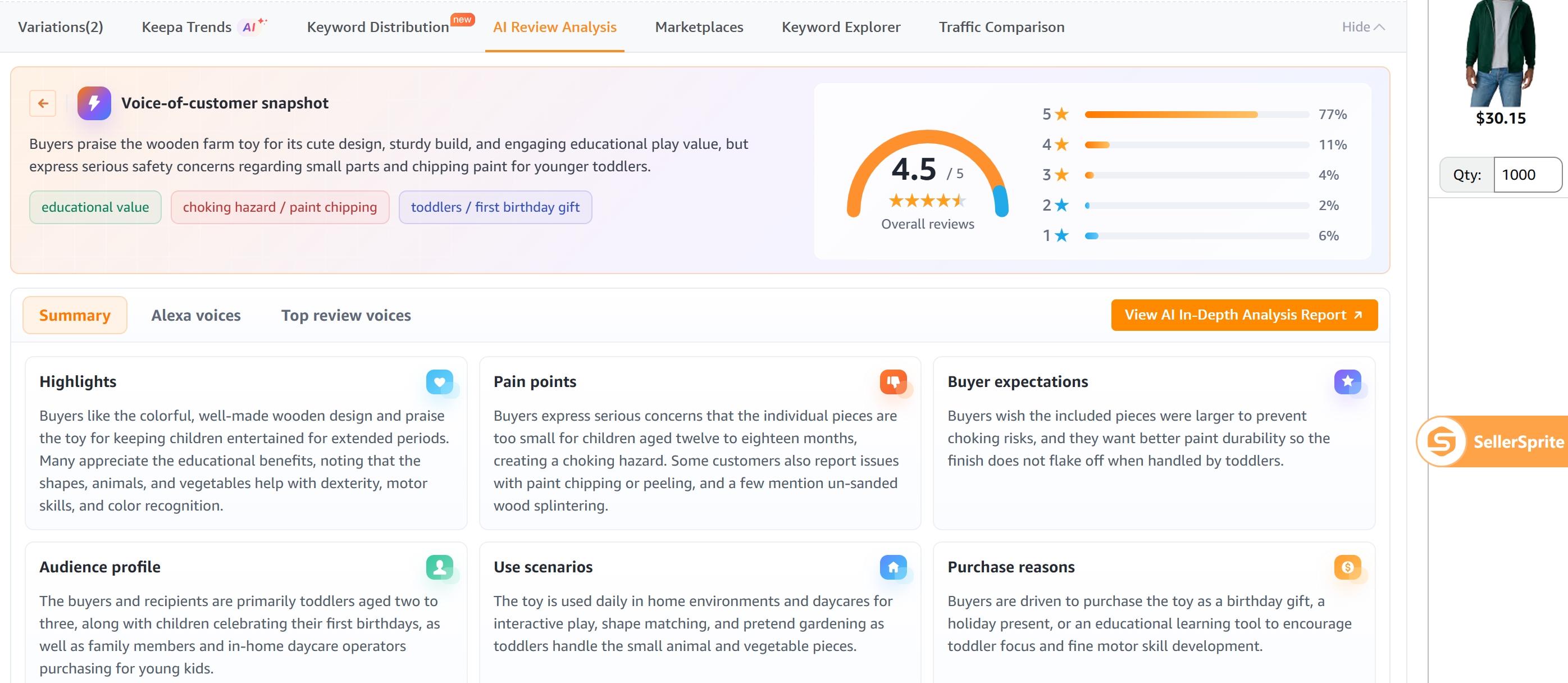
- AI Review Analysis: Identify recurring customer complaints, purchasing motivations, product usage scenarios, and unmet expectations to uncover opportunities for meaningful product improvements.
- Profitability Calculator: Evaluate estimated product economics using selling prices, sourcing costs, Amazon fees, and other applicable expenses.
- Product and Keyword Tracker: Monitor shortlisted competitors and keyword rankings over time to identify important changes in market performance.
- Browser Extension: Access product, keyword, historical, review, variation, and other research insights while browsing Amazon.
What Makes SellerSprite Particularly Useful?
One of SellerSprite's most valuable applications is identifying markets where demand exists but existing products do not adequately meet customer expectations.
A product category might generate substantial revenue while still containing repeated complaints about durability, installation, sizing, functionality, or packaging. These problems create potential opportunities for sellers who can improve the product itself rather than simply introduce another similar listing.
By connecting Category Insights with AI Review Analysis and keyword intelligence, sellers can investigate three important questions together:
- Is the market large enough to support a new entrant?
- Which customer problems are existing products failing to solve?
- Are there relevant search terms through which an improved product can reach its intended customers?
This combination helps turn market research into a product development strategy.
Marketplace Coverage
SellerSprite provides full feature coverage across 10 core Amazon marketplaces: the United States, Japan, United Kingdom, Germany, France, Italy, Spain, Canada, India, and Mexico. Additional marketplaces have partial feature availability.
This coverage is especially useful for businesses evaluating international expansion, where a product's demand, competitive intensity, pricing structure, and relevant keywords can differ significantly between countries.
Practical Application
A seller researching kitchen organization products can begin with Category Insights, narrow potential products through Product Research, examine competitors' keyword visibility with Reverse ASIN, analyze buyer complaints through AI Review Analysis, and test potential margins before requesting supplier quotations. Each research stage contributes evidence to the same product decision.
Strengths and Considerations
SellerSprite is particularly attractive to sellers who want detailed research capabilities without separating market analysis, keyword research, competitor monitoring, and consumer insights across several unrelated platforms.
- Strengths: Extensive product filters, multidimensional market analysis, integrated keyword intelligence, AI-powered review analysis, and broad international marketplace coverage.
- Considerations: The breadth of available data can take time to explore. Beginners may benefit from starting with predefined research modes before building more advanced workflows.
- Best for: Private label sellers, product development teams, established Amazon brands, and sellers entering new marketplaces.
SellerSprite also offers a free browser extension, free research utilities, and a three-day trial without requiring a credit card.
Start Your Free SellerSprite Trial
2. Helium 10: Best for Integrated Research and Seller Operations
Helium 10 is a comprehensive ecommerce software platform covering product research, keyword discovery, listing optimization, advertising, and business operations.
Its product research capabilities are especially relevant to businesses that want to keep product discovery and subsequent launch activities within the same software ecosystem.
Key Product Research Features
Helium 10's research workflow generally begins with product discovery and moves toward listing-level validation and launch planning.
- Black Box: Search for products that match specific requirements related to estimated revenue, sales, price, reviews, and competitive conditions.
- Xray: Analyze products directly on Amazon search results and listing pages through its browser extension.
- Historical Performance Analysis: Examine sales, BSR, and pricing trends to distinguish sustained demand from temporary market fluctuations.
- Cerebro and Magnet: Explore competitor keywords and related search terms to assess potential listing and advertising opportunities.
- Product Launchpad: Organize shortlisted products, competitor information, relevant keywords, and launch planning materials.
The combination of Black Box and Xray creates a useful workflow for narrowing a large product database and then examining competing listings in greater detail.
Where Helium 10 Provides the Most Value
Helium 10 is particularly useful for established businesses that regularly launch products and need their research activities to connect with keyword optimization, listing creation, and advertising management.
For example, a brand managing several upcoming product launches can use Black Box to identify opportunities, Xray to assess the competitive environment, and its keyword tools to prepare the corresponding listings.
The platform's broader operational capabilities may also reduce the need for multiple subscriptions when those additional features are part of the seller's regular workflow.
Strengths and Considerations
Helium 10's primary advantage is the breadth of its software ecosystem, particularly for businesses looking beyond product research alone.
- Strengths: Comprehensive product and keyword research, browser-based product analysis, historical insights, and integrated launch and operational tools.
- Considerations: Higher subscription costs may be less attractive to sellers who only need research capabilities. Some advanced tools are tied to higher-tier plans.
- Best for: Established private label sellers and ecommerce brands seeking a broad research and operations platform.
3. Jungle Scout: Best for Product Discovery and Supplier Research
Jungle Scout is an established Amazon seller software provider with a strong emphasis on product discovery, opportunity validation, tracking, and sourcing.
Its Catalyst platform is designed for new and growing sellers, while Jungle Scout Cobalt serves larger brands and organizations requiring more extensive market intelligence.
For sellers developing private label products, the connection between product research and supplier discovery is one of Jungle Scout's most practical advantages.
Key Product Research Features
Jungle Scout offers a relatively structured route from discovering potential products to evaluating their performance and exploring sourcing options.
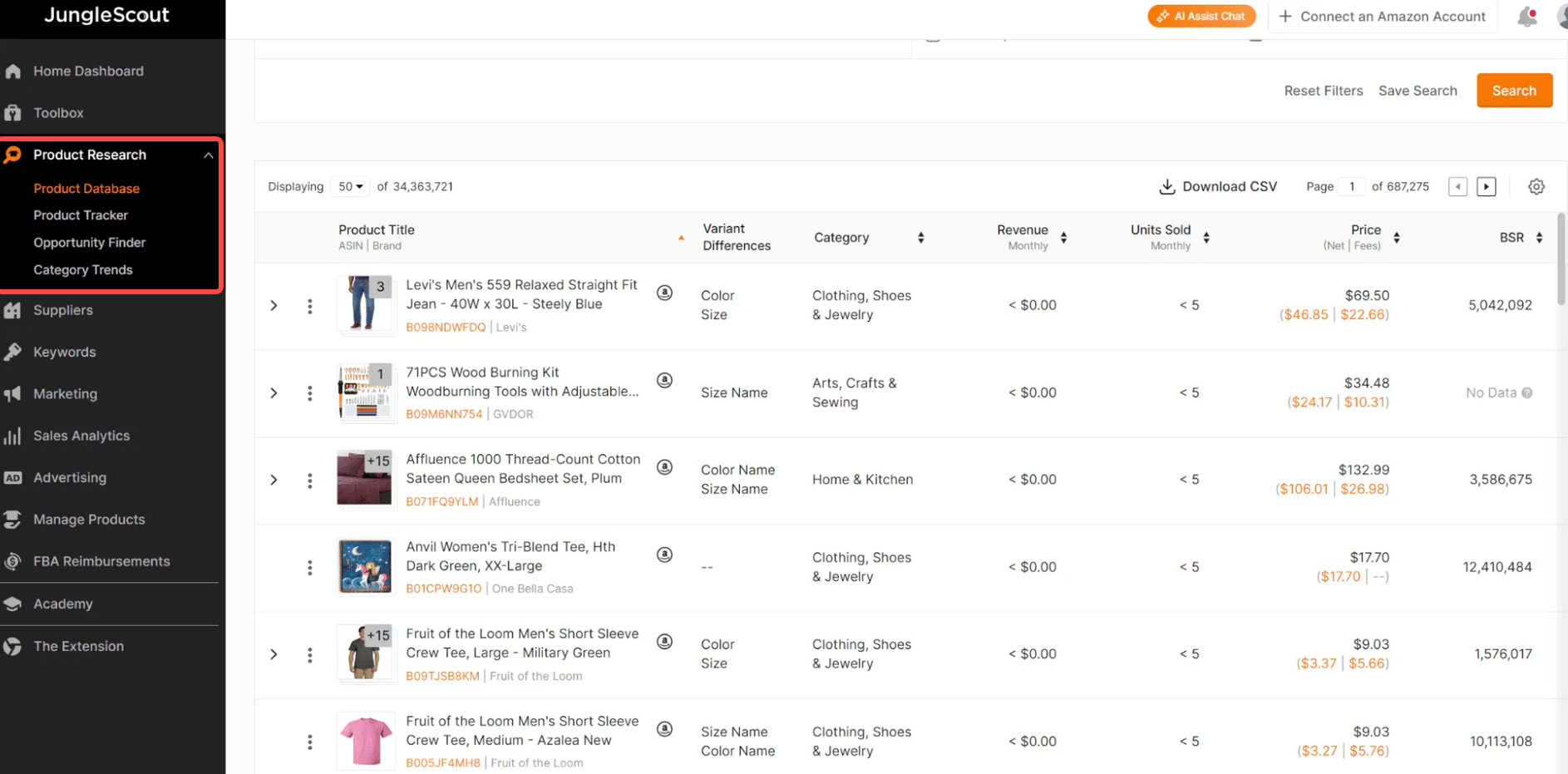
- Product Database: Search and filter Amazon products using estimated sales, revenue, category, pricing, and other product characteristics.
- Opportunity Finder: Discover niche opportunities through keyword-related demand, sales performance, and competition indicators.
- Browser Extension: Evaluate product performance and competing listings directly while browsing Amazon.
- Product Tracker: Monitor shortlisted products and their performance over time.
- Supplier Database: Explore potential manufacturers and suppliers using indexed US customs import records.
- Keyword Scout: Investigate relevant keywords for product demand, listing development, and launch planning.
Where Jungle Scout Provides the Most Value
Product discovery often creates another challenge: determining whether the proposed product can be manufactured at a commercially viable cost.
Jungle Scout's Supplier Database helps bridge this gap by allowing sellers to investigate supplier relationships through import records.
This can be a useful starting point for contacting manufacturers, requesting samples, exploring production alternatives, and comparing sourcing options before committing capital.
Supplier identification should then lead to direct verification of manufacturing capabilities, product quality, compliance documentation, minimum order quantities, and commercial terms.
Strengths and Considerations
Jungle Scout is a practical choice for sellers who want a clearly organized product discovery and sourcing workflow.
- Strengths: Established product research tools, niche discovery, supplier intelligence, product tracking, and accessible learning resources.
- Considerations: Entry-level Catalyst plans have research limits and do not include Supplier Database access. Certain features also have marketplace-specific availability.
- Best for: First-time and growing private label sellers, especially those who need assistance moving from product ideas to supplier discovery.
4. AMZScout: Best for Beginners and On-Page Product Research
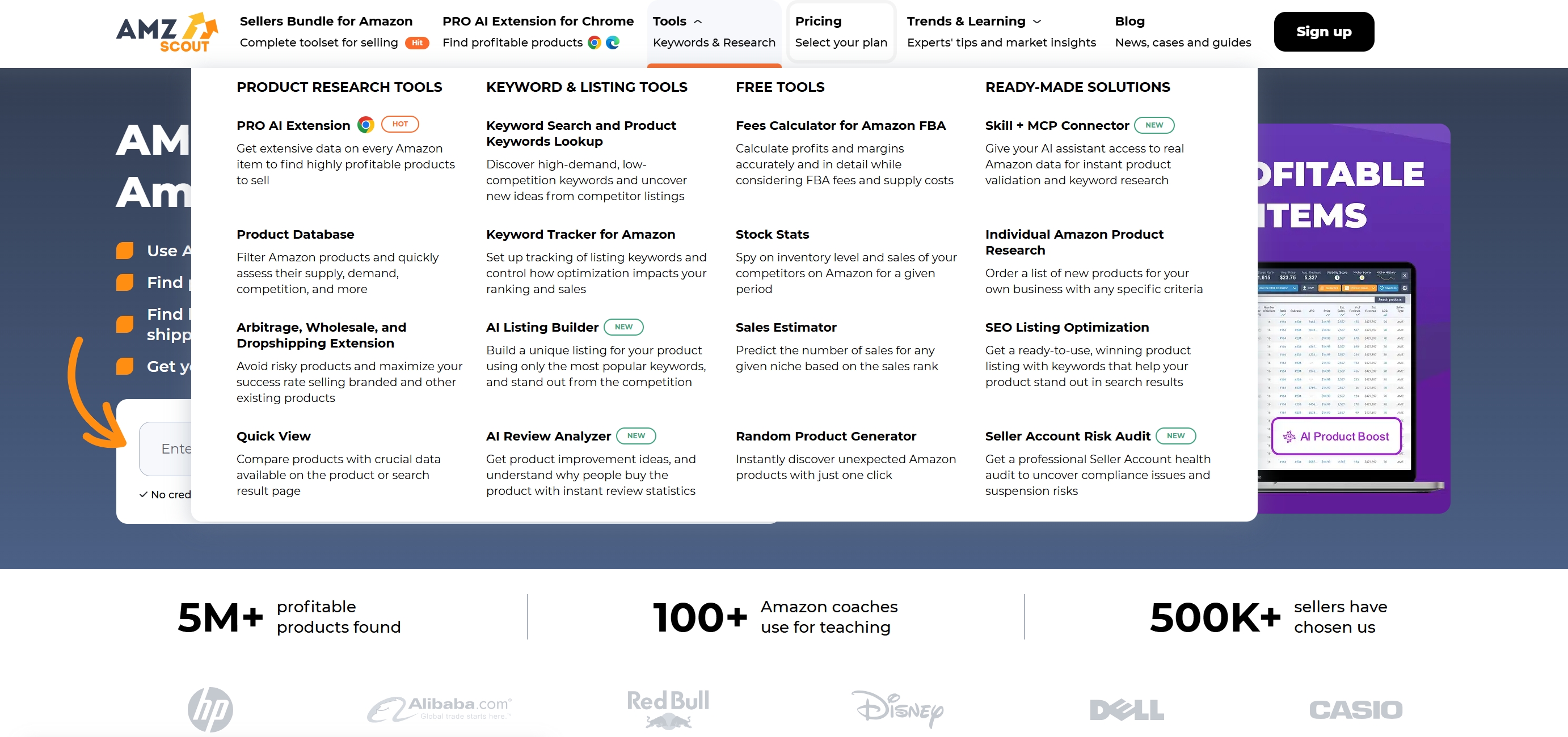
AMZScout focuses on making Amazon product research accessible through browser-based analytics, product discovery tools, sales estimates, and AI-assisted product evaluation.
It is particularly useful for sellers who prefer to explore Amazon directly rather than begin with an extensive market intelligence dashboard.
Key Product Research Features
AMZScout's tools support initial product discovery and quick evaluation of potential opportunities.
- PRO AI Extension: Analyze Amazon products directly from the browser using sales estimates, revenue, trends, and competitive indicators.
- Product Database: Search for product ideas using defined research criteria.
- AI Product Insights: Explore potential product strengths, weaknesses, risks, and opportunities.
- Product Tracker: Follow selected products and changes in their performance, where included in the chosen package.
- Keyword Research: Discover relevant search terms and explore competitor keyword opportunities.
Where AMZScout Provides the Most Value
The AMZScout PRO AI Extension is especially useful when a seller already has a general product idea and wants to assess the products competing for the same shoppers.
A beginner researching home storage accessories, for example, can search for a relevant keyword on Amazon, open the extension, and compare competing listings without switching repeatedly between different applications.
This makes the initial research process relatively approachable while helping users become familiar with the relationship between pricing, sales, reviews, and competitive conditions.
Strengths and Considerations
AMZScout is most appealing when ease of use and efficient initial product screening are important purchasing criteria.
- Strengths: Accessible browser-based research, straightforward product evaluation, AI-assisted insights, and convenient initial opportunity screening.
- Considerations: Sellers requiring extensive market-level intelligence should examine the depth of available category, brand, and competitive analysis before selecting a subscription. Some specialized capabilities are offered through additional packages.
- Best for: New Amazon sellers and individuals who prefer researching products directly on marketplace pages.
5. SmartScout: Best for Brand, Wholesale, and Market Intelligence
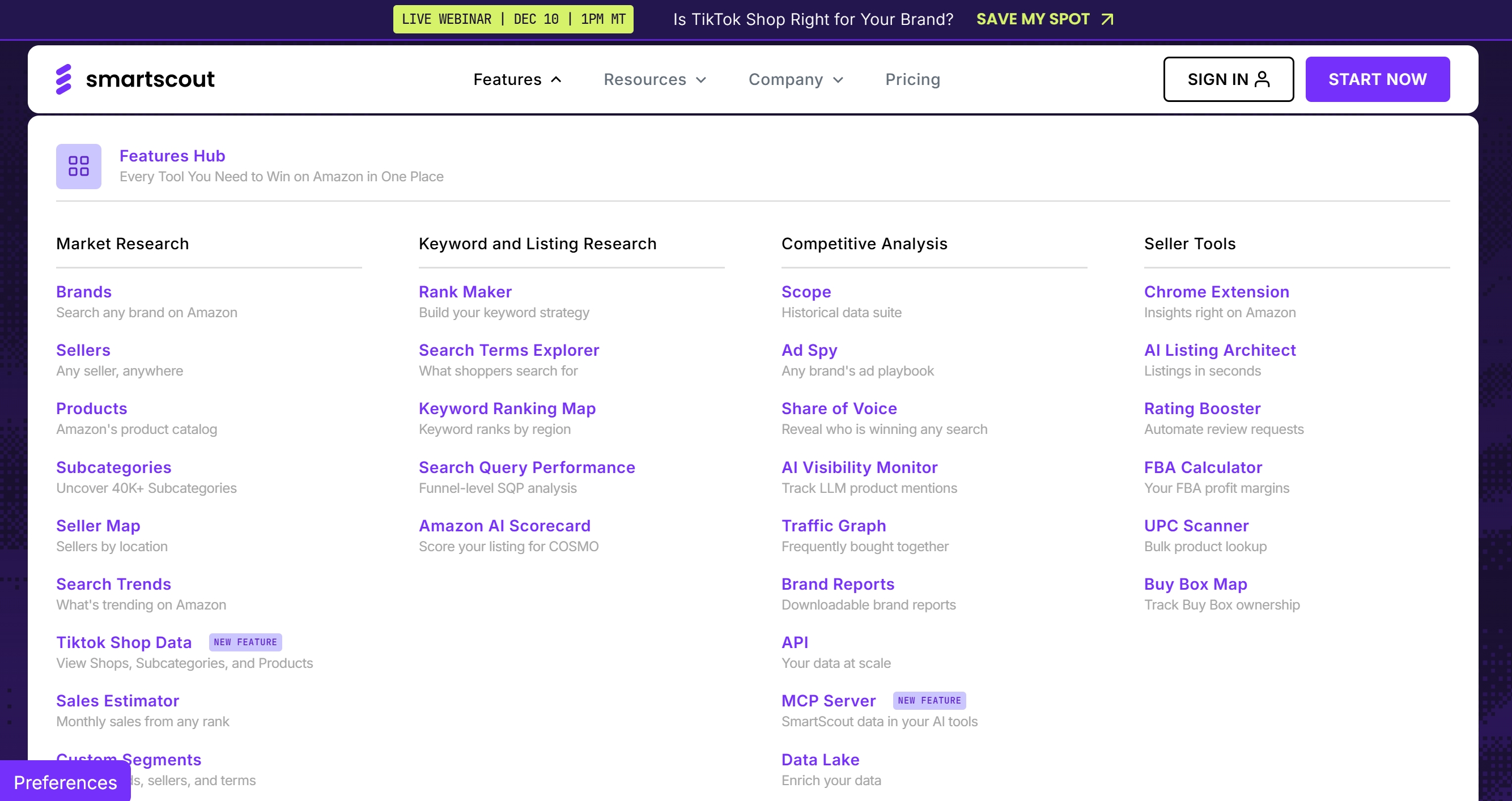
SmartScout approaches Amazon research from a broader competitive perspective, with tools designed to explore products, brands, sellers, subcategories, and the relationships between them.
Rather than focusing only on individual product opportunities, SmartScout is particularly valuable for understanding which businesses control a market, how their catalogs are structured, and where potential opportunities exist within that competitive landscape.
Key Product Research Features
SmartScout provides several levels of research that allow users to move between individual products and the businesses operating within their markets.
- Brand Research: Examine brand revenue estimates, catalog performance, growth, and competitive positioning.
- Seller Research: Discover third-party sellers and investigate their product catalogs and brand coverage.
- Subcategory Research: Explore detailed Amazon market segments through estimated revenue, growth, pricing, and competitive indicators.
- Product Research: Filter and evaluate individual Amazon products using product-level data.
- Traffic Graph: Visualize product relationships connected to Amazon recommendation placements, including frequently bought together associations.
- Price List Scanner: Evaluate potential resale opportunities by matching supplier product information against Amazon data.
Where SmartScout Provides the Most Value
SmartScout is particularly useful for questions that go beyond the estimated sales of individual ASINs.
A wholesale seller might want to identify brands with meaningful Amazon demand but relatively limited seller participation. An established private label brand might investigate how revenue is distributed among competing brands before deciding whether to enter a new category.
SmartScout's brand, seller, and subcategory intelligence supports these broader competitive research tasks.
Its product relationship data can also help sellers identify complementary products, potential cross-selling opportunities, and relevant ASINs for product targeting.
Strengths and Considerations
SmartScout's greatest appeal is its ability to provide a wider view of Amazon's commercial ecosystem.
- Strengths: Brand and seller intelligence, detailed subcategory research, wholesale opportunity analysis, and product relationship visualization.
- Considerations: Access to advanced brand, seller, subcategory, and traffic intelligence depends on subscription level. The most appropriate plan may therefore differ significantly from the entry-level product research plan.
- Best for: Wholesalers, established brands, agencies, resellers, and businesses researching category structure and market share.
What Makes an Amazon Product Research Tool Effective?
A large product database is useful, but database size alone tells you little about whether a tool can support a profitable product decision. Effective Amazon product research software should help sellers move from identifying demand to understanding the conditions required to capture it.
The following five dimensions are especially important when evaluating both research tools and potential products.
1. Demand Quality and Historical Stability
Monthly sales estimates provide an initial indication of product demand. Historical data reveals whether that demand is stable, growing, seasonal, or temporarily inflated.
Amazon explains in its guide to Best Sellers Rank (BSR) that BSR reflects a product's sales ranking relative to other products in its category. Examining historical BSR alongside price and estimated sales trends can therefore provide useful context about changing product performance.
When evaluating demand, look for consistency across several months, investigate unusual peaks, and compare historical performance among multiple relevant competitors.
2. Accessible Demand and Competitive Concentration
Market size and market accessibility are different concepts.
A category generating substantial monthly revenue may appear attractive until you discover that a small number of established brands capture most of its sales. A smaller market with a more distributed revenue structure may provide a more realistic entry point.
One useful metric is the revenue concentration ratio:
Top Brand Revenue Concentration
Combined revenue of selected leading brands ÷ Total revenue of the defined market sample × 100%
Use a consistent market definition and avoid mixing overlapping parent and child ASIN revenue estimates when calculating concentration.
Also investigate how recently successful competing listings entered the market. Newer listings gaining meaningful sales can provide evidence that an opportunity remains accessible.
3. Keyword Demand and Traffic Acquisition
A product can have substantial estimated sales while still depending on traffic sources that are difficult or expensive for a new seller to reproduce.
Keyword research helps reveal how shoppers discover competing products, whether demand is concentrated around a few generic search terms, and whether more specific search terms offer alternative entry points.
Advertising economics also matter. Since Amazon Sponsored Products operates on a cost-per-click model, sellers should examine potential advertising costs alongside conversion expectations and product margins.
A viable product should have a realistic path to attracting customers without depending entirely on prohibitively expensive generic keywords.
4. Customer Needs and Product Differentiation
Review counts reveal an aspect of competitive maturity. Review content reveals what customers actually experience.
Recurring complaints can uncover product design weaknesses, confusing instructions, material problems, inconvenient packaging, or customer expectations that existing sellers have overlooked.
Effective product research should translate these insights into specific improvement hypotheses.
Product Differentiation Rule
Prioritize improvements that address a recurring customer problem, can be implemented at a reasonable cost, and are visible or understandable to shoppers before purchase. Changing a product's color alone rarely creates the same value as solving an important functional problem.
5. Profitability and Operational Feasibility
Estimated monthly revenue is only one part of a product's commercial potential. A seller must also account for sourcing, freight, duties, referral fees, fulfillment, advertising, storage, and returns.
Amazon publishes information about its selling fees and fulfillment costs, including resources that help sellers estimate the expenses associated with different fulfillment methods.
Beyond margins, consider supplier lead times, minimum order quantities, product dimensions, safety requirements, intellectual property risks, and the amount of capital needed to maintain inventory.
These factors determine whether an attractive market opportunity is compatible with your actual business.
Product Research in Practice: From Opportunity to Profitability
Consider a private label seller evaluating an under-sink organizer for the Amazon US marketplace. At first glance, the product may appear attractive because of its established demand and relatively straightforward functionality.
The following hypothetical example illustrates how deeper product research can change the investment decision. All figures and market observations in this example are illustrative rather than live marketplace findings.
Finding a More Specific Customer Opportunity
Imagine that the seller discovers three patterns during research:
- Established brands dominate the generic under-sink organizer search results.
- Some shoppers search specifically for organizers that fit around sink pipes and narrow cabinets.
- Competing products receive recurring complaints about difficult installation and unstable sliding drawers.
These observations suggest that a compact, adjustable organizer designed around plumbing restrictions could be a more defensible opportunity than another generic storage rack.
The next question is whether that improvement can be delivered profitably.
Stress-Testing the Product Economics
Assume the seller builds two scenarios: an expected launch scenario and a more challenging scenario involving a lower selling price and higher advertising costs.
| Per-Unit Economics | Base Scenario | Stress Scenario |
|---|---|---|
| Selling price | $29.99 | $26.99 |
| Landed product cost | $8.20 | $8.20 |
| Amazon referral and fulfillment fees | $9.10 | $8.65 |
| Inbound placement, storage, and returns allowance | $1.60 | $1.60 |
| Advertising cost per unit sold | $4.50 | $6.50 |
| Contribution per unit | $6.59 | $2.04 |
| Contribution margin | 22.0% | 7.6% |
Illustrative calculations before fixed business overhead and income taxes. Actual fees and costs depend on the product, marketplace, fulfillment arrangement, and operating conditions.
Although the product remains contribution-positive in both scenarios, the second scenario provides considerably less room for operating expenses, unexpected costs, and future price competition.
This could lead the seller to negotiate lower manufacturing costs, redesign packaging, pursue a more specific keyword strategy, or postpone the launch until the economics improve.
The Research Lesson
A promising Amazon product should have more than attractive estimated revenue. It needs a specific customer opportunity, an achievable traffic strategy, and enough financial resilience to withstand realistic changes in prices, advertising costs, and operating conditions.
How to Research Products on Amazon with SellerSprite
One of the most effective ways to use an Amazon product research platform is to organize the process around a series of investment decisions. Each stage should answer a specific question and produce an actionable research outcome.
Here is a seven-stage workflow using SellerSprite.
Step 1: Define Your Commercial Constraints
Start by establishing your available investment capital, target marketplace, sourcing capabilities, desired margin, product size limitations, and acceptable lead times.
A seller with limited launch capital may prioritize compact products, manageable initial orders, and relatively stable demand. An established brand might instead prioritize opportunities that complement its existing catalog and supplier relationships.
Research outcome: A clear set of commercial requirements that can guide the subsequent product search.
Step 2: Identify Attractive Markets
Use SellerSprite Category Insights to explore relevant categories and subcategories based on market demand, growth, pricing, and competition.
Look beyond the largest markets. Compare the commercial attractiveness of different niches and examine whether meaningful sales are distributed among multiple competing products.
Research outcome: A shortlist of promising market segments rather than a collection of unrelated bestselling products.
Step 3: Discover and Validate Competing Products
Apply Product Research filters to identify products within the shortlisted markets that match your preferred sales range, price, review profile, dimensions, and other requirements.
Then use Competitor Research to investigate individual listings and compare relevant product variations, historical sales, pricing, and BSR performance.
Pay particular attention to whether demand is concentrated in specific variants, pack sizes, or product configurations. This can influence both product design and initial inventory planning.
Research outcome: A shortlist of commercially relevant products and competitors.
Step 4: Investigate How Competitors Acquire Traffic
Use Reverse ASIN to investigate the keywords associated with competing listings, then expand your research using keyword discovery tools.
Compare generic terms with more specific buyer-intent keywords. Examine demand, competitor visibility, relevant search trends, and potential advertising costs to determine where a new listing could compete.
Research outcome: A preliminary keyword and customer acquisition strategy.
Step 5: Turn Customer Reviews into Product Improvements
Run AI Review Analysis on relevant competing products to identify common complaints, valued features, customer expectations, and usage scenarios.
Cross-check important findings against the underlying reviews and determine which improvements are commercially realistic. Translate the strongest opportunities into product specifications, packaging requirements, or listing communication priorities.
Research outcome: A differentiated product concept based on identifiable customer needs.
Step 6: Calculate Profitability and Assess Risks
Use SellerSprite's Profitability Calculator alongside supplier quotations and current Amazon fee information to develop a realistic cost model.
Test how contribution margins change when the selling price falls, advertising costs increase, or product returns exceed expectations. Review applicable product compliance and category requirements using resources such as Amazon's seller policies overview.
Research outcome: A financially evaluated product concept with clearly identified operating risks.
Step 7: Monitor the Market Before Committing Inventory
Use Product Tracker and Keyword Tracker, where included in your plan, to follow relevant competitors and keyword rankings during the sourcing and sampling process.
SellerSprite's browser extension also offers Stock Status for checking available competitor inventory information directly on supported Amazon product pages. Enable this module in the extension settings if needed.
Combining pricing, product performance, keyword visibility, and available stock observations can help identify changing competitive conditions before you place a substantial inventory order.
Research outcome: An updated market assessment that supports your final launch decision.
Amazon Product Validation Checklist
Before placing your first inventory order, confirm that you can answer the following questions:
- ☐ Does the product have consistent or commercially predictable demand?
- ☐ Is there evidence that newer or smaller competitors can capture sales?
- ☐ Have I identified relevant and attainable keyword opportunities?
- ☐ Does my product address a specific and meaningful customer need?
- ☐ Have I received realistic supplier quotations and reviewed product samples?
- ☐ Have I accounted for Amazon fees, advertising, logistics, storage, and returns?
- ☐ Can the product remain contribution-positive under reasonable stress scenarios?
- ☐ Have I checked intellectual property, product safety, and marketplace requirements?
- ☐ Can my available capital support inventory replenishment and the launch period?
Common Amazon Product Research Mistakes
Even experienced sellers can misinterpret marketplace data when individual metrics are considered outside their commercial context. Avoiding the following mistakes can significantly improve the quality of your research decisions.
Treating Estimated Sales as Your Future Sales
A competitor selling an estimated 1,000 units per month demonstrates existing demand for its offer. It does not mean a new competing product will immediately sell the same quantity.
Build your forecast around realistic market entry assumptions, advertising performance, listing visibility, customer conversion, and inventory availability.
Assuming Low Review Counts Mean Low Competition
A niche with relatively few reviews may still contain established brands, aggressively advertised listings, or recent product launches backed by substantial marketing budgets.
Combine review analysis with brand concentration, organic and sponsored visibility, listing age, and sales distribution to understand the actual competitive environment.
Confusing Parent Listing Sales with Individual Variation Sales
A product family may generate impressive sales while most purchases are concentrated in a single size, color, or configuration.
Investigate variation-level performance whenever available, and make sure the sales figures you compare refer to consistent product scopes.
This is particularly important when selecting inventory quantities or deciding which variations to launch first.
Ignoring the Cost of Winning Traffic
Popular products often attract substantial advertising competition. A niche with strong search volume may require bids and conversion rates that leave very little margin for a new seller.
Estimate advertising costs before selecting a product and evaluate keyword opportunities in relation to your target contribution margin.
Using the Same Product Filters for Every Business
Universal product selection criteria can be useful starting points, but they should reflect the seller's actual operating model.
A small private label business, an established premium brand, and a wholesale distributor have different sourcing advantages, capital requirements, cost structures, and acceptable margins.
Customize your research filters around those differences rather than relying entirely on a predefined winning-product formula.
Which Amazon Product Research Tool Should You Choose?
The most appropriate research platform depends on the decisions your business needs to make regularly. A seller planning a first private label launch may value straightforward product discovery, while a mature brand may require deeper consumer, market, and competitive intelligence.
| Your Main Research Objective | Recommended Tool | Reason |
|---|---|---|
| Comprehensive product development and market validation | SellerSprite | Connects market demand, competition, keyword intelligence, and consumer needs. |
| Product research integrated with broader seller operations | Helium 10 | Combines research, listing tools, advertising, and operational capabilities. |
| Finding products and exploring suppliers | Jungle Scout | Offers structured product discovery and supplier research. |
| Quick initial research directly on Amazon | AMZScout | Provides accessible browser-based product evaluation. |
| Wholesale, brand research, and market share analysis | SmartScout | Provides broader brand, seller, and subcategory intelligence. |
For sellers who want to develop products based on a combination of market demand, competitive opportunities, keyword intelligence, and real customer needs, SellerSprite offers a particularly comprehensive research environment.
Helium 10 is a strong alternative for businesses prioritizing an integrated operations ecosystem. Jungle Scout is useful when sourcing plays a central role, AMZScout supports a more straightforward initial research experience, and SmartScout provides valuable insights into broader brand and market structures.
Before subscribing, consider running the same research task across the tools you are evaluating. Use the same marketplace, product sample, date range, and commercial requirements. Compare the clarity of the results, the depth of available insights, and how easily those insights translate into decisions.
Final Thoughts
The best Amazon product research tools help sellers do more than find products with impressive sales figures. They help determine why customers buy those products, whether a new seller can compete for the same demand, and what it would take to build a sustainable business around that opportunity.
As Amazon markets become more competitive, the ability to connect product research with consumer intelligence, keyword strategy, and realistic profitability becomes increasingly valuable.
SellerSprite brings these research stages together, allowing sellers to move from discovering promising markets to evaluating individual products, identifying customer needs, and validating their commercial potential.
The objective is not simply to discover another product that sells. It is to identify a product that gives your business a credible reason to enter the market and a realistic opportunity to grow within it.
Find Your Next Amazon Product Opportunity with SellerSprite
Explore profitable niches, uncover customer needs, analyze competitors, discover relevant keywords, and validate your product ideas before investing in inventory.
3-day free trial. No credit card required.
Frequently Asked Questions
Here are answers to common questions about Amazon product research tools, sales estimates, software selection, and product validation.
What is the best Amazon product research tool?
SellerSprite is a strong overall choice for Amazon sellers who want comprehensive product research, category intelligence, competitor analysis, keyword research, AI review analysis, and profitability evaluation within one platform. Helium 10, Jungle Scout, AMZScout, and SmartScout are also valuable alternatives depending on specific business requirements.
What is the best free Amazon product research tool?
SellerSprite offers free research utilities, including a Sales Estimator and Profitability Calculator, alongside its free browser extension. Amazon Product Opportunity Explorer is another valuable resource available to sellers through Seller Central. Free tools are particularly useful for initial research, while paid subscriptions typically provide broader data access and advanced analysis capabilities.
Are Amazon product research tools accurate?
Amazon product research tools combine observable marketplace information with proprietary estimation methods. Publicly displayed information such as prices, review counts, and BSR differs from estimated metrics such as monthly sales and revenue. Sales estimates can vary across platforms, marketplaces, categories, and time periods. Historical trends and comparisons across relevant products are especially useful when evaluating these estimates.
How do I find high-demand, low-competition products on Amazon?
Begin with a product or category research tool to identify products with meaningful sales or search demand. Then evaluate brand concentration, review distribution, historical trends, keyword competition, and the performance of newer listings. Look for markets where an improved product can address specific customer needs and acquire traffic at a sustainable cost.
Is SellerSprite better than Helium 10 for product research?
SellerSprite is particularly well suited to sellers prioritizing detailed product discovery, market analysis, keyword intelligence, customer review analysis, and international marketplace research. Helium 10 is especially useful for businesses that want research integrated with a broader ecosystem of advertising, listing optimization, and operational tools. The better choice depends on the seller's research priorities and subscription requirements.
What is the best Amazon product research tool for private label sellers?
SellerSprite and Jungle Scout are particularly useful for private label research. SellerSprite connects market analysis with keyword demand, competitor performance, consumer needs, and product development opportunities. Jungle Scout provides a structured product discovery workflow with additional supplier research capabilities on eligible plans.
Can Amazon product research tools identify profitable products?
They can identify products and markets with promising commercial characteristics, estimate revenue potential, and help evaluate competitive conditions. Determining actual profitability requires a separate assessment of sourcing costs, Amazon fees, advertising expenses, logistics, returns, inventory requirements, and expected selling prices.
Can I do Amazon product research without paid software?
Yes. Amazon Best Sellers, Product Opportunity Explorer, customer reviews, publicly visible listing information, and free sales estimation tools provide useful starting points. Paid research software becomes especially valuable when sellers need to compare many products, investigate historical trends, discover competitor keywords, or analyze markets systematically.
How much does Amazon product research software cost?
Pricing varies by platform, subscription level, billing period, and feature access. The monthly plan examples in this guide range from $39 to $129, while more advanced plans can cost considerably more. When comparing subscriptions, consider research limits, marketplace coverage, historical data, tracking allowances, and whether your required features are included.
About the Author
SellerSprite Content Team
The SellerSprite Content Team focuses on Amazon marketplace intelligence, ecommerce analytics, product development, keyword research, competitive strategy, and seller education. Our ongoing research explores how marketplace data and consumer insights can support more informed product, marketing, and business decisions across international Amazon marketplaces.
References and Further Reading
- Amazon. Product Opportunity Explorer.
- Amazon. Get Product Ideas with Product Opportunity Explorer.
- Amazon. Guide to Amazon Sales Rank: Best Sellers Rank (BSR).
- Amazon. How Much Does It Cost to Sell on Amazon?
- Amazon. Fulfillment by Amazon (FBA).
- Amazon Ads. Best Practices for Your Sponsored Products Ads.
- Amazon. Amazon Seller Policies to Know to Keep Your Business Thriving.