TL;DR: Reverse ASIN for KDP is reader-intent research, not spec-sheet research. It shows which search terms make comparable books visible, so you can route each term to your seven KDP keyword fields, your Amazon Ads targeting, or a monitoring list, without copying anything that breaks KDP's metadata rules.
Key Takeaways
- Books sell promises, not specifications. Reverse ASIN surfaces reader language, including tropes, outcomes, audiences, and formats, instead of product features.
- Reverse ASIN reveals visibility, not metadata. It cannot expose a competitor's seven KDP backend keyword fields, exact sales, royalties, or ad budget.
- Choose comparable ASINs by reader promise, genre, audience, and format, rather than just category, and include emerging titles alongside established leaders.
- One term can be right for Amazon Ads and wrong for KDP metadata: competitor author and book names are targeting inputs, never backend keywords.
- Route every term to metadata, ads, or monitoring, then recheck your own ASIN's search visibility after you make changes.
Table of Contents
- Why Books Break Product Keyword Logic
- What Reverse ASIN Can and Cannot Reveal
- Choosing Comparable Books by Reader Promise
- Fiction Keywords as Reader-Intent Signals
- Nonfiction and Low-Content Keywords
- Research Keywords vs. KDP Metadata Keywords
- Ads or Metadata: Routing the Same Term
- KDP Categories and Reverse ASIN Together
- Kindle, Paperback, and Hardcover Compared
- Building a KDP Keyword Decision Map
- Five Reverse ASIN Misreads
- A KDP-Specific SellerSprite Workflow
- FAQ
- Next Steps
- References
Note on marketplaces: This guide is specifically optimized for the US market (Amazon.com and Kindle Direct Publishing in the US) with terminology and policy references as of the release date.
Reverse ASIN is a familiar move for physical-product sellers: drop a competitor's ASIN into a tool and read the search terms driving its visibility. Books complicate that workflow, because a reader browsing for a novel is shopping for an emotional promise rather than a feature list. That single difference changes how you pick competitors, how you read keyword data, and which terms you allow into your KDP metadata.
This spoke guide is the book-specific companion to our complete reverse ASIN strategy guide. It covers what reverse ASIN can and cannot reveal about a competing book, how fiction, nonfiction, and low-content titles generate different signals, and how to turn raw terms into decisions using SellerSprite Keyword Reverse.
Reverse ASIN Works Differently for Books Because Readers Search for Promises, Not Specifications
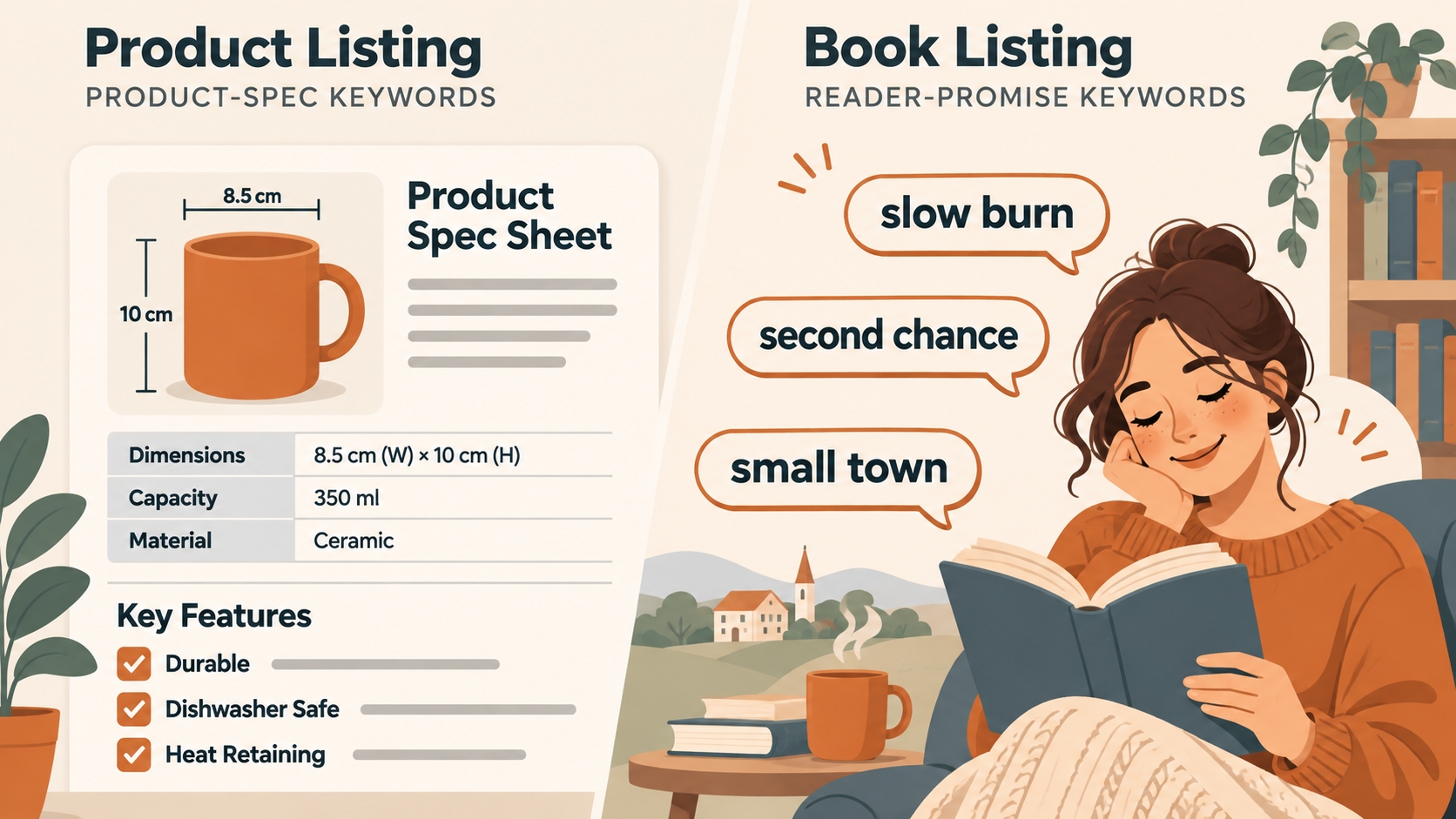
Before you open a keyword tool, reset the mental model. A product listing can be reverse-engineered against a spec sheet; a book listing cannot. Readers search for the experience they want, the problem they want solved, or the shelf they want to browse, and reverse ASIN for KDP becomes useful the moment you read its output as reader language rather than feature language.
Product Keywords Describe Features; Book Keywords Often Describe an Experience or Outcome
A shopper typing 'insulated water bottle 32 oz' has already decided what the object must do. A reader typing 'grumpy sunshine small town romance' is describing a feeling and a promise. When you review reverse ASIN results for a book, ask what each term promises: tension, comfort, transformation, a solved problem, or a finished project.
| Product keyword signal | Book keyword signal |
|---|---|
| Component or specification ('stainless steel') | Emotional promise ('slow burn', 'feel-good') |
| Compatibility ('fits iPhone 15') | Reader situation ('grief after loss') |
| Use case ('for meal prep') | Genre plus trope ('cozy mystery series') |
| Measured performance | Outcome ('budget on one income') |
Fiction, Nonfiction, and Low-Content Books Produce Different Keyword Signals
Fiction data clusters around genre, trope, setting, and series. Nonfiction clusters around problems, audiences, and methods. Low-content books, such as journals, planners, logbooks, behave closest to physical products, where format, page count, and use case do the ranking work. Blending all three languages in one analysis produces a keyword list that fits none of them.
Keyword Rank, Best Sellers Rank, and Category Position Answer Different Questions
Keep the three metrics separate. Keyword rank tells you where a book appears for one specific query. Best Sellers Rank summarizes recent sales velocity inside a category and updates frequently. Category position tells you where the title currently sits on a bestseller list. None is a proxy for another, and none is a sales figure.
Definitions to keep straight
- Keyword rank: position for one query, measured at a point in time.
- Best Sellers Rank: a category-relative sales-velocity indicator, not a keyword position.
- Category position: placement on a bestseller list, driven by sales relative to that list.
What Reverse ASIN Can and Cannot Reveal About a Competing Book
Reverse ASIN is an inference engine, not a back door into Amazon's database. It builds a picture from which searches return a given ASIN and how that ASIN performs across them. Knowing exactly where the inference stops keeps you from planning a launch on a claim the data cannot support.
It Can Reveal Search Terms Where a Competing Book Gains Visibility
Typical output includes the queries a book appears for, its estimated position for each, and often search volume plus related terms. That is enough to see which reader language the title has already claimed, for example, a trope, an outcome, or an audience, and which language it has left unattended for you.
It Cannot Reveal the Competitor's Seven KDP Backend Keyword Fields
No external tool can read the private keyword fields inside another publisher's KDP account. A term in your report may live in the competitor's backend keywords, title, subtitle, description, or A+ content, or may simply be matched by Amazon's indexing. Treat output as evidence of visibility, never as proof of metadata.
It Cannot Prove the Book's Exact Sales, Royalties, or Advertising Budget
BSR-based models and visibility counts carry real error bars. A competitor running heavy paid traffic can look identical to one selling organically, and royalties depend on format, list price, and territory. Use these signals to prioritize research, never to forecast revenue or reverse-engineer someone's ad budget.
Reality check before you plan
- Visibility is not metadata: a ranking term may come from anywhere on the page.
- Estimates are not sales: direction is reliable, precision is not.
- A bestseller's keywords are not your keywords until the promise matches.
Choose Comparable Books by Reader Promise, Not Just by Amazon Category
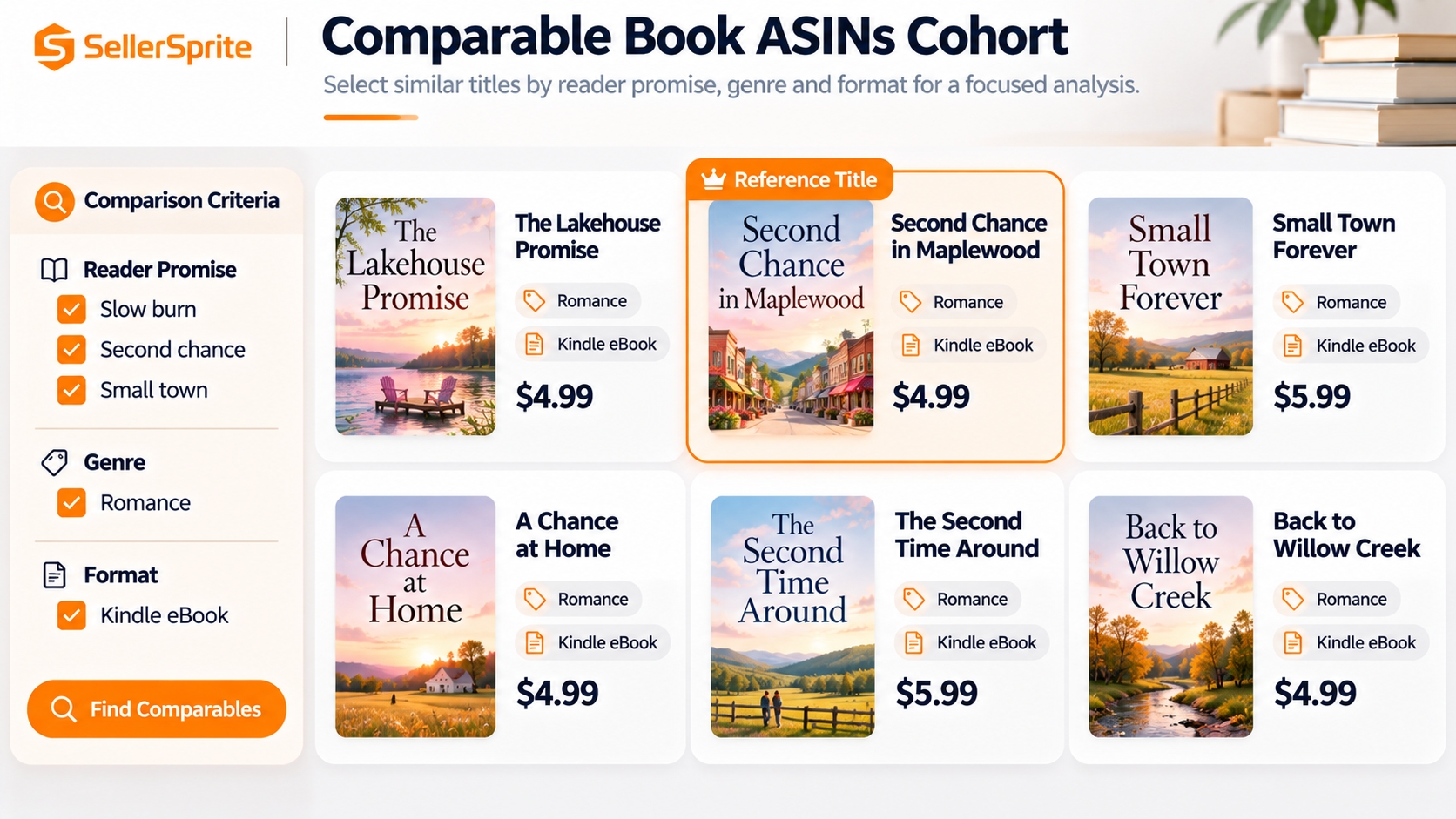
The quality of a reverse ASIN report is decided before you run it. If you choose the wrong comparables, you may end up collecting keywords from a different market that is larger, smaller, or targeted at a completely different reader. Ten extra minutes choosing a cohort protects every decision that follows.
Start With Books That Serve the Same Reader Need
Ask what job the reader is hiring the book to do: escape, learn a skill, finish a project, laugh, or feel understood. A competitor that solves the same job is comparable even when its cover, price, or publisher looks different. A title in your category that solves a different job will pollute the dataset.
Match Genre, Audience, and Format When They Change Search Intent
A young-adult fantasy romance and an adult epic fantasy share a shelf, not a search box. The same is true of a workbook versus a hardcover reference, or a large-print edition versus an ebook. When audience or format changes what the reader types, analyze the titles as separate markets.
Include Both Established Leaders and Emerging Titles
Leaders show the size of the prize and the language that already converts. Recent releases with rising BSR show which new phrasing is working before it saturates. A cohort of five to ten ASINs, weighted toward mid-list titles and anchored by one or two leaders, is usually enough for a first pass.
Do Not Let One Famous Bestseller Define the Entire Keyword Market
Bestsellers carry author-name searches, award mentions, film tie-ins, and social media spikes that a new title cannot inherit. If one ASIN dominates your report, check whether its top terms describe the book's content or its fame. Strip out the fame terms before you plan metadata.
Comparable-ASIN checklist
- Same reader need, even if the cover or price differs.
- Same genre and subgenre language the reader would type.
- Same audience and reading level.
- Same dominant format (ebook, paperback, hardcover).
- At least two titles older than 12 months and one recent release.
Read Fiction Reverse ASIN Keywords as Reader-Intent Signals
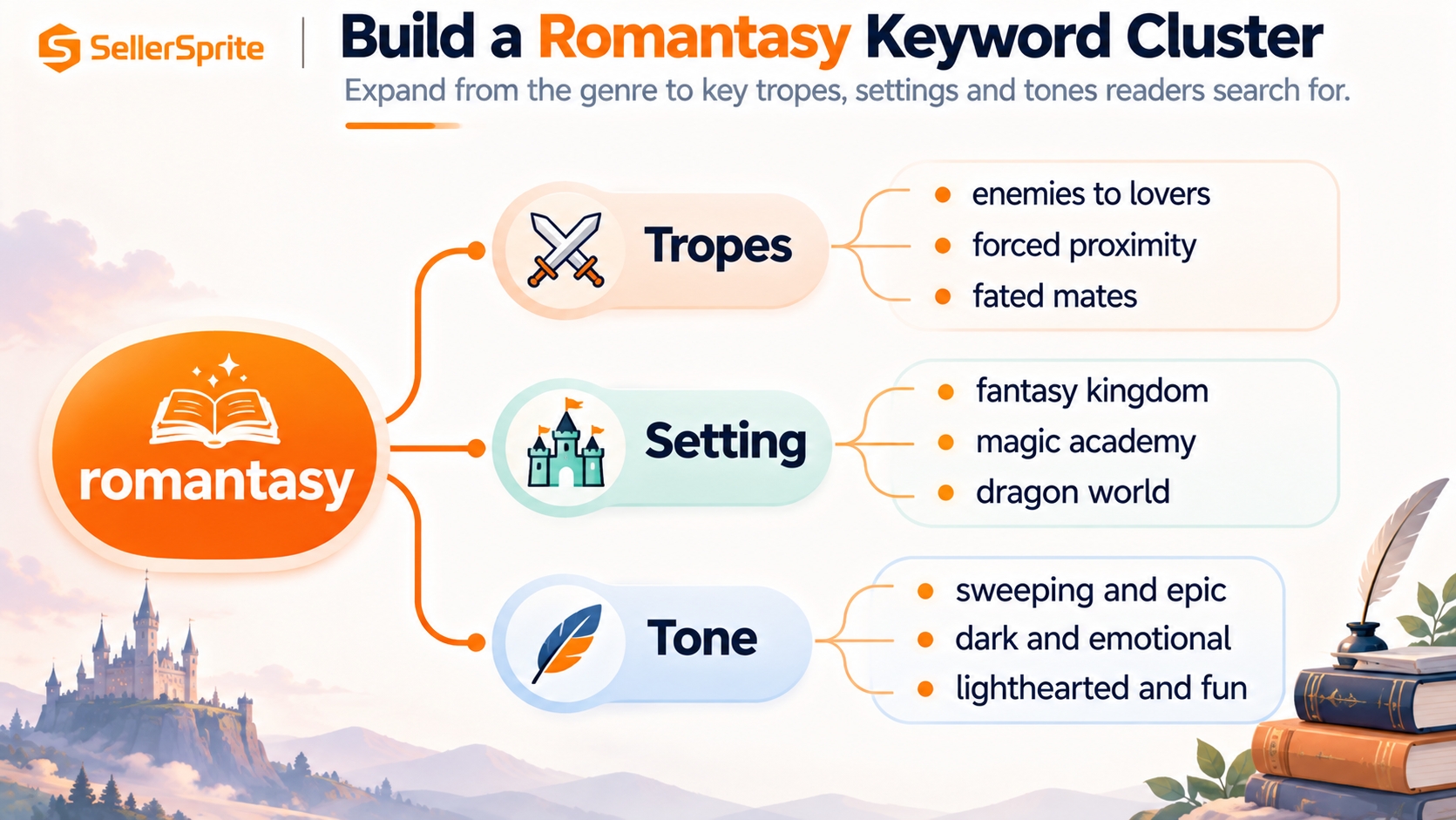
Fiction keywords look vague until you sort them by the layer of intent they represent. Genre says where the reader browses, trope says what they expect to feel, and detail says why this story. Reading in layers stops you from spending all seven keyword fields on the same broad idea.
Genre and Subgenre Define the Broad Discovery Layer
Terms like 'cozy mystery', 'romantasy', or 'domestic thriller' form the broadest, most competitive layer. They usually belong in your category selection and title-level metadata rather than in every field. Reverse ASIN shows which subgenre labels the comparable cohort genuinely ranks for, which is far more reliable than guessing.
Tropes and Themes Reveal Why the Reader Wants the Story
Second-chance romance, found family, morally grey hero, and revenge arc are the kinds of phrases readers type when they want a specific emotional pattern. In fiction reports they often carry a better intent-to-volume ratio than genre terms, and they translate cleanly into backend keywords without repeating your subtitle.
Setting, Character Types, and Tone Add Long-Tail Intent
Small-town bakery, rival hockey captains, snowy cabin, dual timeline, closed-door romance. These modifiers narrow a search to something a reader can picture. They are also the terms most authors skip, which makes them one of the few realistic places to compete with a small ad budget or a brand-new listing.
Series-Level Terms Can Reflect Reader Loyalty Rather Than Generic Demand
Queries containing a series name, book number, or character usually signal existing fans rather than new demand. Those terms matter for ads, read-through, and title consistency, but they rarely expand discovery for a standalone title. Pull them out of the report before you rank keywords by volume.
Read Nonfiction and Low-Content Keywords Through a Different Lens
Nonfiction and low-content titles answer a reader's question, so their keyword data reads like problem-solving language. The mistake here is broader than in fiction: authors chase the big topic term and ignore the audience, method, or format modifiers that separate a browsing reader from a buyer.
Nonfiction Queries Often Start With a Problem or Desired Outcome
'Stop yelling at my kids', 'pass the Series 7 on the first try', 'budget with an irregular income'. Outcome language converts because it mirrors the reader's own words. Topic language, such as 'parenting', 'finance', describes a shelf. Both appear in reverse ASIN reports, but only one of them usually sells the book.
Audience and Skill Level Can Matter More Than the Broad Topic
The same topic splits into very different markets: for beginners, for nurses, for teens, for busy parents. If your cohort serves a different reader, its keyword list will look appealing and convert poorly. Rank candidates by whether they describe your reader, not just your subject.
Method, Format, and Use Case Help Separate Similar Books
Workbook, 30-day plan, CBT-based, large print, with worksheets, Kindle Unlimited. These modifiers tell a reader whether the book fits their life. They are legitimate metadata, and they are often the difference between ranking for a topic and ranking for a purchase.
Low-Content Books Behave More Like Products Than Narrative Books
A logbook competes on layout, dimensions, and use case: 'fishing log book for kids', '13-month weekly planner', 'mileage log for small business'. Study these ASINs the way a product seller studies a competitor. Prompts, cover words, and interior structure all surface as query language. For the publishing basics behind this, see our guide to Amazon book publishing and self-publishing.
Separate Reverse ASIN Research Keywords From KDP Metadata Keywords
This is where most KDP keyword plans go wrong. Research and metadata are different jobs: research is broad, exploratory, and tolerant of noise; metadata is narrow, policy-governed, and visible to buyers until you edit it. Mixing the outputs fills your keyword fields with terms Amazon already indexes elsewhere.
KDP Gives You Up to Seven Relevant Keywords or Short Phrases
Your backend slots are few, so each one must earn its place. A field can usually combine two related ideas, a trope plus a setting for instance, instead of burning a slot on a single word Amazon already reads in your title. Confirm current field limits in KDP Help before you finalize anything.
Do Not Copy Competitor Authors, Book Titles, Brands, or Promotional Claims Into Metadata
KDP's metadata rules prohibit misleading or infringing keywords. Other authors' names, other books' titles, trademarked brands, and claims such as 'bestseller', 'free', or 'award-winning' are the classic violations. A term that performs brilliantly in ad targeting can become a policy problem once it lands in your backend fields.
Avoid Wasting Keyword Space on Information Already Covered Elsewhere
Your title, subtitle, author name, series name, and selected categories are already indexed. Repeating them in the seven fields adds nothing. Repeating one idea in five variations, such as 'romance', 'romantic', 'romance book', is the same leak in a different shape, and Amazon usually handles plurals and spelling variants on its own.
Reverse ASIN Is a Discovery Source, Not a Copy-and-Paste Metadata Generator
The report maps what readers search and what comparable books rank for. It is not a recommendation engine for your listing. Two books with overlapping keywords may still need different metadata, because their covers, opening pages, and promises pull different readers through the sample.
Never put these in your seven KDP fields
- Another author's name, including misspellings of famous names.
- Other book titles or series names you do not own.
- Trademarked brands or celebrity names.
- Promotional claims such as 'bestseller', 'free', 'sale', or 'award-winning'.
- Unrelated trending terms added purely for traffic.
The Same Competitor Term Can Be Useful in Ads but Wrong in KDP Metadata
Amazon Ads and KDP metadata accept different inputs for different reasons. Ads let you aim at a specific book or author; metadata describes what your book contains. That is not a technicality; it is the line between a compliant campaign and a policy warning.
Similar Authors and Titles Can Inform Amazon Ads Targeting
On Amazon Ads, product targeting lets you place ads on a comparable book's detail page, and keyword or interest targeting can include author and title terms, subject to Amazon's advertising policies and any trademark concerns. Readers who finished a similar book are a strong audience, and this is a legitimate use of competitor names.
Competitor Author and Book Names Do Not Belong in Your KDP Metadata
The exact term that earns a placement in ads can violate KDP's metadata rules when it lands in a keyword field. Book metadata is meant to describe your book, not to intercept another author's readers through backend fields. Keep the routing clean and the compliance risk stays low.
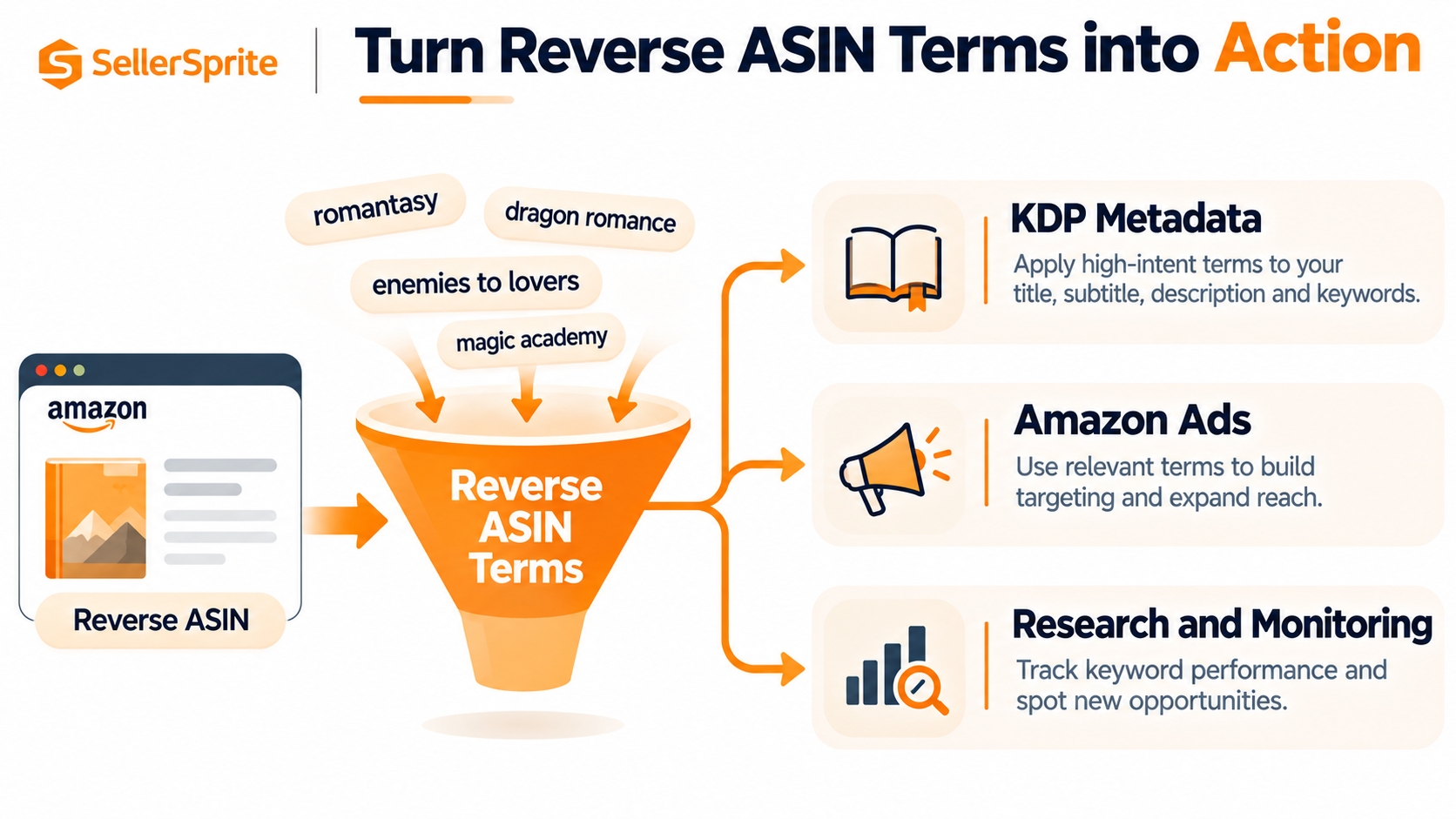
Route Every Reverse ASIN Term to Metadata, Ads, or Research Only
Routing takes seconds per term and prevents most mistakes. Ask three questions in order: does this term honestly describe my book, could it mislead a reader, and is it a name or claim I do not own? The answers decide the destination.
| Term type | KDP metadata | Amazon Ads | Research only |
|---|---|---|---|
| Trope, theme, or outcome | Yes | Yes | — |
| Competitor author or title | No | Yes, policy-dependent | — |
| Category label | Usually redundant | Yes | Yes |
| Promotional or superlative claim | No | No | Yes |
| Emerging reader phrase | Monitor first | Test with small budget | Yes |
Use KDP Categories and Reverse ASIN Keywords Together Without Treating Them as the Same Signal
Categories and keywords are often treated as two versions of the same decision. They are not. Categories tell Amazon where to shelve your book; keywords describe what it is about and who it is for. Reverse ASIN can inform both, provided you keep the outputs in separate lanes.
Categories Tell Amazon Where to Shelf the Book
Your selected categories determine which bestseller lists you can appear on and which browse paths lead to your detail page. Amazon's category tree is structural, not descriptive. Choose lists where your reader actually browses, and where a realistic sales volume can earn visibility rather than permanent obscurity.
Search Queries Reveal How Readers Describe What They Want
Readers rarely type category names. They type 'enemies to lovers fantasy', 'budget planner for couples', or 'grief journal for losing a parent'. Reverse ASIN hands you that natural language, and it is far more useful for metadata and ad copy than the official taxonomy label ever will be.
Category-Like Keywords Can Be Useful for Research but Redundant in Metadata
If 'cozy mystery' already appears in your subtitle and category selection, spending a backend field on it usually adds nothing. Use category-like terms to judge competitive density and to brief your cover and description, then reserve the field for language Amazon cannot already find on your page.
Reverse ASIN Can Surface Demand Beyond Your Three Selected Categories
Books frequently rank for queries that belong to adjacent categories: a business memoir pulling 'leadership', a romance pulling 'women's fiction'. Those queries reveal cross-shelf demand. Use them to test category choices, ad sets, and description phrasing, but do not to stuff every adjacent label into metadata.
Compare Kindle, Paperback, and Hardcover Without Treating Them Like Normal Product Variations
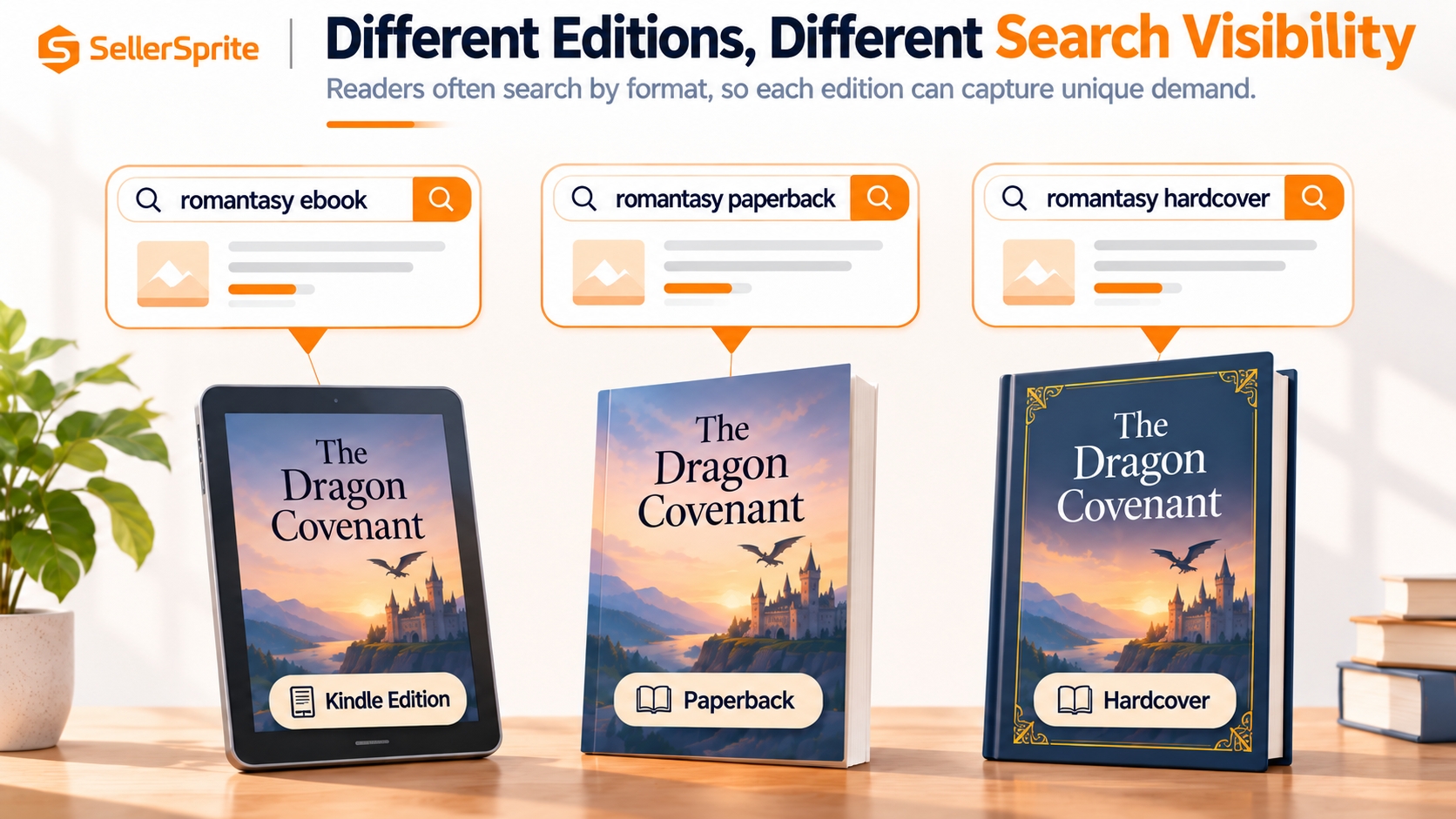
Kindle, paperback, and hardcover editions are not simple variations the way a blue and a red version of a product are. They have separate ASINs, sometimes separate review pools, and different buyers. Reverse ASIN results between them can diverge more than most authors expect.
Different Formats Can Produce Different Search Visibility
A paperback may rank for gift-oriented and box-set queries the ebook never touches, while a Kindle edition often dominates price-sensitive and Kindle Unlimited searches. Running the report on one format only risks missing an entire layer of reader language that belongs to the other edition.
KDP Recommends Keeping Keywords and Descriptions Consistent Across Formats
Consistency is the safer operating rule: readers should meet the same promise whichever edition they land on. KDP's help documentation is the source of truth here, so confirm current guidance before you diverge. If you adapt a subtitle for one format, document the reason so the difference stays deliberate rather than accidental.
Analyze the Format That Best Represents the Reader's Buying Behavior
For most indie fiction, the ebook is where discovery and ranking happen. For planners, workbooks, and gift books, paperback is the market. Pick the format that mirrors how your buyer actually purchases, then spot-check one secondary format for terms you would otherwise miss.
Turn Reverse ASIN Results Into a KDP Keyword Decision Map
A reverse ASIN export is just a list until each line carries a decision. The goal is not a longer list; it is a defensible set of choices you can explain to a co-author, a client, or your future self. Four buckets cover almost every term you will encounter.
Keep Terms That Accurately Describe the Book and Its Reader Promise
These are the terms where content, cover, and description all agree with the query. They earn a metadata slot or a category decision without hesitation. If you cannot picture the exact reader who would type the phrase and be satisfied by your book, it is not a keep.
Test Ambiguous but Relevant Search Intent Through Amazon Ads
Some terms are honest but unproven: adjacent audiences, new phrasing, mild stretches of your promise. Ads let you measure interest without locking anything into metadata. Give each test a small budget, a fixed window, and a defined success metric before you start spending.
Exclude Attractive Keywords That Would Misrepresent the Book
High volume plus weak relevance is the most expensive combination in publishing. A keyword that pulls mismatched readers produces returns, ebook refunds, weak reviews, and declining conversion. Excluding those terms is a commercial decision first and a compliance decision second.
Keep Emerging Reader Language on a Monitoring List
Slang, tropes, and formats move quickly. A phrase that looks tiny this quarter can define a subgenre next year. Keep a dated list of terms you are watching, revisit it monthly, and promote a term only when both search behavior and your catalog support it.
Decision map rules
- If the term describes the book honestly and precisely, consider metadata.
- If the term is relevant but unproven, send it to an ad test.
- If the term would mislead a reader, exclude it whatever its volume.
- If the term is early or trending, log it with a date and revisit monthly.
Five Reverse ASIN Misreads That Can Hurt a KDP Keyword Strategy
Most reverse ASIN failures are interpretation failures, not tool failures. The five below account for a large share of wasted keyword work in KDP publishing, and each one has a quick counter-check you can run before anything reaches your listing.
Treating Best Sellers Rank as Keyword Rank
A book ranked #40,000 overall is not 'ranked 40,000' for a keyword. BSR reflects recent sales velocity in a category; keyword rank reflects position for one query. Confusing the two leads authors to chase sales rank improvements when the real problem is relevance.
Copying Bestseller Keywords Without Matching the Reader Promise
A bestseller's top term may work because the author is famous, the book was adapted, or a community adopted it. Copying the phrase without the matching cover, sample, and reputation produces traffic that bounces. Match the promise first, then borrow the language.
Putting Competitor Author Names Into KDP Metadata Because They Work in Ads
Ads permit targeting comparable titles; KDP metadata does not permit listing them. Authors who move an ad-targeting list straight into backend fields risk complaints, listing suppression, or account issues. Keep two separate documents: one for targeting, one for metadata.
Treating Every Search Term as One of Your Seven Backend Keywords
Search terms are inputs, not assignments. A report with 400 rows might yield 10 metadata candidates, 30 ad tests, and a long monitoring list. Filling all seven fields in the first hour guarantees you will waste most of them on phrases you never validated.
Assuming One Book Format Represents Every Edition
An ebook report can miss paperback-only demand, and a paperback report can miss Kindle Unlimited behavior. If your catalog has multiple editions, run the format your buyer prefers and spot-check the others before you conclude a term is irrelevant.
A KDP-Specific SellerSprite Reverse ASIN Workflow
Here is the workflow we recommend to SellerSprite users who publish on KDP. It takes about an hour for a first pass and fifteen minutes for a monthly refresh, and it keeps research, metadata, and advertising in separate lanes.
Start With a Small Cohort of Truly Comparable Book ASINs
Five to ten ASINs is enough for a first pass: two or three leaders, four to six mid-list titles, and one or two recent releases. Run these all together through SellerSprite's Reverse Multiple ASINs, export the terms, and date the ASIN list so you can re-run the same cohort later.
Group Keywords by Reader Intent Before Sorting by Search Volume
Sorting by volume first anchors you to the most competitive language in the market. Group by intent instead, for instance, genre, trope, outcome, audience, or format, and then rank inside each group. This keeps a small, winnable cluster from being buried under one broad head term.
Route Candidates to KDP Metadata, Amazon Ads, or Monitoring
Apply the routing questions: honest description, no misleading claims, no names you do not own. Metadata gets the precise, defensible phrases. Ads get the exploratory ones. Monitoring gets anything early, unproven, or trending. Document the reason for each decision so future edits stay consistent.
Recheck Search Visibility After Metadata or Advertising Changes
After you update keywords or launch a campaign, allow time for indexing and then re-run the report on your own ASIN. Compare rank for the target terms before and after. If a term never moves, the cause is usually relevance or competitive density, not a tool error.
Mini case (illustrative scenario, not a benchmark)
A 90-page guide on meal planning for shift workers. A six-ASIN cohort surfaced 'meal prep for night shift', 'freezer meals for one', and a high-volume 'carnivore meal plan'. The two honest phrases went into metadata, the 'night shift' variants went into ad tests, and the carnivore term was excluded as a promise mismatch. These are hypothetical decisions, not measured results.
FAQ
Can Reverse ASIN Show a Competitor's KDP Backend Keywords?
No. A reverse ASIN tool infers visibility from search results and rank data; it cannot read the private keyword fields inside another publisher's KDP account. A term in your report may come from the competitor's title, subtitle, description, A+ content, or from Amazon's own indexing behavior. Treat it as evidence of visibility, not proof of metadata.
How Many Keywords Can I Add to a KDP Book?
KDP currently provides seven keyword fields, each accepting a short keyword or phrase rather than a long list, and each with a character limit. Confirm the current limit in KDP Help before finalizing. In practice, seven well-chosen phrases that avoid repeating your title, subtitle, author name, and categories outperform seven fields packed with variations.
Can I Use Another Author's Name as a KDP Keyword?
No. KDP's metadata rules prohibit keywords that infringe or mislead, and another author's name is the classic example. Beyond policy, it invites complaints and can damage your listing's standing. Advertising is different: targeting comparable authors and titles is a normal Amazon Ads tactic, subject to Amazon's ad policies and trademark considerations.
Can I Target Similar Authors or Books in Amazon Ads?
Yes, within Amazon's advertising policies. Product targeting lets you place ads on comparable ASINs, and keyword targeting can include author and title terms. Keep that naming inside your ads account and never in KDP metadata, then monitor performance. If a name that produces clicks without conversions, it usually signals a promise mismatch.
Should I Reverse Search the Kindle or Paperback ASIN?
Usually, analyze the format your buyer actually purchases: the Kindle edition for most indie fiction, the paperback for workbooks, planners, and gift books. Then spot-check the other editions for terms you would otherwise miss. Different editions can rank for genuinely different queries, especially around gifting and format-specific searches.
Is Amazon Best Sellers Rank the Same as Keyword Rank?
No. Best Sellers Rank measures recent sales velocity within a category and updates frequently. Keyword rank measures where a book appears for one specific search query. A title can hold strong keyword positions with a modest BSR, and a high-selling title can still be weak for a particular phrase.
Should Fiction and Nonfiction Authors Use Reverse ASIN Differently?
Yes. Fiction intent arrives through genre, trope, setting, and series layers, where emotional promise drives the click. Nonfiction intent usually starts with a problem, an audience, a method, or a format. Low-content titles behave like products. Use the same tool and the same routing discipline, but read each category's terms through its own lens.
Next Steps
Reverse ASIN does not tell you what to publish; it tells you how readers already describe what they want. Authors who win with it treat the report as a research input, keep metadata honest, and test uncertain language in ads before committing it to a listing. Start with a small cohort, route every term deliberately, and revisit the data as your catalog grows.
- Build a five-to-ten ASIN cohort of books that serve the same reader need.
- Run SellerSprite Keyword Reverse and group terms by intent before sorting by volume.
- Write seven metadata phrases that describe the book honestly and add no new information already indexed elsewhere.
- Move competitor names, titles, and speculative phrases into ad tests rather than backend fields.
- Recheck your own ASIN's visibility two to four weeks after each change and log what moved.
References
- Amazon KDP — Metadata Guidelines for Books View
- Amazon Ads — The Author's Guide to Sponsored Products View
- Amazon KDP — Sales Ranking View
- SellerSprite — The complete reverse ASIN strategy guide View
- SellerSprite — Amazon book publishing and self-publishing guide View
By SellerSprite Success Team
The SellerSprite Success Team combines deep Amazon marketplace expertise with data science to help sellers grow profitably. With years of experience in e-commerce analytics, we focus on ethical, sustainable strategies that align with Amazon's evolving algorithms and policies. Our insights are trusted by thousands of sellers worldwide.
Last updated: 2026-11-10